- Friday, 5 June 2026

Surkhet Bheriganga Airport’s EIA report made public
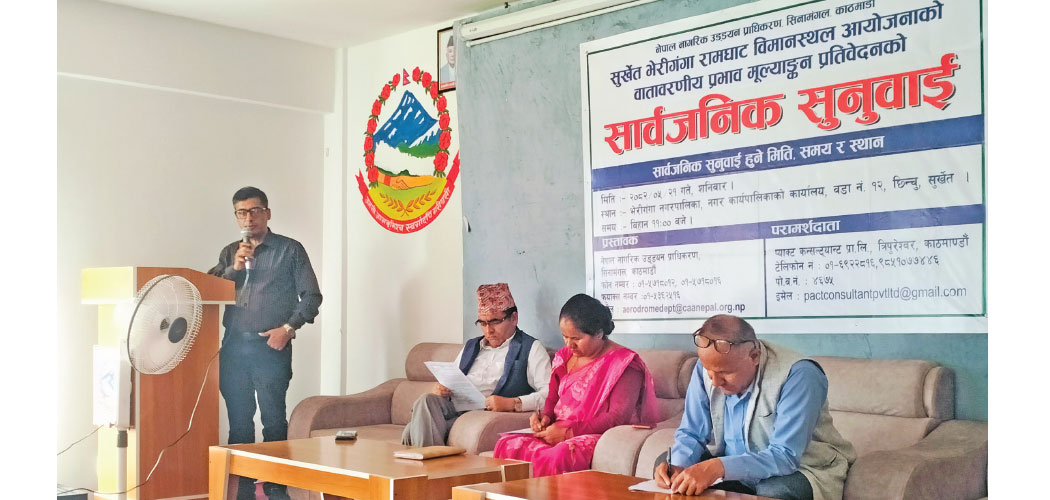
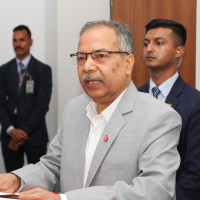
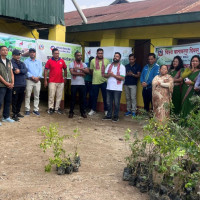
Public hearing being held on Surkhet Bheriganga Ramghat Airport in Surkhet. Photo: Nabin Subedi/TRN

By Nabin Subedi,Surkhet, Sept. 8: The Environmental Impact Assessment (EIA) report of the Surkhet Bheriganga Ramghat Airport, located in Bheriganga Municipality of Surkhet district, has been made public.
The airport is being developed as an alternative to the Surkhet airport in the provincial capital. The Civil Aviation Authority of Nepal (CAAN) made the report public on the occasion of a public hearing programme organised for the project.
At the event held in Chhinchu, Bheriganga–12, local residents, stakeholders, and people’s representatives described the construction of the airport as a historic opportunity and demanded its immediate implementation.
According to the report, the airport will be built on 218.26 hectares of land covering Wards 9, 10 and 11 of Bheriganga. Of this, 131.46 hectares comprise community forest and 86.80 hectares national forest.
The airport will lie at an altitude of about 628 metres above sea level. The runway will be 2,790 metres long and 45 metres wide. Designed to accommodate aircraft such as the Airbus A320 and Boeing 737 with up to 150 seats, the airport will allow safe take-off and landing, according to CAAN’s Director of Engineering, Hari Prasad Adhikari.
The airport will be built to international standards with an east–west runway. Supporting infrastructure will include a taxiway, hangar, control tower, fuel storage, cargo building, police post, parking area and security posts. The apron will have the capacity to hold 17 aircraft at a time, while the terminal building will cover 24,375 square metres.
Once operational, the airport is expected to handle 11 flights per day, transporting around 374 passengers.
Adhikari said that the EIA report highlights the airport’s role in linking not only Surkhet but also the remote districts of the entire Karnali and Sudurpaschim Provinces with the national capital. It is expected to greatly contribute to the expansion of trade, tourism and markets for agricultural products.
44,000 trees to be felled
The construction will require the felling of about 44,605 trees, which will inevitably affect wildlife habitats. Local pipelines and irrigation canals will be impacted, while dust, noise pollution and waste management will pose further challenges, the report notes.
In particular, noise levels at night are expected to exceed normal levels in the Madanichaur area. Around 1,200 metres of pipeline and 1,167 metres of irrigation canal will be affected.
The area is home to 15 species of mammals, 62 species of birds, 12 species of reptiles and four species of amphibians. Of these, 15 species are listed under CITES, and three are on the IUCN Red List.
Mitigation measures
To minimize the negative impacts, CAAN has proposed several measures. For each tree felled, 10 saplings will be planted, amounting to more than 446,000 trees, with protection guaranteed for at least five years.
Likewise, to control dust, roads will be regularly sprinkled with water and construction materials be transported under tarpaulin covers. Compensation will be given to those affected by damage to pipelines and canals, while priority in employment will be given to locals. Skill development through training has also been proposed.
The project is expected to provide direct employment to around 350 people: 50 skilled, 100 semi-skilled and 200 unskilled workers. Consumption of local fruit, vegetables, milk and meat will rise, while the growth of hotels and tourism-related businesses is expected to bring major benefits to the local economy.
‘Pride of Karnali’
Speaking at the hearing, Bheriganga Mayor Yagya Prasad Dhakal said the airport was a project of pride for Karnali Province. “The government should not delay constructing this airport that will be the lifeline of the province,” he said, adding that the local government was ready to provide all possible support.
Similarly, Deputy Mayor Dhansara Bohara stressed the need for scientific methods to reduce environmental impact, and called for priority employment for locals, with special opportunities for women and disadvantaged communities. Nepali Congress Bheriganga Municipality President, Ram Bahadur Singh, emphasised that the project should move forward above partisan interests. “Only with strong political commitment can the airport be completed quickly,” he said.
Local resident Dhan Bahadur BK urged that priority be given to members of impoverished families in employment opportunities.
Stakeholders remarked that the Surkhet Bheriganga Ramghat Airport was not only a necessity for Karnali Province but for the whole of western Nepal. The CAAN has pledged to implement all the management plans included in the EIA report.