- Friday, 5 June 2026

Tiantan Award Panorama concludes screening six Chinese films
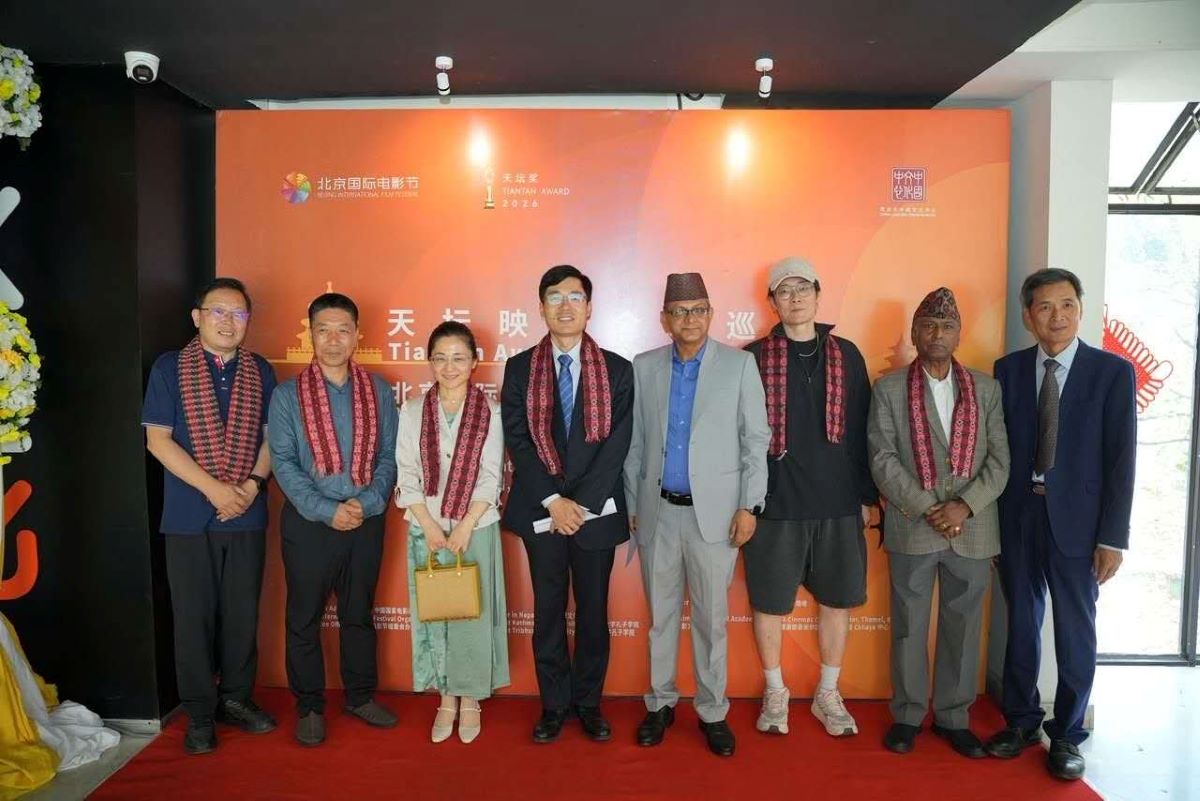
By TRN Online, Kathmandu, June 5: The screening of award winning Chinese films in the Beijing International Film Festival concluded on Thursday.
Named as the Kathmandu stop of the Tiantan Award Panorama, the screening event was hosted by the China Film Administration and the Beijing International Film Festival Organizing Committee Office, with support from the China Cultural Center in Nepal, the Confucius Institute at Kathmandu University, the Confucius Institute at Tribhuvan University, and the Nepal Film and Cultural Academy.
Bringing six diverse and acclaimed Chinese films—The Shadowless Tower, Beyond the Skies, Lost in the Stars, Summer Diary, Journey to the West, and Trapped—to local audiences, the event presented a total of nine screenings and jointly composed a moving chapter in China–Nepal cultural exchange.
"Kathmandu, a historic city nestled on the southern slopes of the Himalayas, has long been a place where faith and art converge. Its unique geographical location has naturally made it an important bridge connecting the cultures of South Asia and China. Upon this bridge, the longstanding friendship and cultural dialogue between China and Nepal have continued to flourish through the years", stated the organiser in the press note.
Prior to the screening of the opening film Trapped, Zhou Pan, Deputy Chief of Mission and Minister Counsellor of the Chinese Embassy in Nepal, inaugurated this cultural exchange event between China and Nepal. In his remarks, Zhou Pan noted that film, as a “universal language” that transcends linguistic and national boundaries, serves as one of the most sincere and vivid vehicles for cultural exchange between the two countries.
The six Chinese films showcased during the Kathmandu stop of the Tiantan Award Panorama presented the diverse landscape of contemporary Chinese cinema from different perspectives. The Shadowless Tower invited audiences to feel the pulse of urban life beneath one of Beijing’s iconic landmarks; Beyond the Skies explored the boundary between life and death along the frontline of conflict; Lost in the Stars drew viewers into a labyrinth of twists and revelations; Summer Diary embarked on a drifting journey, witnessing the gentle coming-of-age of a young boy in the desert; Journey to the West embraced absurdity to the fullest while paying tribute to every dream; Trapped confronted audiences with brutal choices in an isolated town.
As part of the panorama, Trapped director Sagara Zhang attended the Kathmandu stop in person and engaged in an in-depth discussion with local audiences. During the exchange, one audience observed that the film’s distinctive aesthetic style differed from the Asian cinema with which he had previously been familiar.

Chinese cinematic works continue to cross geographical borders, fostering emotional and spiritual resonance while demonstrating a shared human understanding of core values such as family, faith, and freedom. Looking ahead, the Tiantan Award Panorama will continue its journey to more cities around the world, bringing Chinese stories to international audiences, stated the organiser in a press note.
Cultural exchanges between China and Nepal will likewise continue to inspire new ideas and connections through future encounters.
-square-thumb.jpg)


-original-thumb.jpg)