- Friday, 5 June 2026

Nepal Faces a Climate Finance Crossroads
Janak Prasad Pandey and Atal Dev Dhakal
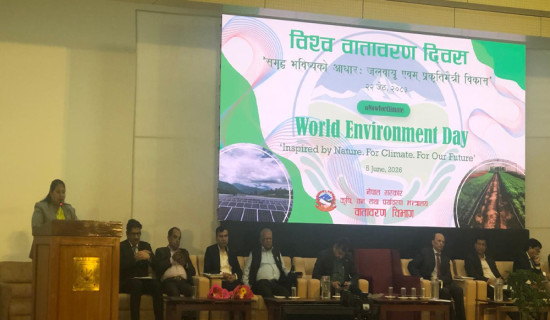
Every year on June 5, the world pauses to take stock of what the planet is telling it. The date traces back to 1972, when the United Nations convened the Conference on the Human Environment in Stockholm that brought together 113 countries in what was the first international gathering to place environmental protection at the Centre of global politics. World Environment Day was born from that moment, first observed in 1973, and has since grown into the largest global platform for environmental public outreach. This year, the host is Azerbaijan, and the theme is one that feels less like a celebration and more like a reckoning: Inspired by Nature. For Climate. For Our Future.
The theme carries three ideas that are meant to be
read together. Nature, as the United Nations Environment Programme argues, is
the most reliable medicine for the climate crisis. For Nepal, these three
ideas, nature, climate, and future, land with particular weight. Nepal
consistently ranks among the top ten most climate-vulnerable countries in the
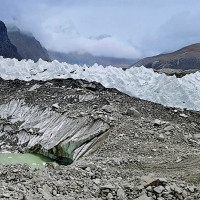
world, depending on the index used. Mountains and glaciers that feed the rivers
of a nation of 30 million people, and broader South-Asian region, are
retreating at a pace that outstrips most projections. Erratic monsoons,
intensifying floods, and unpredictable droughts are becoming more evident
impacts of this crisis in the scientific reports. The natural systems this
year's World Environment Day asks us to be inspired by are, in Nepal's case,
already under serious stress.
This reality gives Nepal two equally important reasons
to think hard about climate finance on this day. The first is ecological.
Protecting the forests, wetlands, and watersheds that continue to function
means funding conservation at a scale and consistency that domestic budgets
alone have not managed. The second is developmental. Climate finance, channeled
well, is not to be treated as charity. It is to be treated as investment in
renewable energy, climate-resilient infrastructure, and sustainable agriculture
that Nepal needs to grow without repeating the mistakes of industrialized
economies. Both reasons point toward the same question: is Nepal positioned to
access the money that exists in the global system?
The answer, for now, is cautiously yes, but only
partly. Nepal has three institutions accredited to the Green Climate Fund,
which is the world's primary dedicated mechanism for climate finance under the
Paris Agreement. The Alternative Energy Promotion Centre (AEPC), a government
body, and the National Trust for Nature Conservation (NTNC), a conservation
organisation, were the first to gain direct access status, allowing them to
develop and submit proposals independently. Nepal Investment Mega Bank (NIMB)
more recently became the first private sector entity and first commercial bank
in the country to receive GCF accreditation, in the medium-size category,
covering projects between 50 and 250 million dollars. Between 2019 and 2025,
Nepal secured roughly 148 million US dollars from the GCF across five projects,
a figure that reflects progress but also, given the scale of Nepal's climate
needs, an enormous gap still to close.
The question of how to close that gap runs into a
structural problem. Climate finance does not flow easily into countries that
lack clear national frameworks telling investors, banks, and funds what
"green" means locally and what standards they are expected to meet.
Nepal took a meaningful step toward solving this in October 2024, when the
Nepal Rastra Bank released the Nepal Green Finance Taxonomy. It is a landmark
document. It made Nepal one of only about 21 countries in the world to have
developed such a taxonomy then. This taxonomy establishes a colour-coded
classification system to guide financial institutions in determining which
economic activities qualify for green investment. Activities are broadly sorted
into categories: those that are clearly green and eligible for investment,
those that are transitional and need careful consideration, and those that
carry risks or environmental costs that make them unsuitable for green financing.
The taxonomy is directed at licensed banks and financial institutions,
essentially telling them that ignoring the green sector when making lending
decisions is no longer acceptable.
But a taxonomy is a reference document. It is not a
law.
This distinction carries enormous significance as
Nepal enters what many economists and planners are describing as a period of
large infrastructure expansion. The government's ambitions, reflected in rising
capital budgets and a pipeline of mega projects in hydropower, road
connectivity, and urban development, require financing on a scale that Nepal
cannot generate domestically. International green finance could bridge a
significant part of that gap, but only if Nepal can demonstrate to global funds
and private investors that it operates within a coherent, legally binding green
finance regime. A reference guideline from the central bank is a beginning.
Legislation that mandates disclosure, sets enforceable standards, and creates
accountability for how public and private institutions classify and report
green investments is the next step, and it has not yet arrived.
Nepal's Sustainable Development Goals commitments,
including its Nationally Determined Contribution under the Paris Agreement, set
out ambitious targets for renewable energy access, emissions reduction, and
climate resilience. The institutions are there, GCF-accredited entities are
operational, and taxonomy has been written. What is remaining is the political
decision to consolidate all of this into a dedicated green finance policy that
carries the force of law.
This World Environment Day, as Baku hosts the global
commemoration and the world speaks of being inspired by nature, Nepal's most
fitting contribution to that conversation would be to acknowledge what it has
built and to close, and honestly so, the gap that still exists. Nature does
not, or cannot, wait for legislative calendars. The signals it is sending to
our country through every erratic monsoon and retreating glacier are evidently
clear. Since the institutions to respond exist, what is now needed is the law
that makes them legally based, effective, and sustainable for the long-term
future.
(Pandey
is a legal advocate and Dhakal is Climate Justice Advocate)





-original-thumb.jpg)