- Thursday, 7 May 2026

Patient Safety: A Collective Responsibility

World Patient Safety Day 2024 was celebrated on 17th September 2024 with the slogan “get it right, make it safe!” and this year theme was “Improving diagnosis for patient safety”. The theme and slogan emphasise importance of correct and timely diagnosis in ensuring patient safety and improving health outcomes.
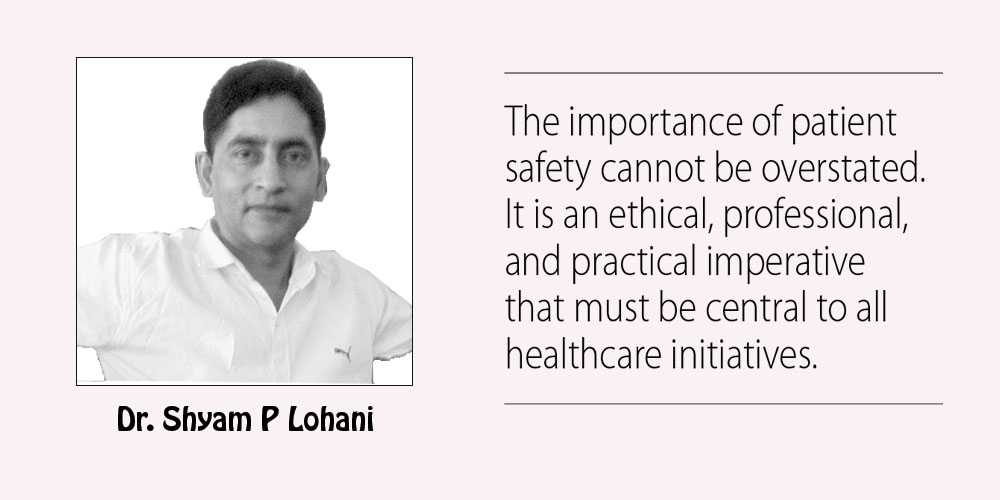
Patient safety is a fundamental principle that determines the quality of care and the overall integrity of health systems worldwide. Every day, millions of patients entrust their lives to doctors, nurses, and other healthcare professionals, expecting to receive care that heals rather than harms. Yet, preventable errors, misdiagnoses, and systemic oversights often result in unintended injury, illness, or even death. The importance of patient safety cannot be overstated. It is an ethical, professional, and practical imperative that must be central to all healthcare initiatives.
Collective responsibility
The World Health Organisation (WHO) estimates that nearly 1 in 10 patients worldwide is harmed while receiving care. These alarming statistics underscore the urgent need for continued focus on patient safety. The solution lies in a multifaceted approach that involves healthcare professionals, administrators, patients, and policymakers working collaboratively to create safer environments. Ensuring patient safety is a collective responsibility. It requires healthcare providers, administrators, and policymakers to work together in creating environments that prioritise patient well-being. Policy reforms focused on reducing hospital errors, investing in safety training, and supporting healthcare professionals to report and learn from mistakes are crucial.
One of the primary challenges in patient safety lies in the complexity of modern healthcare systems. The more sophisticated and technologically advanced medical care becomes, the higher the potential for errors, miscommunications, or technical malfunctions. Whether it is a medication error, surgical complication, or infection acquired during a hospital stay, these adverse events can have devastating consequences for patients and their families.
The WHO estimates that preventable medical errors harm millions of patients each year globally, resulting in needless suffering and, tragically, death in many cases. Beyond the physical toll, these errors erode patient trust in healthcare systems, making the case for a stronger focus on patient safety even more pressing.
First and foremost, patient safety is an ethical mandate. The Hippocratic Oath’s principle of "first, do no harm" underpins every healthcare provider's responsibility. Yet, unintentional harm does occur, often because healthcare environments are not sufficiently geared toward preventing errors. Healthcare systems that prioritise patient safety integrate checks and balances to minimise risks. This includes not only clear guidelines but also fostering a culture where healthcare workers can report near misses and errors without fear of punishment. A healthcare setting where mistakes are acknowledged, analysed, and used to improve future practice is far more effective than one where blame and secrecy prevail.
However, it is important to recognise that most healthcare errors are not due to individual negligence but are systemic failures. For instance, understaffing in hospitals can lead to overworked clinicians, who are more prone to fatigue-related mistakes. In such cases, no amount of individual diligence can overcome structural shortcomings. Therefore, addressing patient safety requires both the prevention of errors at the individual level and the correction of broader systemic issues.
Beyond the moral case, prioritising patient safety also brings significant practical benefits. For healthcare institutions, errors come with enormous financial costs that include lawsuits, extended hospital stays, and reputational damage can drain resources. According to research, adverse medical events cost health systems billions annually. Implementing comprehensive safety programmes is a smart investment, reducing the economic burden while ensuring better care outcomes.
Technology has provided new avenues for reducing errors, but it has also introduced new challenges. Electronic health records (EHRs), for example, have revolutionised how patient data is managed, helping reduce prescription errors and enhancing communication between physicians and pharmacists. Yet, EHRs are not infallible, and their mismanagement can introduce new risks. This underscores that patient safety is not just about adopting new tools but about embedding safety-oriented thinking into every aspect of care.
Trust is the foundation of the patient-provider relationship. When patients enter a healthcare facility, they trust that the professionals involved will deliver care with the utmost competence. However, any error, no matter how minor, can shatter that trust. When patients are informed about mistakes that were made during their care, and how those mistakes are being addressed, they are more likely to retain their trust in the system. Transparency, therefore, plays a critical role in patient safety.
Engaging patients
Moreover, engaging patients in their own care is a growing trend that enhances safety outcomes. When patients are well-informed about their treatment plans, they are empowered to act as a final line of defense, catching potential errors such as incorrect medications or procedures. Patient involvement in safety initiatives can also improve communication and outcomes, making healthcare more patient-centered and effective.
In conclusion, patient safety is an ongoing commitment, one that demands vigilance, communication, and systemic reform. As healthcare continues to evolve, so too must our strategies for ensuring that patient safety remains paramount. Reducing harm is not only a moral obligation but a practical one, as safer care leads to better outcomes, fewer legal liabilities, and more trust in healthcare systems. Let us not wait for the next adverse event to spur action, thus, patient safety should be the standard, not the exception.
(Dr. Lohani is the executive director at the Health Concern. lohanis@gmail.com)