- Saturday, 9 May 2026

US adults fracture along party lines
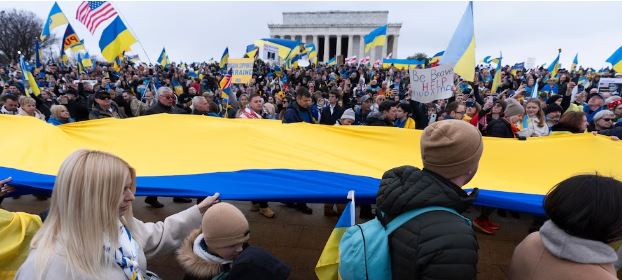

Washington, Mar.1: As Russia makes battlefield advances and Ukrainian soldiers run short on ammunition, U.S. adults have become fractured along party lines in their support for sending military aid to Kyiv, according to a new poll from The Associated Press-NORC Centre for Public Affairs Research.
Democrats are more likely to say the U.S. government is spending “too little” on funding for Ukraine than they were in November, but most Republicans remain convinced it's “too much.” That divide is reflected in Congress, where the Democratic-held Senate — with help from 22 GOP senators — passed a $95 billion package of aid for Ukraine, Israel and Taiwan earlier this month. But the bill, which includes roughly $60 billion in military support for Kyiv, has languished in the Republican-held House as Speaker Mike Johnson has so far refused to bring it up for a vote.
President Joe Biden, along with top Democrats and Senate Republican Leader Mitch McConnell, passionately urged the Republican speaker during a White House meeting this week to take up the foreign aid package, but Johnson responded by saying that Congress “must take care of America's needs first.” Most Republicans still share Johnson's view, and their opinions haven't changed significantly since the fall: 55% say the U.S. is spending too much on Ukraine aid, compared to 59% in November.
Meanwhile, support for increasing Ukraine aid has grown among Democrats. About 4 in 10 Democrats say the U.S. is spending “too little” on aid to Ukraine in the war against Russia, up from 17% in November. The share of Democrats who say the U.S. is spending “too much” or “about the right amount” has also dropped over the same period.
Chloe Henninger, 24, a Democrat from West Hartford, Connecticut, was among those who said the U.S. is spending too little on aid to Ukraine. She said it was important for the U.S. to show commitment to democracies like Ukraine that are under siege.
“From a humanitarian point of view, there were sovereign borders agreed upon internationally. And then an autocratic power went and invaded a sovereign territory. The U.S., as one of the major military forces in the world, sort of has a duty to respond,” Henninger, who works as a cosmetic chemist, said.
The poll shows that two years after Russia’s initial invasion, the Ukraine war has become a partisan dividing line: Majorities of Democrats think it’s extremely or very important to prevent Russia from seizing more Ukrainian territory, to negotiate a permanent ceasefire between the two countries, help Ukraine regain its land and provide general aid to its military, while less than half of Republicans and Independents agree.
Biden and Democratic leaders in Congress have cast the conflict in Ukraine — the largest land invasion in Europe since World War II — as a potential turning point in history. Failing to repel Russian President Vladimir Putin's assault, they warn, would have grave consequences, from destabilizing the rest of Europe to emboldening other potential foes such as China and North Korea.
At the same time, Donald Trump, the former president who appears to be marching towards the Republican nomination, has injected serious doubts about America's involvement in Ukraine and the rest of the world. While McConnell, the top Republican in the Senate, has remained a strong advocate of robust American involvement abroad, Trump has swayed the party towards an isolationist stance, as well as at times heaped admiration on Putin's strongman style of rule.