- Sunday, 10 May 2026

Complexity In Indo-Maldivian Ties

Weeks after winning November election in the Maldives, during which Indian and some international news media projected him as “pro-China”, President Mohamed Muizzu is embroiled in testing times, exasperated by a war of words in the social media between his supporters and pro-Indian sections.
The row erupted in the wake of Indian Prime Minister Narendra Modi’s much highlighted trip to the Indian islands of Lakshadweep, ostensibly to promote tourism. The Lakshadweep shares features similar to those the Maldives offers —and is located close to the Maldives.
Three Maldivian deputy ministers took the event as a bid to adversely affect tourism in their islands, to which tourism accounts for one-third of GDP. The trio made insulting remarks like “terrorist” and “clown” on the Indian premier. Although the three were subsequently suspended, the fire and fury will take time to die down. On the surface, the derogatory comments on Modi publicly triggered a row at personal level. Beneath the surface, the Modi government was closely watching the newly elected Muizzu team.
The undiplomatic comments from Male, therefore, added fuel to the fire of increasing distrust between the two governments. New Delhi might have assessed the patterns of development, starting from the election campaign during which Muizzu had made strong anti-India comments. The three ministers might have made the insulting remarks to echo their perceived sense of existing mood in their island nation.
Deepening divide
In a statement issued after the row broke out, the Maldives government issued a statement: “The government believes that the freedom of expression should be exercised in a democratic and responsible manner, and in ways that do not spread hatred, negativity, and hinder close relationships between the Maldives and international partners.”
Muizzu’s government move to regret the tirade expressed by its ministers did not have the desired effect on New Delhi. Many Indian celebrities and travel agencies quickly decided to boycott travel to the archipelago. Some of India’s leading travel agencies declared that they would “stop promoting Maldives” following the anti-India comments its deputy minsters made.
Maldives wants to reduce heavy dependence on India. During the four-day visit to China last fortnight, Muizzu asked his counterpart Xi Jinping, the Chinese prime minister and other senior ministers for giving priority to his country’s tourism industry. China, after all, accounts for 155 million of its citizens making holiday trips annually to foreign destinations.
The Maldives sought to reduce too much dependence on any one country. Prior to COVID-19, Chinese tourists for more than a decade accounted for the largest arrivals in the archipelago, whose tourism industry contributes to a third of the economy. Last year, India was ahead by a few thousand. Russian tourists generally account for No. 3 in this respect.
In 2022, China was the Maldives’ second-biggest trading partner, accounting for almost 16 per cent of its total trading volume, surpassing India, which was the third largest with nearly 14 per cent. During his recent state visit, Moizzu made it a point to ask host President Xi, Premier of the State Council Li Qiang and other senior leaders to help boost his country’s tourism industry.
Shortly after returning home from Beijing, the Moizzu government gave New Delhi a March 15 deadline for the 70 Indian military personnel to leave his country. The personnel are stationed officially for assisting the island nation in maintaining a Dornier aircraft and two military helicopters provided by New Delhi. Responding to press inquiries about the deadline the Maldivian government had set for the Indian military personnel to return home, India’s External Affairs Minister S. Jaishankar said India “cannot guarantee” that time frame.
A joint press communiqué issued at the end of the Maldivian leader’s China visit is to be viewed against the afore-mentioned background and events. It reiterated the “strategic significance” of Sino-Maldivian relations which would be upgraded to a “comprehensive strategic cooperative partnership”. Of considerable meaning is that Beijing supports the Maldives “in upholding its national sovereignty, independence and national dignity” and “firmly opposes external interference in the internal affairs of the Maldives”. China expressed its readiness to continue providing support for the archipelago nation “in areas that the Maldives deems as priorities”.
On its part, the Maldives reaffirmed that Taiwan is part of China, and assured the hosts that their Belt and Road Initiative would receive “greater cooperation”. Muizzu has already visited Turkey and China but is yet to announce any plan to visit New Delhi, which is a departure from the tradition of the island nation’s newly elected executive head visiting the Indian capital first.
In an editorial, the official English news outlet of the Chinese Communist Party’s Global Times wrote: “India should not underestimate China’s opposition to unilateral military intervention.” It warned that Beijing would “take action” if foreign troops were unilaterally sent troops to the Maldives.
Restraint needed
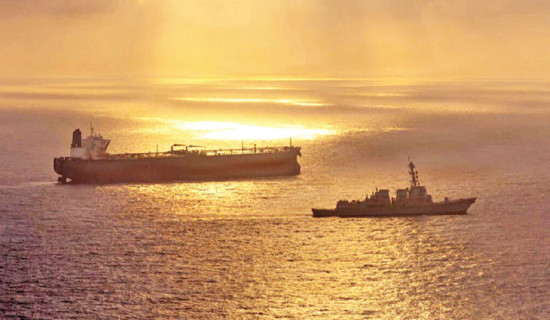
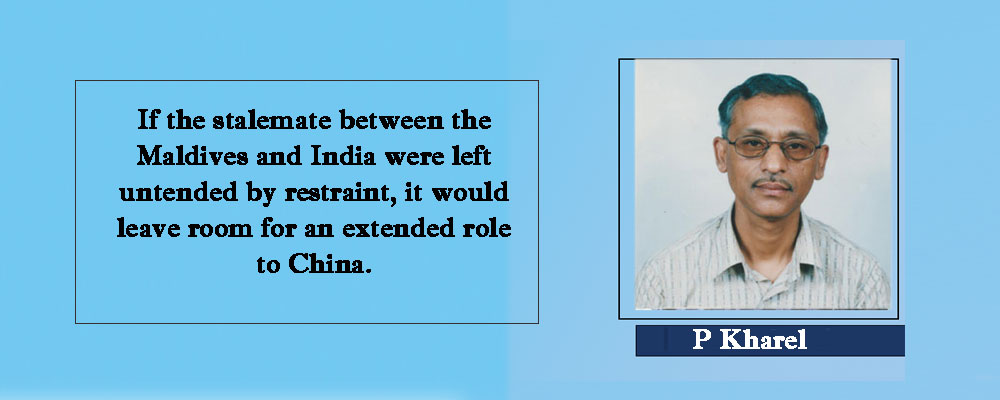
Beijing’s support is rarely so explicit when addressing other countries. Overstretching things could complicate matters with India. Muizzu is armed with Beijing’s assurances. If the stalemate between the Maldives and India were left untended by restraint, it would leave room for an extended role to China. Tough talk and threats marked Indian social media and news channel reports and debates. These do not help to smoothen things.
In view of the complex and complicated ties between South Asian nations, an effective activation of SAARC should add to the regular avenues of communication and dialogue among its leaders. If propelled with committed purpose and in the spirit of its declared objectives, SAARC can become a forum for regular communication at different levels culminating periodically at the highest levels.
On the eve of general elections three months away, Ram Mandir inaugural issues as well as the formation of I.N.D.I.A., a 28-party alliance with one-point programme of ending the 10-year rule by the Bharatiya Janata Party-led government, the recent events cannot be drawn as positive, or dismissive, events for the party that won the last two general elections with impressive showings. Until recently, major international media had concluded that Modi’s party was likely to record a third consecutive victory this spring.
India’s former Foreign Secretary Shyam Saran, in a newspaper article, advised patience to the Modi government. He said the obvious: “Strained Delhi-Maldives relations will boost Chinese presence in the Indian Ocean.” And, for sure, it will if prudence gets sidelined.
(Professor Kharel specialises in political communication.)