- Monday, 11 May 2026

Haitian students play drums, guitars to escape hunger and gang violence
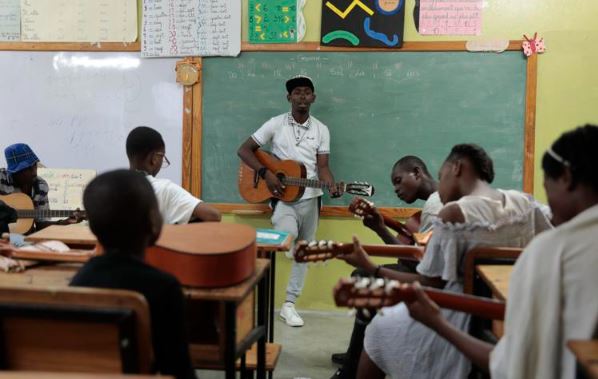

Port-Au-Prince, Haiti, Oct. 5: Woodberson Seïde held his stepsister's hand as they walked through Haiti 's capital on their way to an afterschool music program.
They avoided cars, motorcycles, and territory controlled by the gangs whose predation prompted this week's U.N. Security Council vote for the deployment of a multinational armed force. Once he arrived at the school that hosts the program, 11-year-old Woodberson didn't think much about how he sometimes eats once a day. His family sleeps on the floor of a church, something they've done since losing their home to gangs.
The boy was neatly dressed and ready to play drums. Across Port-au-Prince, hundreds of children like Woodberson are playing percussion, piano and bass guitar to drown out the violence and hunger around them.
“When I play drums, I feel proud,” Woodberson said.
To many, Haiti feels hopeless. Children are mostly kept indoors for safety. Their parents worry about gangs recruiting children as young as 8.
Woodberson and other young musicians in a U.S.-sponsored music program refuse to let circumstances dictate their future, helping both themselves and their parents.
“Seeing my son performing makes me very happy,” said Jean Williams Seïde, his father.
Woodberson took his first lesson two years ago as part of the after-school music program founded in 2014 by U.S. nonprofit Music Heals International. The program started with 60 children and has grown into a group of 400 enrolled in the $160,000-a-year program offered at eight schools. Many play at church and in local concerts, some after founding their own band.
“It’s very rare ... that you can provide a little bit of peace in such craziness, such a hellish landscape,” said Ann Lee, CEO and co-founder of Community Organized Relief Effort, a California nonprofit organization that sponsors the program.
Haitian musical traditions range from rara to compas to mizik rasin, or roots music. The program's teachers and students decide together what music they’ll play, picking from genres that include compas, reggae, rock, Latino music and African music.
Many of them meet twice a week to play for two hours as the rat-tat-tat of gunfire echoes across Port-au-Prince.
“Music transforms,” said Mickelson Pierre, who learned how to play guitar in the program and now teaches it. “It’s something extraordinary, and it leads to peace of mind.”
Gangs are estimated to control up to 80% of Port-au-Prince and fight over territory daily, with more than 2,400 people reported killed this year. Rapes and kidnappings also have spiked. Families are reluctant to send their children to school, let alone allow them to play outdoors.
Gang violence also has left nearly 200,000 people homeless.
Woodberson and his family once lived in Canaan, a makeshift community established on the outskirts of Port-au-Prince by people who survived the devastating 7.0 magnitude earthquake that struck in 2010. In April, gangs raided the community and forced many to flee.
“The bandits took everything from my house and left me with nothing,” said Jean Williams Seïde. (AP)