- Wednesday, 3 June 2026

Global Efforts To Promote Literacy
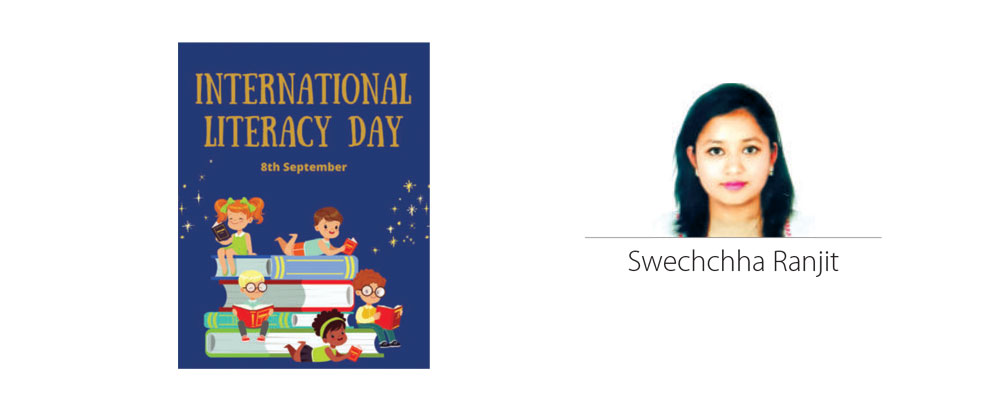

Every year on September 8, International Literacy Day is observed in order to increase awareness for literacy problems that occur both locally and internationally. The United Nations Educational, Scientific, and Cultural Organisation (UNESCO) established International Literacy Day in 1966 in order to remind the public of the importance of literacy as a matter of dignity and human rights, to advance the literacy agenda towards a more literate and sustainable society, and to return the burden of illiteracy to local communities.
Literacy in the broadest sense refers to the ability to distinguish written or spoken words, read and write, and do basic mathematical tasks. After the founding of Durbar High School in Nepal in 1910 B.S., the literacy mission was launched, but education progress didn't begin until the country's democratic system was established. Speaking, followed by songs, proverbs, and stories, was discovered to be the most ancient and conventional type of literacy.
The Vedas and Puranas had a later transition from oral tradition to writing. Academic literacy, or the art of writing, is the foundation of formal education. Currently, literacy is being digitalized as a result of the improvement of science and technology.
Over the past few years, the rapidly shifting global backdrop has taken on new significance, impeding literacy advancement and growing disparities among world regions, countries, and populations.
Although significant progress has been made in raising literacy rates in the more than 50 years since the first International Reading Day, illiteracy is still a major global issue. It is estimated that there are more than 750 million illiterate adults worldwide. Every country and culture on earth is impacted by illiteracy, including the United States, where an estimated 32 million people lack basic literacy skills. In Nepal, the literacy rate among those who are 15 years of age and older is 67.9 per cent, which is higher among the population of young people aged 15 to 24.
The literacy rate for people 65 and older is 23.6 per cent. Many children and adults still struggle with basic literacy abilities, despite steady progress being made worldwide. To create and put into action the best strategies for eradicating illiteracy, institutions, states, and international organisations operate mass literacy projects. In order to raise money for the cause, they also host activities. International Literacy Day is used to promote awareness of a particular issue by picking a topic each year. In light of this, the theme for this year's International Literacy Day is "Promoting literacy for a world in transition: Building the foundation for sustainable and peaceful societies."
ILD (International Literacy Day) 2023 will be an opportunity to join efforts to accelerate progress towards the achievement of Sustainable Development Goal 4 (SDG4) on education and lifelong learning and to reflect on the role of literacy in building more inclusive, peaceful, just, and sustainable societies. In doing so, it will embrace the reciprocal relationships between literacy and other areas of development. Literacy is central to the creation of such societies, while progress in other areas of development contributes to generating interest and motivation in people to acquire, use, and further develop their literacy and numeracy skills.
ILD (International Literacy Day) 2023 will be a chance to get involved in initiatives to hasten the realisation of Sustainable Development Goal 4 (SDG4) on education and lifelong learning, as well as to consider how literacy contributes to the creation of inclusive, just, and sustainable societies. By doing this, it will acknowledge how literacy and other developmental domains are mutually supportive. The development of such societies depends heavily on literacy, while advancements in other fields of development encourage people to learn, use, and improve their literacy and numeracy abilities.
CiST College


-original-thumb.jpg)