- Wednesday, 3 June 2026

Is Electoral System Change Essential?

Since the implementation of the present constitution in 2015, many had hoped that the country would turn a new leaf in its political and socioeconomic life. However, even after eight years, the country's overall transformation remains unachieved due to the instability and frequent changes in government leadership.
During this time, the nation was led by three major parties: the Nepali Congress, the CPN-UML, and the Maoist Centre. Unfortunately, they failed to keep the promises they made to the country. Because the nation's politics are currently typified by a culture of coalition, both at the national and provincial levels, in which several parties, from major to fringe, have participated. As a result, the government's goals of implementing its plans and programmes have encountered challenges since they must cater to the aspirations of all coalition members.
Provisions
Experts refer to our election system and certain constitutional clauses as key contributors to our government's poor performance. The constitution established a mixed electoral system for the Lower House of Parliament or the House of Representatives (HoR), with 60 per cent of members elected by first-past-the-post or direct election and 40 per cent via proportional representation (PR). In the 275-member House of Representatives, 165 members are elected directly, while 110 are filled using the PR system.
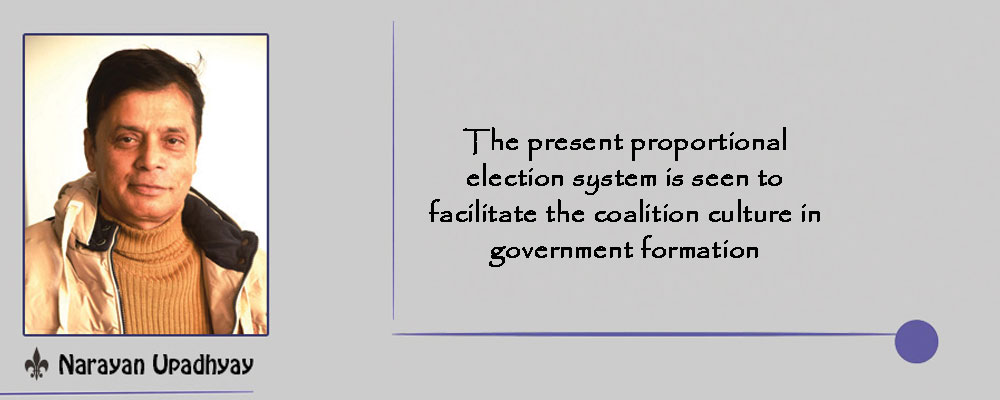
The present proportional election system is seen to facilitate the coalition culture in government formation since it is mostly responsible for preventing any one party from attaining an absolute majority in the nation's bicameral parliament's lower house. In the past and in the present, this system has resulted in hung parliaments. When the country had a Constituent Assembly (CA), the mixed electoral system was first implemented.
This electoral system has particularly favoured minor and fringe parties, while providing major support to a party like the Maoist Centre, which has seen voter support fall in successive HoR elections. Former rebels almost won a majority in the 2008 CA elections but currently sit in third place with 32 MPs out of 275 in the House. Following the November 2022 elections, no party was able to obtain a majority, leaving the Maoist Centre and its chairman as kingmakers. Despite gaining 89 seats in FPTP elections and 79 in PR elections, no party has been able to establish a government. Instead, the Maoist Centre, the third largest party, has assumed government leadership, backed by a coalition of five parties, including the Congress, to keep the UML at bay.
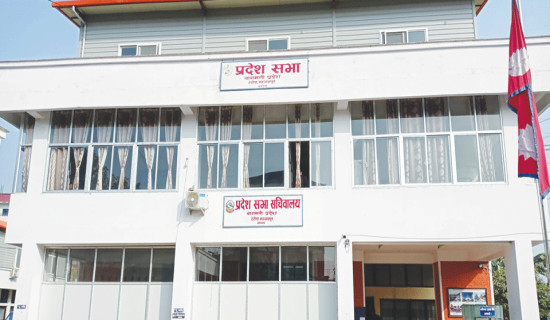
Several members of Congress think that the existing electoral system has made it difficult for their party to assume government control. This dissatisfaction prompted Congress officials such as Gagan Thapa and Bishwa Prakash Sharma to argue for a change in the current election system during a meeting of the Central Working Committee. Their reasoning is that the PR election frequently ends in a hung parliament, making it difficult for parties like as the Congress to gain a majority. Similarly, several UML leaders have expressed similar sentiments and are exploring reforms to the voting process for the same reasons. Some have advocated that the National Assembly, the Upper House of Parliament, should be transformed into a legislative chamber with all members elected by the PR system, while the Lower House has all members chosen through direct polls, in order to eliminate the present pattern of hung parliament.
Having said this, a question comes to the mind- Is Proportional Representation Really All That Bad? Not really, if political parties play by the rules.
Proportional Representation (PR) is an election system that ensures equitable representation of different political parties and varied groups inside a country. Unlike the First-Past-the-Post (FPTP) system, in which the candidate with the most votes gets the seat, PR allocates seats based on the percentage of votes received by a party in elections. This mechanism is frequently used in multi-party democracies to promote diversity while reducing the likelihood of majoritarian dominance.
However, PR may be complicated, especially when it comes to creating coalition government. Negotiations and concessions necessary to form a majority coalition may result in policy impediments, posing challenges for our nation that has comparatively weaker democratic institutions. Furthermore, PR may result in the rise of many minor parties, making it impossible for any single party to gain a decisive majority. This can lead to weak and indecisive governance, preventing governments and their agencies from implementing necessary and promised reforms.
Under PR system, political parties prepare lists of candidates in the PR system, and voters must pick a party rather than individual individuals. As a result, the power of party top-rung leaders grows in legislative politics. This is obvious in Nepal's politics, as parties preferentially nominate those close to top leadership while ignoring more appropriate or competent candidates. Regrettably, major and minor parties in Nepal have repeatedly failed to select leaders in accordance with the constitution's PR rules. Top leaders have used PR loopholes to their advantage. Parties, for example, have nominated close allies, confidants, and relatives in a variety of groups, including Indigenous, Khas-Aryas, Tharus, Dalits, Muslims, Women, and representatives from backward distant places. This type of manipulation has led many to feel that the PR system is vulnerable to manipulation, demanding reforms in voting system and designs to prevent parties from exploiting such gaps.
Challenges
To sum up, while proportional electoral system offers benefits like fair representation and inclusivity, it also comes with challenges like forming stable governments and potential manipulation by parties and leaders. Striking a balance between the positive aspects and addressing the drawbacks is crucial to develop an electoral system that best serves the interests of the people and promotes effective governance.
(Upadhyay is former managing editor of this daily.)