- Wednesday, 3 June 2026

Work To End Hunger
 Bini Dahal
Bini Dahal
Bini Dahal
We live in a world with widening inequalities. As I write this piece, there might be an individual who is starving and has literally nothing to eat. S/he might have missed several meals over the week. But as this happens, there is another individual who is enjoying a good feast in a restaurant. S/he has the ability to choose from a wide variety of food items and can even throw away some of the food if it doesn’t match his or her taste bud or if s/he feels they can eat no more. These inequalities are the reality of our society and our world.
Among different issues, hunger remains to be one such problem that demands attention from the side of the government and other stakeholders. Global Hunger Index (GHI) is an indicator responsible for measuring hunger levels in different countries around the world.
The index mainly focuses on four key indicators, namely undernourishment, child stunting, child mortality and child wasting. In the case of Nepal, the country earned a GHI score of 19.1 in 2022, representing a moderate level of hunger. Over the years, the nation has been able to reduce its serious hunger level significantly.
In 2000, the GHI score was stood at 37, an alarming situation for the nation. This number dropped to 30 in 2007 and further to 21.2 in 2014. In an era where national and global events heavily influence our day-to-day lives, food security and hunger have taken a centre stage, with COVID-19 being a key turning point.
The pandemic’s far-reaching consequences led to prolonged lockdowns and disruptions in production and supply chains. Particularly in rural areas, people were left unable to access necessary food items.
Additionally, many lost their livelihoods resulting in a lack of income and leaving them with nothing to eat.
Furthermore, the ongoing Russia-Ukraine conflict has led to a rise in fuel and food prices, a devastating situation for those with lower incomes. A joint publication by the United Nations and the European Union titled “Global Report on Food Crises 2023” states that the growing global hunger prevents the timely attainment of the Sustainable Development Goals (SDGs).
The global goals have to be achieved by 2030. Amidst these barriers and the challenging present situation, the need to ensure food security with a special focus on vulnerable groups like children, women, and senior citizens is paramount.
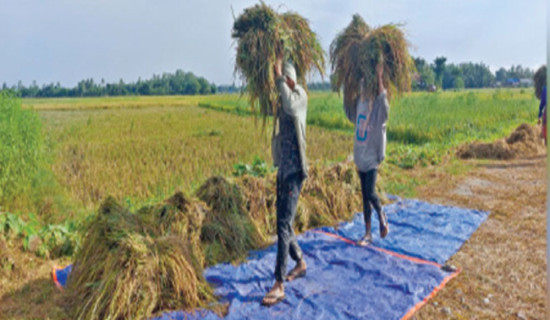
Nepal must take proactive steps to improve its food chain and ensure sufficient food supply for its people. Relying solely on home-grown agricultural production is not enough to meet the needs of even half of the country’s population. So, it is necessary to promote and encourage local agriculture.
The practice of consuming indigenous and nutritious food items should be prioritised, especially in rural areas. Every citizen must have access to and be able to consume an adequate amount of food. Prioritising the path to ensuring healthy citizens is essential for the overall development of the country.
Addressing hunger and food insecurity demands collective efforts from the government, stakeholders, and society as a whole.
While Nepal has made progress in reducing its GHI score, the battle is far from over. By prioritising food security, supporting local agriculture, and promoting nutritious diets, the nation can lay the groundwork for the overall well-being and development of its citizens. Only through unified and concerted actions can we strive towards a more equitable world, where no one goes to bed hungry.