- Tuesday, 2 June 2026

SCO Virtual Summit
Pitches For New Global Order

The recent virtual summit of Heads of State of the Shanghai Cooperation Organisation (SCO) brought together the leaders of Eurasian nations at a time when rising geopolitical tension has divided the world. India hosted the 23rd meeting of SCO’s summit in which its two arch rivals – Pakistan and China – shared their views and position on regional security and global issues. It took place against the backdrop of the Russian-Ukraine military confrontation. It provided much-needed diplomatic breather to Russian President Vladimir Putin, who has been isolated by the US-led Western bloc. Likewise, the world leaders such as Chinese President Xi Jinping and Indian Prime Minister Narendra Modi offered their vision of development and international cooperation. It had the theme – ‘Toward a SECURE SCO’ which stands for security, economic development, connectivity, unity, respect for sovereignty and territorial integrity, and environmental protection, which Indian PM Modi had coined at the 2018 SCO summit.
The summit has granted Iran a full membership of the largest regional grouping of nine nations, which has transformed itself into a comprehensive forum for security, economic, cultural and geopolitical dialogue across Eurasia. Belarus has also applied for the membership while other countries such as Saudi Arabia and Turkey are vying to be its dialogue partners. The SCO has grown owing to its accommodative policy and focus on the matters of shared concerns. It has refrained from imposing ideology and political systems on its any members and prioritised mutual development, multilateral and inclusive cooperation for the well-being of the people of the member states.
Non-ideological approach
The SCO’s non-ideological approach has been also reflected in its declaration issued following the end of the summit. It read, “The Member States pursue a policy that excludes bloc, ideological and confrontational approaches to address the problems of international and regional development, countering traditional and non-traditional security challenges and threats.” This is a clear indication of opposition to the West’s stated strategy to force its own model of democracy on other countries. The SCO leaders also criticised the negative impact of "unilateral and unlimited expansion of global missile defense systems by certain countries or groups of countries", alluding to NATO's expansion and military support to Ukraine.
Like BRICS, the SCO that consists of world’s three big countries – China, Russia and India – seeks to serve as an alternative global forum to minimise the ‘Western hegemony’. China and Russia appear to be on the same page on many issues such as conducting foreign trade in local currencies to replace US dollar but India has to walk a tightrope as it does not want to irk its traditional ally – Russia – on the one hand, and the Western nations on the other. Nonetheless, they have stood on common ground “to promote cooperation in building of a new-type international relations in the spirit of mutual respect, justice, equality and mutually beneficial cooperation.” China has been pitching for fair and inclusive global governance and order by democratising the international institutions created in the aftermath of Second World War and dominated by the North American and European nations.
As per SCO document, new international relations will be guided by ‘respect for the right of peoples to an independent and democratic choice of the paths of their political and socio-economic development, the principles of mutual respect for sovereignty, independence, territorial integrity of states, equality, mutual benefit, non-interference in internal affairs and non-use of force or threats to use force.” It stands for peaceful settlement of disagreements and disputes between countries through dialogue and consultations. The leaders have identified situation in Afghanistan as security challenge to the SCO region and called for building the war-torn Talban-led nation as an independent, neutral, united, democratic and peaceful state, free from terrorism, war and drugs.
The summit served as a viable forum for Indian PM Modi to boost his image on the global stage. At the same time, China and Russia also earned diplomatic scores. All SCO members except India reaffirmed their support for China’s Belt and Road Initiative (BRI), a signature initiative of Chinese President Xi. The member states agreed to jointly implement the BRI projects, including efforts to link the construction of Eurasian Economic Union. As most of the countries in South Asia have become the part of China’s trillion-dollar connectivity project, India has opposed it, citing its reservation about the China-Pakistan Economic Corridor (CPEC) that runs through Pakistan-occupied Kashmir (PoK).
Putin’s confidence
Putin’s appearance in the summit shows that his confidence has not been dented despite all Western tactics to tame him. He said that Russia would stand up against 'Western pressure, sanctions and provocations imposed over its special military operation in Ukraine'. Chinese President Xi emphasised strategic communication and coordination to bridge differences through dialogue, and replace competition with cooperation while protecting and promoting the security and development interests of member states. Indian PM Modi said that some countries used cross-border terrorism as an instrument of their policies and gave shelter to terrorists and SCO should not hesitate to criticise such countries.
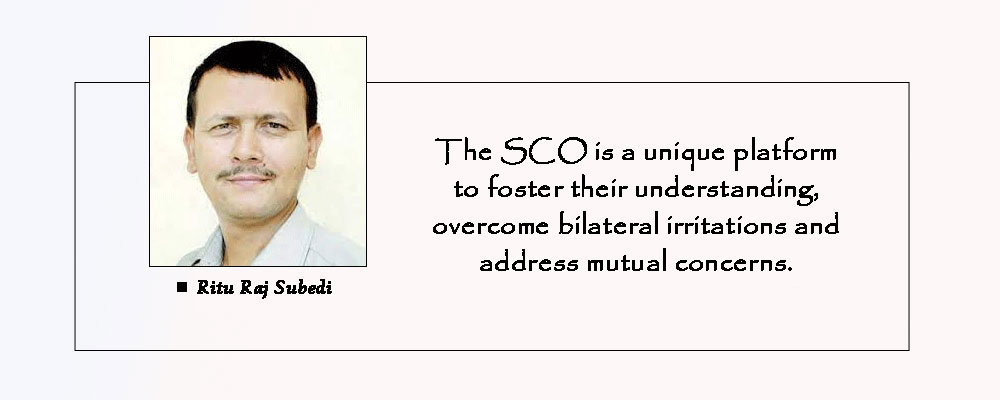
Considered as the NATO of Asia, the SCO has expanded its areas of cooperation. It has become the world’s largest organisation in terms of geography, economy and population. But the dynamism, potentiality and strength of any organisaton largely lies in the sound relations among its members. China and India are still stuck in border disputes although this has not hindered their bilateral trade. Bilateral ties between India and Pakistan are often tense. The SCO is a unique platform to foster their understanding, overcome bilateral irritations and address mutual concerns. As a dialogue partner, Nepal has been participating in various activities of SCO. It also offers huge opportunities to the Himalayan nation that has recently gained much geopolitical traction. It should apply for membership of the organisation to enhance diplomatic image and muster international support for economic development and greater regional connectivity.
(The author is Deputy Executive Editor of this daily.)