- Tuesday, 9 June 2026

Organised gangs smuggling buffaloes from Bihar
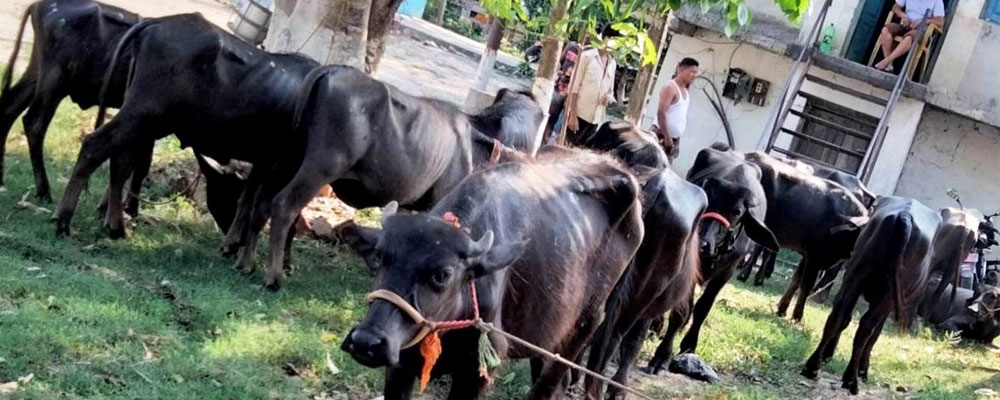

By Rabindra Upreti,Bardibas, June 10: Smuggling of buffaloes, especially the males, from the Indian state of Bihar has increased of late. According to local buffalo farmers in areas of Mahottari district bordering Bihar, organised gangs are involved in the smuggling.
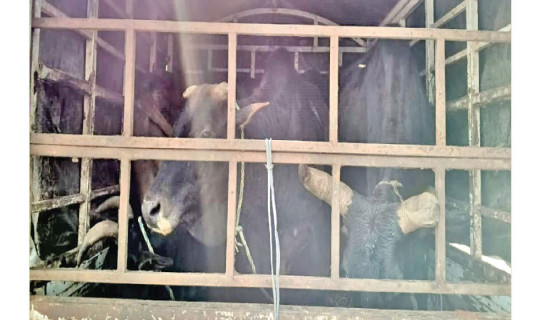
Locals involved in animal husbandry and butchery informed that around Rs. 10 million worth of Indian he-buffaloes alone are smuggled monthly and sold in the Nepali market.
The smuggled buffaloes are mainly sold at Gaushala Bazaar, a major cattle market in the district. A similar sale of smuggled buffaloes is rampant in Sarlahi's Mahendra Bazaar and Dhanusha's Sakhuwa Bazaar as well.
"People running butchery businesses in Kathmandu, Pokhara and Ramechhap, among other districts arrive here with big empty trucks every now and then and leave after cramming them with buffaloes," said Santosh Jha, a cattle farmer in Gaushala Bazaar.
Authorities sometimes confiscate smuggled cattle but the smuggling was still out of control.
"Surveillance along the open border is often strict. On Thursday, we confiscated 18 he-buffaloes from Ward No. 6 of Gaushala Municipality. Other than buffaloes, goats and cows are also seized every now and then and handed over to the Customs," said Deputy Superintendent of Police (DSP) Dilip Kumar Giri, spokesperson for the Mahottari District Police Office.
Several cattle farmers informed that the smuggling was rampant because the demand could not be met by Nepali farmers alone.
According to them, to meet the demands and make a good amount of money, organised gangs from Nepal and India have been active in smuggling.
The prevailing law states that foreign cattle should first require a certificate of quarantine before beginning the necessary customs procedures.
"There is no animal quarantine shelter either on this side of Mahottari or across its border in Bhitthamore, Bihar. It is why passing cattle through this border route is illegal," said Amit Paudel, chief of the Jaleshwor Customs Office.
Paudel added, "If there was an animal quarantine shelter in the area, it would increase the legal trade of cattle and support the country's economy. It would also create job opportunities."
Customs and security officials argued that unless farmer-friendly border-trade policies were implemented and proper infrastructures unconstructed, smuggling through the open border would continue unabated.
"The need for a quarantine certificate before cross-border trade is to block entry of unknown, harmful infection or disease.
Animal Health and Livestock Services Act and its regulation have prohibited foreign cattle from entering without quarantine," said Dr. Surendra Bharati, a veterinarian.