- Monday, 18 May 2026

Monsoon preparedness plan underway for BP Highway
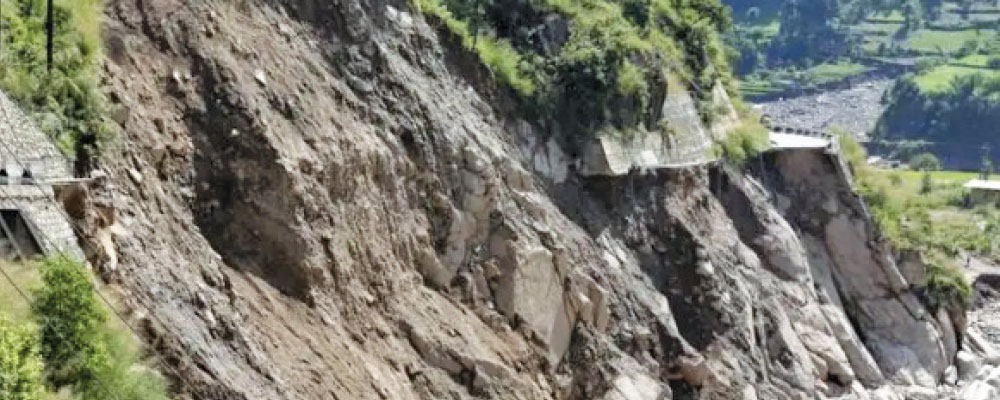

By A Staff Reporter,Kathmandu, May 18: Not even a month remaining for the onset of monsoon for this season, the government has drawn up a plan to allow vehicles to operate on sections of the BP Highway even during the monsoon season, particularly around the Roshi River area, which was severely affected by last year’s incessant rainfall.
According to the Department of Roads, the move comes in the aftermath of an incident last Monday in which 89 passengers travelling by microbuses were stranded when the vehicles got stuck amid sudden flooding. They were rescued after a joint operation by security agencies that continued until 1:00 am.
“We will operate using the river diversion for about a month. After that, we are working to make it possible for vehicles to run along the original alignment,” said Deputy Director General (DDG) Shyam Bahadur Khadka of the Department of Roads. “We are carrying out works so that traffic can continue on the main road even during the peak monsoon season, instead of relying on river diversions.”
DDG Khadka said that although full blacktopping will not be completed by then, the road will be in a condition suitable for vehicular movement.
He also acknowledged coordination with the Department of Hydrology and Meteorology to halt traffic during high-risk periods, adding that last Monday’s incident occurred after warnings were ignored.
Safety concerns along vulnerable section
Bhola Nath Guragain, Assistant Chief District Officer of Kavrepalanchowk, said notices were issued primarily for public safety as reconstruction work continues between Katunjebeshi in Kavre and Nepalthok in Sindhuli.
“Along the roughly 28-kilometre stretch, vehicles sometimes have to travel through riverbeds and sometimes along the road. If a vehicle breaks down, there is a risk that floods could arrive before it is repaired and cleared,” Guragain said.
Officials expect that with about one more month of work, repairs on half of the damaged roadside sections along the river could be completed.
Nepal’s monsoon season typically begins in mid-May or first week of June and lasts until mid-October.
Reconstruction expected within 18 months
The BP Highway, constructed over nearly two decades with Japanese assistance using a retaining-wall design rather than heavy hill cutting, suffered severe damage during floods and landslides in October last year.
Out of the 158-kilometre highway, around nine kilometres were completely destroyed, while rehabilitation works are currently under way across approximately 25 kilometres in total, according to the Department.
“About three kilometres are being handled under a JICA-supported agreement, with contractors already mobilised. Nepali contractors have been working on the remaining sections for the past six to seven months,” said Director General Dr. Bijaya Jaishi for the Department.
He said that progress of about one-fifth of the total work so far is considered satisfactory, with priority currently being given to the most severely damaged sections.
Officials say the overall reconstruction is expected to be completed within the next 18 months, as originally planned.
The highway, which connects Kathmandu to eastern Nepal, suffered additional damage soon after its opening due to the 2015 earthquake. Despite its strategic importance, its challenging terrain and narrow structure have often made travel difficult and risky.
DG Jaishi also said that rising pre-monsoon rainfall has added to the challenges but expressed confidence that stabilising and elevating road sections will improve conditions for traffic flow.
The BP Highway is one of the shortest routes linking Kathmandu with eastern Nepal, but the mid-September 2023 floods disrupted travel, significantly increasing journey times and causing widespread inconvenience.
Experts say the road’s design, built with minimal hill cutting and extensive retaining structures, makes it more expensive and complex to maintain than standard highways, and in some stretches it functions more like a rural road than a major highway.
The government has allocated around Rs. 8.5 billion for reconstruction due to the complexity of the terrain.
DG Dr. Jaishi said contractors have reported rising costs due to global supply disruptions, but stressed that the priority remains completing the project on schedule. “Our focus is to complete the reconstruction on time,” he said.

-square-thumb.jpg)