- Wednesday, 1 April 2026

Patient Welfare Key To Sound Health Care

The global landscape of health care is changing in increasingly complex environments of health systems in low-and middle-income countries. With the advancement in new treatments, technologies and care models, there are enormous opportunities to harness the therapeutic potential. However, there are also risks of posing threats and vulnerabilities to safe care. Therefore, patient safety is not only a fundamental principle of health care, it is also a growing public health challenge. In many low- and middle- income countries, patients are harmed due to unsafe care is a serious concern as it is one of the leading causes of death and disability. Despite global advocacy, patient safety incidents are still occurring which have profound impacts on victims, their families and communities.
According to World Health Organisation (WHO), as many as 4 in 10 patients are harmed in primary and outpatient health care worldwide. More importantly, up to 80 per cent of harm is preventable. The most detrimental errors are related to diagnosis, prescription and the use of medicines. Available evidence suggests that 134 million adverse events occur due to unsafe care in low- and middle-income countries. Sadly, in the years preceding the COVID-19 pandemic, 2.6 million people died every year due to safety lapses in hospitals in lower-income countries.
Quality health care
Patient safety is increasingly considered as cornerstone of quality health care services. The WHO defines patient safety as a broad framework of organised activities that creates cultures, processes, procedures, behaviours, technologies, and environments in health care. More importantly, this consistently and sustainably lower risks, reduce the occurrence of avoidable harm, make errors less likely, and reduce the impact of harm when it occurs. In this context, promoting a culture of patient safety is an emerging priority which focuses on a patient-centred approach. To do so, it is necessary to strengthen the local health systems by advancing leadership and systemic approaches, adequate human and other resources, robust data, mutual learning, trust and accountability.
More recently, Global Ministerial Summit was convened in Montreux, Switzerland to discuss a range of patient safety issues in different technical domains through a broader health policy perspective. The summit was a major landmark in terms of sharing the wider experiences of patient safety, key gaps and challenges, and promoting sustainable interventions in the context of COVID-19 pandemic. In Montreux, delegations from many countries discussed the key gaps for the implementation of Global Patient Safety Action Plan (2021–2030) which eventually aims to eliminate avoidable harm in health care. More precisely, the Montreux Charter on patient safety reaffirms that patient harm in health care is an urgent public health issue which demands shared responsibility for multi-sector actions.
Moving forward, it is time to make zero avoidable harm to patients and improve patient safety and quality care by developing a multi-sector strategy and partnership. With the use of both scientific expertise and patient experience, the approach of translating evidence into actionable and measurable improvement in patient safety can be more effective and sustainable. Still, there are critical needs to prioritise key priority interventions for countries to address implementation gaps in patient safety, including medication safety, safe surgery, infection prevention and control, and antimicrobial resistance.
Building on the lessons learned from the COVID-19 pandemic, local initiatives are urgently needed to deepen partnerships, foster collaboration and mutual learning, and ensure meaningful engagement of patients and their families. Safe health care should be seen as a basic human right. Unfortunately, there are limited efforts to advance patient safety in health policies and strategic interventions. In the context of universal health coverage, it is crucial to assess the gaps and challenges of patient safety including risks, errors, adverse events and patient harm at all levels of health service delivery.
Most often, there is a tendency to ignore the concerns and perspectives of patients and their families, timely reporting and feedback systems need to be strengthened by implementing systematic measures to reduce the risks associated with harm in health care delivery. At local level, there is an emerging need to develop comprehensive patient safety polices, strategies, guidance and tools in consultations with a network of patients, health care providers and civil society organisations.
Concerted efforts
Further, enhancing safety culture requires concerted efforts of health workers, patients and their families towards open and transparent systems of communications which will help better understanding of the causative and contributing factors of harm and possible measures to address the human factors. In this context, it is equally important to consider hygienic infrastructure of health facilities, clinical governance and risk management approaches to further advance patient safety at large. For instance, unsafe injection practices in health care settings can transmit infections, including HIV and hepatitis B and C, and pose high risks to patients and health care workers.
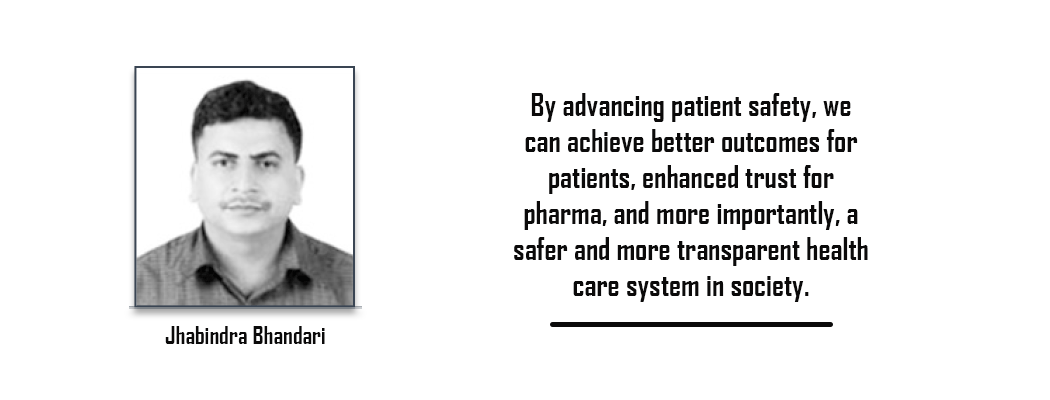
Likewise, provision of safe water, sanitation and hygiene in the health care facilities can also reduce infection prevention to large extent. Again, there are critical needs to enhance active participation and empowerment of patients, families and communities in the delivery of safe health care. Participatory networking of civil society and patient associations is instrumental in raising community awareness on patient safety and effective implementation of systematic approaches for eliminating avoidable harm in health care. By advancing patient safety, we can achieve better outcomes for patients, enhanced trust for pharma, and more importantly, a safer and more transparent health care system in society.
(PhD in global health, Bhandari writes on health and development issues.)

-original-thumb.jpg)