- Monday, 8 June 2026

Promote Tax Cooperation And Transparency

On March 18, 2026, Nepal formally acceded to the OECD Global Forum on Transparency and Exchange of Information for Tax Purposes (the Global Forum) as its 173rd member jurisdiction. This membership represents a definitive step in the counry's journey toward international tax cooperation and a robust fiscal governance trajectory in today’s interconnected global world.
In the modern world, cooperation among various jurisdictions on tax matters is not merely a luxury; it is a necessity to protect the tax base and ensure economic and financial integrity. Such cooperation is vital to relieve multinational investors from the burden of double taxation while ensuring the right taxation, resolving the underlying clash between "residence" and "source" principles.
Mutual agreement
Effective tax cooperation and mutual agreement are only possible when jurisdictions have access to sufficient data regarding the transactions of multinational taxpayers and companies’ ownership details, known as beneficial ownership. The exchange of information — both under common reporting standards and on request —is the cornerstone of this mutually beneficial cooperation. The Global Forum works consistently to standardise tax reporting frameworks and facilitate member's jurisdiction in sharing information, ensuring a level playing field for all.
The Global Forum, hosted by the OECD, is the world’s premier body dedicated to the implementation of international tax transparency standards. Nepal’s decision to accede as the 24th Asian jurisdiction comes at a critical juncture, as the country is under constant pressure to increase domestic revenue following scheduled LDC graduation, while simultaneously striving to ensure financial integrity amidst intense surveillance by international watchdogs like the FATF.
Various reports estimate that developing economies have lost significant revenue through base erosion and profit shifting, a phenomenon where wealth generated in one country is shifted to offshore tax havens, beyond the reach of domestic authorities. In a world where digital transactions and complex corporate structures can obscure the true ownership of assets, no single country can effectively police its tax base in isolation. By joining the Global Forum, Nepal has committed to two primary international standards to address this challenge: Exchange of Information on Request (EOIR) and the Automatic Exchange of Information (AEOI).
The EOIR standard requires tax authorities to provide/seek specific information to/from their foreign counterparts upon request for tax audits and investigations. For the Inland Revenue Department (IRD), this means that if a taxpayer is suspected of hiding income in a foreign jurisdiction that is also a member of the Forum, Nepal now has the rights to request and receive the necessary financial data. This is the fundamental shift from a localized to a globalized audit and investigation approach.
Under the Automatic Exchange of Information (AEOI), Nepal will move toward a system where information on financial accounts held by Nepali residents abroad is exchanged on an annual basis. This proactive data flow allows for the systematic verification of global income, further strengthening the IRD’s capacity to ensure full tax compliance. Membership serves as a doorway to a global pool of information and the right to access. It manifests both the right to receive and the obligation to share information. To leverage the forum, Nepal must focus primarily on three strategic pillars:
The first pillar is statutory harmonisation. This requires domestic tax law compatible with sharing and requesting information, more particularly related to "Beneficial Ownership." In simple terms, the law must be able to identify the real people who ultimately own or control a company or trust. This is the very foundation for uncovering hidden wealth and stopping sophisticated tax fraud.
The second pillar is digital transformation and data security. The exchange of sensitive financial information requires a highly secure IT infrastructure. The IRD must be committed and capable of enhancing its data protection protocols to meet the stringent confidentiality requirements of the Global Forum. This ensures that while we seek transparency, we also protect the legitimate privacy and data rights of our citizens.
Regional leadership
The third pillar is activating regional leadership. By participating in the Asia Initiative, Nepal can collaborate with neighbors to address common issues, such as the taxation of the digital economy. By sharing experiences with peer countries in South Asia, Nepal can advocate for a tax system that reflects the unique economic realities of developing nations while adhering to global norms.
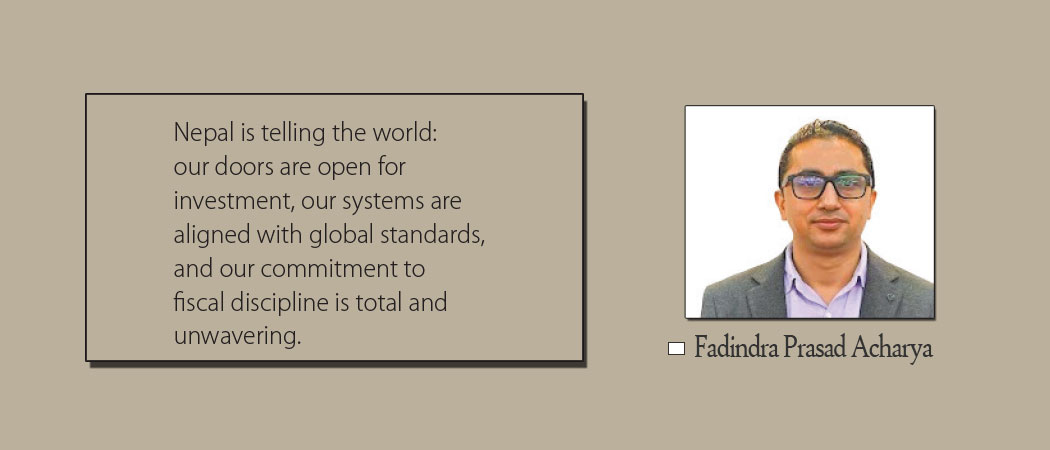
This membership is a promise to the honest taxpayer that the government uses every global resource available to ensure fair play and equality among domestic and international taxpayers and investors. This is also a manifestation of Nepal’s commitment toward fairness and integrity in taxation while adhering to transparency and accountability standards. Through this membership, Nepal is telling the world: our doors are open for investment, our systems are aligned with global standards, and our commitment to fiscal discipline is total and unwavering.
(Acharya, who holds an MA in Policy Economics from Williams College, USA, works at the Inland Revenue Department, International Taxation Section.)

-square-thumb.jpg)