- Thursday, 30 April 2026

Revamp Education And Health

When a nation-state long gripped by perennial government instability finally gets a government with absolute power to rule for a full five-year term, hopes and expectations are bound to ensue. But history is the witness that all euphoria dampens in a matter of time when the government fails to serve as per the public expectations. And the public opinion, once in favour of the government leadership, takes no time to shift to the status quo ante. Those who learn from history, therefore, wisely guard their optimism.
There is no dearth of recommendations regarding what the new government should prioritise—effective service delivery, corruption control, maintaining balanced ties with foreign powers, and so on and so forth. Among the voters, there is an expectation for sweeping reforms on multiple fronts. These great expectations are valid because, probably for the first time after 1960, a party with only two seats short of a two-thirds majority has taken up the reins of the government. But I think, as much as other important agendas, the government should work on two major fronts - education and health - to make the people in general feel that the government is for the people and by the people. What ills beset these sectors should be obvious to those in the government.
State of education
According to the Flash Report 2024, there are over 27,000 community schools where over five million children, mainly from poor and disadvantaged backgrounds, are estimated to study. But the years of partisan politics and neglect by state actors on public schools (because they do not educate their children there) have pushed the sector to such a point that most people don’t want to educate their children there, mainly because of low learning outcomes resulting from low-quality teaching inputs. Public schools appear to be the last resort for the poorest of the poor. Part of the reason this has happened is that the politicians of the post-1990s allowed the public school system to rot under their own watch—by recruiting their cadres and supporters as teachers, by giving hoots to the principle of merit, and by paying no attention to improving education quality.
Some small measures can have big and lasting impacts. Provisioning that every single teacher in public school will be appointed only after having them sit through rigorous qualifying exams and guaranteeing their promotion, once appointed, based only on skills and qualifications, can be one step. Second, departisanising schools - something the government seems to have up its sleeve already- will keep teachers focused on their profession. Raising the pay and perks of teachers in parity with their colleagues in the civil service may keep them motivated. In other words, nearly all the demands—with the major exception for one that undermines merit in selection, appointment, and promotion of teachers—with which the school teachers had hit the streets in April 2025 may be considered.
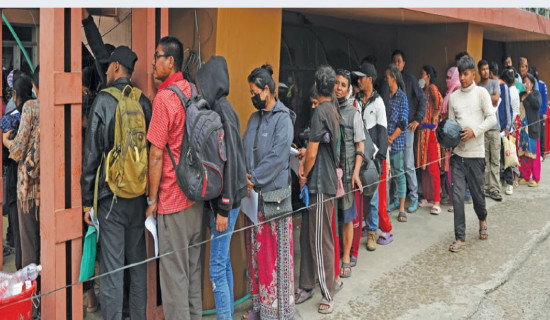
To understand what ails Nepal’s health service, just go to a government hospital. Suppose you have a condition that requires prompt medical intervention, even a surgery. So, you go to a renowned government hospital, say, Teaching or Bir. You wait for hours to see the doctor—long frustrating queue at the ticket counter, equally long queue at the doctor’s room. The doctor recommends some tests, such as an MRI or CT scan—for which you have to wait for at least one week or even more than a month. When the diagnosis process is complete, you will have to wait for another round of days and months for your date because there are no ICU beds available.
If you want to get rid of the disease fast, the doctor might suggest visiting a private hospital where the treatment may be reliable but way too expensive. Fearing for your life, you may go to a private hospital to receive out-of-pocket treatments. But others are not as lucky; they will have to wait and, if the disease is fatal, will have succumbed to it before the given date for surgery. Ensuring access to affordable health care requires expanding the infrastructure base of big hospitals like Bir and Teaching or establishing similar hospitals in every province. The only way to make our public health system function and service-oriented in a true sense is by furnishing over 10,000 public health facilities with vital equipment and human resources, while also bringing in supportive tools—such as effective health insurance programmes—with an aim to achieve Universal Health Coverage.
Reason to prioritise
The health and education sectors drain a major share of the money earned by taxpayers through hard work. Many Nepalis prefer to go on foreign employment because they think the earnings here are not enough to educate their children and provide for the basic health of their families. Not because the state provides no education and health needs of its citizens, but because the public health institutions and public education institutions have been left in such dire states for decades that they are no longer the first choice of people.
It might take years to correct the ills built over the years, but people will feel the real change when they can visit a government hospital without the fear of dying there without getting treatment or when they can visit a private hospital without the fear of going bankrupt the next day. The real change in the education sector will be when you can trust that government schools—run by your own taxes—can fulfil the education needs of your children. Yes, we cannot achieve these reforms overnight, but we can start now, and we may reach close to where we want to get.
(The author is a journalist and educator based in Kathmandu.)
-original-thumb.jpg)