- Thursday, 30 April 2026

Workplace Harassment
 Nandita Ghimire
Nandita Ghimire
Nandita Ghimire
To most women, workplace harassment is not initiated by a touch or a threat; it is initiated by a feeling that they can hardly describe. There is a kind of workplace dread that leaves no evidence. No messages to screenshot. No words you can quote. Nothing you can easily squeeze into a complaint form. And still, it doesn't go away; it hangs on until it begins to shape your entire day around its presence.
It is the fear that comes on Saturday evening, making Sunday no longer abstract. When you remember, he will be there. He never said anything technically wrong. And this is what makes it so hard to explain, and so easy to dismiss. We have built systems to address workplace harassment: policies, reporting mechanisms, and carefully worded definitions. But most of them are designed to catch something visible, something that can be proven.
We have established frameworks to address workplace harassment: policies, reporting systems, and well-chosen definitions. But the majority are constructed to trap something visible, something provable. What they fail to capture is the accumulation of the subtle. The smirk when you speak, not loud enough to call out, but sharp enough to notice. The glance exchanged with another colleague, as if you were the punch line of a joke, you were never meant to hear. The tone, patient in a way that feels less like respect and more like condescension, reserved only for you, never for your male counterparts.
Then there is how he occupies space. The walk, calculated, rather artificial, shouldered, footfall grave, as though all the corridors were his. His sitting position, leaning back, takes up more space than he needs. It is not unjustified aggression, but it conveys a silent message: this is his kingdom and you are just passing by it. And always, the joke. Delivered lightly, defensively, with an escape route built in, “Can’t you take a joke?” When you laugh, you accept the insult. Otherwise, you are the problem, too sensitive, too difficult. And how he thrusts his way into a conversation, dropping into it, till it turns around him, and there is no place where you can speak without being interrupted.
None of this is accidental. When dismissiveness, interruptions, and subtle mockery are consistently directed at women, it is not personality; it is intention. And yet, we are trained to doubt that recognition. To question ourselves before we question the behaviour. Maybe it’s just me. Maybe I’m overreacting. Maybe it’s not that serious.
So, we wait. I’ll say something if it happens again. Again. Again. The threshold keeps moving, because each moment feels too small to justify confrontation. Until, slowly, the accumulation becomes too heavy to ignore. You start to prepare before a meeting, rehearse sentences, change your tone, and select your words. Before your mind catches up, your body reacts: you can feel your stomach tightening when you see his name on your calendar, you can feel yourself mentally calculating how to avoid him.
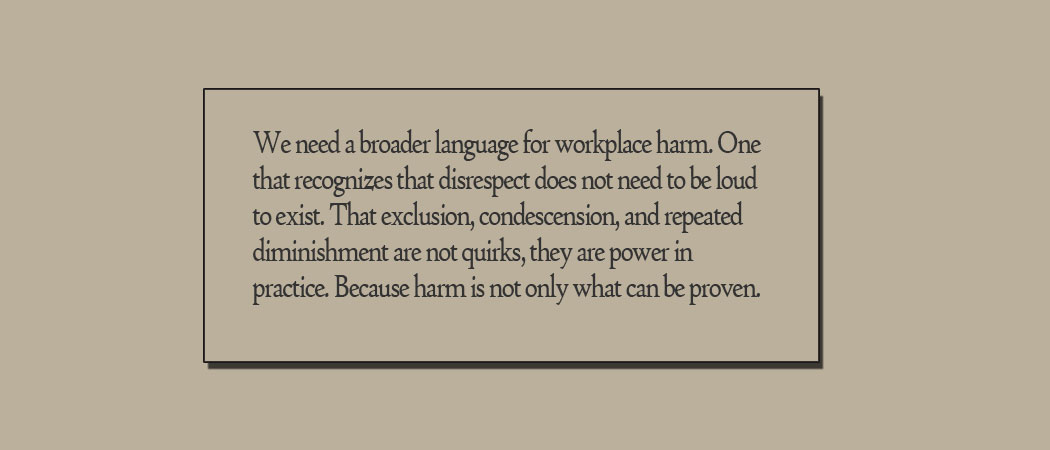
We need a broader language for workplace harm. One that recognizes that disrespect does not need to be loud to exist. That exclusion, condescension, and repeated diminishment are not quirks, they are power in practice. Because harm is not only what can be proven.
It is also what is consistently felt. And to every woman quietly calculating whether it is “bad enough” to speak up, that calculation itself is the evidence. You already know what is happening. You knew it the first time.
-original-thumb.jpg)