- Wednesday, 27 May 2026

Democratic Aspirations Are Marginalised
It has been almost three-quarters of a century since we achieved democracy in Nepal. In fact, democracy was attained in Nepal after the Nepalese people overthrew the autocratic Rana regime. It was the great feat of the Nepalese people to mount a struggle against the Rana misrule and topple it for the sake of democracy and the rights of the people. Since then, the undeterred quest for democracy, rights, and the well-being of the people has not ended. Further, we are nearing a decade since we established democratic and republican politics in Nepal. The democratic republic has come to Nepal at a huge cost and with many sacrifices.
To give enduring value to the epoch-making changes and institutionalise republican polity, the new constitution, written by the popularly mandated constituent assembly, has been promulgated and enacted in Nepal. We have overthrown the monarchy, a hallowed institution with a long history and rich tradition. We have seen how a country with a monarchy like Denmark or Sweden can be the happiest and most prosperous country
in the world. In Nepal, too, if one looks at the history with a sense of objectivity and a broader perspective, the monarchical institution cannot be faulted for every wrong that has befallen and cursed the country.
Unification of the Nepali State
Prithvi Narayan Shah should be credited with the making and unification of the Nepali state that is in its present shape today. The Kings, like Birendra, should be hailed for conceding to the democratic change in the country. Had he not respected the wishes of the agitating Nepali people, multiparty politics would not have been restored in the country with less cost. We did uproot and abolish the monarchical institution, anticipating that the democratic welfare of the people would be the foremost goal of the state. That was the only expectation of the people—that many, many thousands of them would sacrifice their lives and
Hundreds of thousands of people suffered in their battle for democracy and justice. However, the contemporary political developments illustrate that the wishes and aspirations of the people have not been realized, if not shattered. Democratic institutions are under attack.
The extent to which we can stoop to abusing public resources to serve our vested interests is indicated by the way public institutions are designed to work at the whims and mercies of their political masters. We are not properly adhering to the path to ensure that our aspirations and wishes are fulfilled. It is often said that getting the concept and
It is difficult to introduce the institution of democracy or republicanism; it is also difficult to make it thrive and sustain. We have frittered away time and resources for several years to serve one's own vested political interests. We destroyed and maligned the courts, bureaucracy, and police organisations because of our constant bickering over worthless issues and causes dictated and motivated by our own partisanship and self-centered interests. The wrangling over the appointment of justices in high courts and the appointment of police chiefs indicates the dominance of sheer partisan interests at the cost of the glory and majesty of the public institutions. It is relevant to quote Robert A.
Dahl, the reputed US political scientist of contemporary times, who in his celebrated work on democracy has blamed political tendencies and behaviours for the failures to institutionalise a democratic system. He writes, "With the visible failures of the totalitarian systems, military dictatorships, and many other authoritarian regimes, anti-democratic ideas, beliefs, and ideologies have been fostered," losing their previous appeal throughout much of the world.
Never before in human history have so many people supported democratic ideas and institutions. Similarly, democracy can be reversed and rolled back, or the basic tenets and practises of democracy can be overruled, as this has happened in many countries where democracy has either failed to deliver or been appropriately institutionalised. The setback meted out to democracy is called the "reversal of democracy."
This has occurred in several nations at different times in history. This has primarily happened, as pointed out above, due to the deviousness of political leadership or systemic failures of democratic regimes to deliver effectively in order to meet the needs and aspirations of the people. The growing inability to provide welfare, prosperity, equity, justice, domestic order, or external security has caused the reversal of democracy. If democracy and republicanism are to be strengthened, they must be strengthened through their performance and delivery on people's aspirations.
Deepening of Democracy
It has to be made a real and living reality for the ordinary populace. It is in this context that the widening and deepening of democracy are necessary to assure that democracy not only delivers but is also practised as a way of life by the people.
Deepening and broadening democracy necessitates moving beyond the formal democratic institutions and procedures, as well as reaching out to the people and allowing them to participate as shapers and makers of democratic goods and services. As a result, the democratic institution must be integrated with participatory democracy politics.
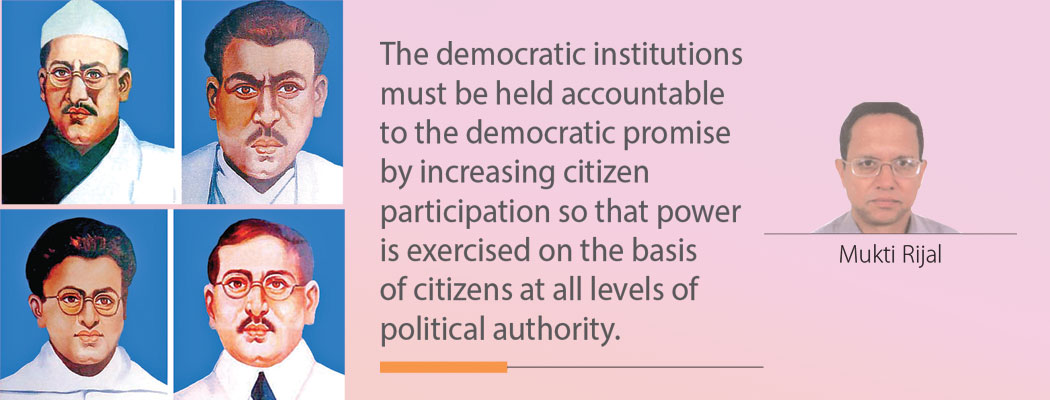
The democratic institutions must be held accountable to the democratic promise by increasing citizen participation so that power is exercised on the basis of citizens at all levels of political authority. This entails maximising the accountability and transparency of the holders of political power and bureaucratic offices at all levels. The deepening and widening of democracy is possible only when citizens are educated for democracy and an enabling environment is created in order to ensure that specific context or situation.
A nation develops itself as a laboratory for democratic innovations and practices. However, we in Nepal have not been able to do a basic thing for this that would take cognizance of our democratic wishes and aspirations and consequently institutionalise republican ideals.
(Rijal is associated with Policy Research Institute as a senior research fellow)
How did you feel after reading this news?






-original-thumb.jpg)