- Wednesday, 27 May 2026

Fostering Democratic Culture
Ballav Dahal
Seven long decades have passed since Nepali people first introduced multiparty democracy in the country by overthrowing the 104-year-old repressive Rana rule on 7th of Falgun 2007 BS. Many brave political leaders and common people had sacrificed their lives for the sake of democracy that ensures freedom to citizens and safeguards their political, economic, socio-cultural and individual rights. On this important occasion, the nation and the people pay their profound tributes to all those who had attained martyrdom in course of fighting for national sovereignty, democracy and rule of law.
A large number of other people who had put their lives at stake for democracy also deserve much reverence. The dawn of democratic era would not have been possible in Nepal without their strong commitment and dedication to democracy.
Active participation
It needs no mention that the people’s movement against the family rule of the Ranas was undoubtedly a momentous political event in the nation’s history of political struggle. Being the first people’s uprising, the anti-Rana movement was the mother of all other successive democratic struggles in the country.
Even when the people at that time had not been so educated and economically sound, their active participation in the rebellion was quite astonishing. The Nepali people’s dream of establishing democracy would not have materialised if there had not been their massive support for and involvement in the fight against the intolerant Rana regime. So, the remarkable political transformation has had wider implications for the nation’s political, economic, educational and cultural domains. The country was opened to the outside world only after the introduction of democracy.
But the democratic form of governance set up in the country through the popular uprising in 1951 could not last longer due to the growing ambition of the then King Mahendra to rule the nation as an absolute monarch. The cunning king nipped the hard-earned democracy in the bud and imposed the autocratic Panchayat rule in 1959.
However, that crucial political change led to a massive rise in the level of people’s consciousness and inspired them to carry out campaigns against the Panchayat regime, too, in order to restore democracy in the nation. As the Panchayat rule seized citizens’ rights, they had to pass through a difficult situation. However, the people’s movement toppled that tyrannical Panchayat system in 1990, reinstating the multiparty democracy with constitutional monarchy.
With the restoration of democracy, the nation has adopted a policy of economic liberalisation, privatisation and globalisation. That policy shift has paved the way for the private sector to play a leading role in the economic development. But in the name of privatisation, many state-owned industries were sold out to private companies for a price of soil. It was a blunder on the part of the then government to do so as it incurred a huge loss to the nation.
The country witnessed yet another political revolution in 2006.

That movement put an end to the 240-year-old monarchy and made Nepal a federal republic. With the promulgation of the present inclusive constitution in 2015, the nation has gone through a sea change in terms of political system and state restructuring.
Three-tier elections (federal, provincial and local) have been held for two times in the country since the implementation of the new national charter. As envisaged by the constitution, the three-tier governments seem to be functioning smoothly even amidst different obstacles and challenges. Although these governments are autonomous in nature and functioning, they are required to work in close coordination and cooperation with one another in order to run the federal system of governance in an effective manner.
A universally accepted assumption is that democracy is the best form of governance. A success or failure of democracy hinges on the political parties and their leaders as they are the key stakeholders. Whether a nation requires a good political system or leadership to move ahead on the path of overall development has now become a matter of discussion. Some say that an undemocratic nation could make great strides in economic, social and technological development when its leadership is visionary, dedicated and honest.
Others argue that tackling major national challenges and problems will be possible only when the nation possesses a better political system (democracy).
Despite being a democratic nation, Nepal seems to have failed to achieve her development goals. The country is still facing political instability.
The political parties and their leaderships are rarely found raising themselves above their partisan and petty personal interests. It appears that they forget the pledges and commitments made to the people during elections. This is one of the reasons why the nation has continued to fall behind other nations in terms of achieving progress and prosperity.
In their election manifestoes, most political parties seem to have embraced a ‘zero tolerance’ policy on corruption. But it is mockery that the misuse of public funds is still widespread. Citizens are reported to have been forced to give money or favour to public officials working with all the three-level governments. Service-seekers often complain that they still face hassles while getting their works done at offices related to land revenue, transport management and local government. It is the responsibility of the political leaderships to resolve such grievances once and for all.
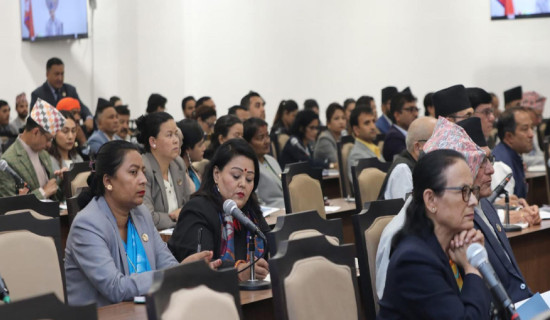
Another worrisome aspect is- even the federal parliament gets obstructed frequently. In its last tenure, the House of Representatives was dissolved twice within six months. However, the Supreme Court (SC) restored the legislature, terming the move to dissolve it as unconstitutional.
Law formulation
Even top leaders of different political parties are still seen using the federal parliament as a forum for venting their frustrations and angers. They must realise the fact that the people have not voted to the parliament only to criticise others. As the supreme body of elected representatives, the legislature is supposed to focus on formulating the effective laws that the nation is in need and addressing the problems facing the country and the people.
It is the duty of the political parties to dedicate themselves towards consolidating democracy and institutionalising the constitution. Their growing greed for power has created an aversion towards the political system itself. Another public concern is that the nation has witnessed criminalization of politics. This type of tendency does not give a good indication for the sustenance of democracy and democratic culture.
(Dahal is a deputy executive editor of this daily).
How did you feel after reading this news?


-original-thumb.jpg)