- Wednesday, 27 May 2026

Lingering Process Of Transitional Justice
Liladhar Upadhyaya
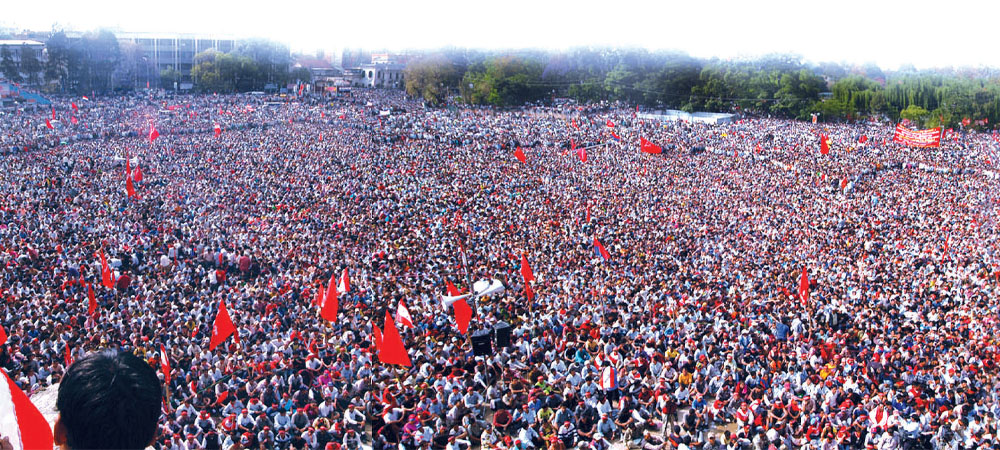
The nation is celebrating Democracy Day today as an acknowledgement to the achievements of the People's Movement of 1951 which had overthrown the Rana oligarchy to restore multiparty democracy in Nepal. However, the achievements could not last when then King Mahendra seized power in 2017 BS introducing the one-party Panchayat system under absolute monarchy.
The direct rule of monarchy was ended though another People's Movement in 1990 which was later followed by the April uprising of 2006. Falgun 7 is considered as the vital date, which had cultivated democratic awareness in the Nepali people.
Present situation of democratic freedom is the result of a series of people's movements which include Sat Sal ko kranti, Maoist uprising, Madhesh Movement, Tharu's movements and so on. However, the transitional justice, the important component of Comprehensive Peace Process (CPA) signed between the Government of Nepal and the Maoist rebels is yet to yield positive results even after the lapse of over one-and-a-half-decade of its signing. Just establishing the commissions is not enough if there is no final solution of this issue. Pushing the efforts towards producing better results is the matter of concern for all the peace loving people.
The nation is under federal democratic republican set up now following various national milestones including the CPA in 2006, enactment of the Interim Constitution in 2007 and the promulgation of the new Constitution of Nepal in 2015. Transitional justice is the integral component of these achievements. All the concerned stakeholders should think wisely and act sincerely to conclude the TJ process of Nepal that will definitely boost nation's dignity in the international arena in line with principles and practices of democratic governance.
Present situation
Two commissions—namely Truth and Reconciliation, and Commission of Investigation on Enforced Disappeared Persons are in operation with the enactment of related laws. Its office bearers are appointed at the recommendation of the Government of Nepal. However, the administrative and legal structures are just the showing teeth reflecting that the nation is effortful to settle the TJ process for assurance of non-repetition of atrocities. TJ and its settlement issues are also included in nation's policy document and the budget.
However, these documents are not sufficient to produce meaningful results. The commissions are mandated to investigate into serious human rights violations during the period of war, to find out truth and to keep record of the rights violations, to identify the perpetrators and victims, to take initiation for reconciliation, to recommend reparation and to recommend those perpetrators for action, who have not got amnesty and not found liable for reconciliation. The commissions are often criticised of being economic burden rather than being result oriented institutions. The functions and mechanisms relating to the TJ could not give durable solutions till now because of the various challenges. Some of the challenges are discussed below:

Consensus building
Forging consensus among the political parties is a prime challenge of TJ process in Nepal. There should be minimum common understanding among the political parties, no matter where they stand either in the government or in the opposition. Change in power equation directly affects the activities of these commissions.
New minister comes with new mandate and he/she either ignores the process or tries to guide the process as per his/her wish, or, new government has another priority than the previous one. There is lack of consistency between the consecutive governments formed under different circumstances. An assertive leadership with sound understanding of the TJ process should take initiation to lead the process towards a logical conclusion.
Shunning power tactics
The political parties either from the insurgency or from peaceful democratic process want to settle the TJ process. Power politics is associated with the TJ process if we look into the international situations like that of South Africa and Colombia.
They had their own context to settle the issues. However, there are certain standards which can be a benchmark for leading the process to a logical conclusion. The political parties have the leverage of international norms of TJ process under which the stakeholders or victims' acceptance towards the process.
The political parties should keep themselves away from the power tactics while dealing with the TJ process. They should consider the concerns of the victims by reiterating broader democratic commitment nationally and internationally.
Victims' concerns
Victims are the byproducts of the armed conflicts. They may be commoners, cadres and supporters of political parties or the families of armed forces or militias. These people are forced to suffer at multiple levels. They have psychological trauma, economic hardships and social stigma to deal with. Giving priority to the concerns of victims should be the main objective of the TJ process along with other processes like truth seeking, reconciliation and reparation. There are different models to address the grievances of the victims. Rehabilitation of the victims at different levels after the end of the conflict should be the agenda of TJ process.
Empowering the Commissions
The government has established two commissions-- Truth and Reconciliation and Commission of Investigation on Enforced Disappeared Persons to settle the TJ process. The commissions have enacted bylaws, guidelines, directives
and procedures under the jurisdiction of the delegated legislation.
However, the officials of commissions claim that they should be well equipped with infrastructure, resources, logistics and full- fledged autonomy to settle the TJ process. The commissions should have full power or authority to settle the issues. They need to show they are not merely the puppets of political forces to linger the TJ process as per their wish. Rather, they should have final authority to take initiation to end the TJ process as per the demand of the multiple stakeholders.
The TJ process of Nepal is protracted for no reason, but it happened because of the lack of proper initiation and action of the government and the stakeholders. The discourse relating to TJ is raised in the national and international spheres of the rule of law. It is the duty of the state as well as the former rebels to lead the process towards a logical conclusion.
All stakeholders should think of finding viable solutions by forging common minimum understanding to settle the TJ process. The CPA, Interim Constitution 2007, Constitution of Nepal and other set principles of international practices are the key tool to settle the TJ process in Nepal. As a TJ process comprises of legal, political, economic and social ingredients, sincere and meaningful efforts should be taken for positive outcome. Dignity of Nepal and its people shall be heightened with the logical conclusion of the TJ by bolstering broader democratic commitment and the rule of law.
(Upadhyaya is Associate Editor at TRN)
How did you feel after reading this news?







-original-thumb.jpg)