- Friday, 5 June 2026

Activists resist lowering marriage age to 18
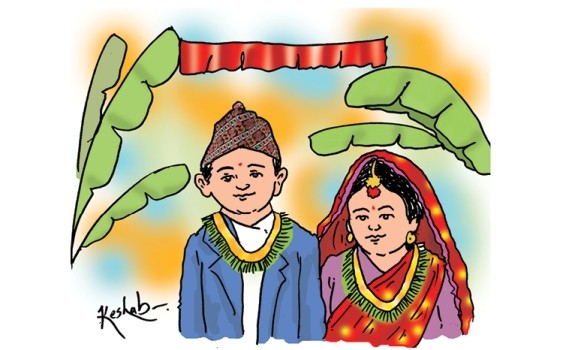

Kathmandu, May 16: Child rights activists have strongly protested the government's proposal to reduce the marriage age to 18, citing that this will have serious negative impacts on the children's health, education and overall development. They has stressed to maintain the legal age of marriage at 20.
Children as Zone of Peace (CZOP), a non-governmental organisation working for the protection and promotion of children’s rights since 2001, has expressed serious concerns regarding the current exercise of the government to reduce the current legal age for marriage.
Tilottama Poudel, president of the CZOP, said, “No one has formally discussed the issue at any event or programme, but we have received reports that the government is considering reducing the legal age of marriage. According to him, the change may come directly through an ordinance.
He further said that the suggestion to reduce the legal age to 18, according to CZOP, is problematic from a child rights perspective.
It could undermine significant campaigns such as promoting child-friendly, nutrition-friendly, and child labour-free local communities. It may also have negative implications for the overall Human Development Index (HDI).
Presenting the paper on Child Marriage: Age and Impact, Tarak Dhital, former Executive Director of the National Council for Child Rights, said that various studies have shown that lowering the age of marriage has serious negative effects on educational, mental, economic, social and reproductive health.
He cited examples of countries like China, South Korea and India where the legal age of marriage is 20 years or above.
Before having discussions on reducing the age of marriage, it is necessary to conduct a comprehensive study in the context of Nepal.
He further said that of the pregnant and post-partum women rescued by air under the President Women Upliftment Programme from June 17, 2025 to January 24, 2026, 50 per cent were between the ages of 17 to 20.
Similarly, an in-depth study is needed on the relationship between child marriage and education and child marriage and economic earnings.
Pregnancy under the age of 20 is 50 per cent more likely to result in still birth or neonatal mortality than pregnancy between the ages of 20 and 29, according to World Health Organisation. It affects education, career development and empowerment, hinders intellectual development and personality development. It also affects employment, economic, social development and skill development. There is a risk of sexual violence, domestic violence and socialisation is hindered.
The data show that early marriage is more common in low-income and backward communities. Lowering the age of marriage does not help in the upliftment of that community, but rather in further backwardness.
The survey data of Nepal Demographic and Health Survey (NDHS) shows that the marriage rate of women aged 15-19 has been declining since 2015, when the marriage age was raised to 20.
The amendment of marriageable age in the Civil Code was made based on various facts and grounds, primarily to take into account the welfare of adolescents and children born to them, as well as to eliminate the negative impact of early marriage on the family, society and nation, said Dhital, Former Executive Director of the National Council for Child Rights.
Article 39 of the Constitution of Nepal stipulates that children should not be forced into child marriage, while Section 173 of the Criminal Code of Nepal 2074 BS makes marriage before the age of 20 a punishable offence. Moreover, early marriage carries long-term consequences for society.