- Sunday, 31 May 2026

Stolen 13th century Mahagauri idol restored to its original spot
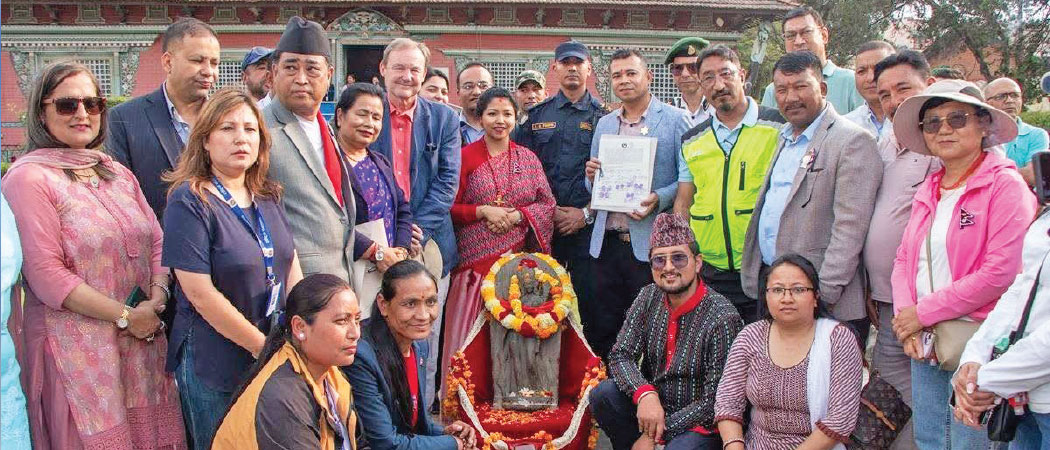

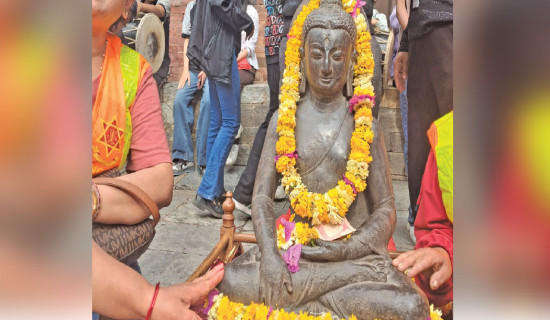
Kathmandu, Apr. 20: The stolen 13th century idol of Mahagauri (Parvati), originally from the Suryamukhi Mahadev Temple premises at Maru, Ward No. 20 of Kathmandu Metropolitan City, was restored to its original place on Saturday.
The idol was returned from the UK in 2025 and had been kept at the Chhauni Museum for a long time. It was formally reinstalled at its original site after many years.
Acting Mayor of Kathmandu Metropolitan City Sunita Dangol, Coordinator of the Heritage and Tourism Committee Ashaman Sangat, Ward No. 20 Chairman Rajendra Manandhar, heritage campaigner Ganapati Lal Shrestha, and advocate Sanjay Adhikari brought the statue from the museum’s Juddhabati Art Gallery after completing the necessary formalities.
In the presence of Chief of the National Museum (NA) Aruna Nakarmi, Chief of the Hanumandhoka Palace Museum Development Committee Kajiman Pyakurel, Museum Officer Subash Krishna Dangol, and Archaeology Officer Amrita Maharjan of the Department of Archaeology, the statue was handed over by Museum Keeper Binda Shrestha and Assistant Guide Usha Kumari Singh.
The statue measures 68.5 centimetres in height and 30.5 centimetres in width. This statue, which was stolen and taken to London, was sent to the National Museum for safekeeping by the Department of Archaeology on April 11, 1996 (Chaitra 29, 2052 BS) after the Nepali Embassy returned it from the UK.
Heritage campaigner Ganapati Lal Shrestha said that the idol of Parvati was stolen from its original place in 1978 (2035 BS), and a replica was installed by locals in 1998 (2055 BS).
“The 13th-century idol was stolen some 47 years ago. But now it has been restored. We are very happy to reinstall the idol at its original place after such a long time,” he said.
Aruna Nakarmi, Chief of the National Museum (NA) in Chhauni, said that after being kept at the museum for a long time, the idol was restored to its original site on World Heritage Day.
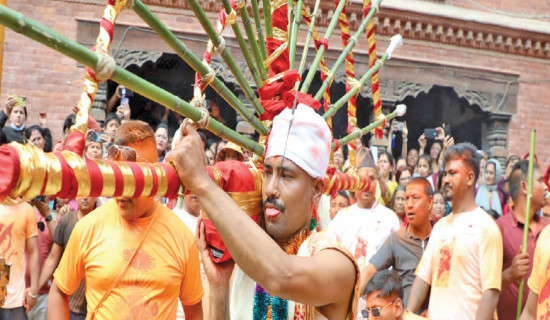
People dressed in traditional Newa attire carried the idol from the Chhauni Museum with traditional folk music and reinstalled it at its original place.
The collection of repatriated artefacts at the National Museum’s temporary exhibition hall has been increasing, thanks to the efforts of the Department of Archaeology, government bodies, and activists. A temporary exhibition hall has been developed at the National Museum to display these artefacts.
The Chhauni Museum is the only museum in the country that safely houses repatriated antiquities whose origins have not yet been fully ascertained. It currently holds 137 returned artefacts that are yet to be restored to their original locations.
Only 11 returned artefacts have been restored to their original places so far, according to Nakarmi. Some artefacts could not be restored because their original locations are unknown, she said.
According to the National Museum, several artefacts including the statue of Vasuki Nagraja, the statue of Umamaheshwar at Tangal Hiti in Lalitpur, a Buddha statue stolen from Bhinche Bahal, the toran of Yampi Mahavihar, Gandharva from Itumbahal, Salbhanjika Tundal from Itumbahal, and Bajradhar from Dolakha have already been restored to their original places.
In one section of the exhibition hall, there is an 11th-century statue of Shreedhar Vishnu depicting Vishnu flanked by Goddess Laxmi and his mount Garuda which was stolen from Bungamati’s Bahili Hiti in Kotatole, Lalitpur, in the 1980s.
Small and large Bhairav masks dating back to the 16th century were returned from the Rubin Museum of Art and the Dallas Museum of Art in New York, USA, in January 2024.
These masks belong to Nokchhe Pradhan Guthi in Bhimeshwor Municipality-2, Dolakha, and were stolen on March 6, 1994. The masks, returned seven months ago, are still awaiting restoration at their original site.
Similarly, several artefacts including the four-faced Shivalinga of Pashupati, Panchadewal, statues of Shreedhar Vishnu, Agastya Rishi, Shiva from Kankeshwari Temple, Umamaheshwar, a Buddha statue from Bungamati (Machhindrabahal Tole), a lotus-holding goddess, Tara, a dancing lady from Ibahabahi, and the head of Saraswati from Pharping are awaiting reinstallation at their original locations.
“Many of the returned objects are kept here because their original locations are not known,” she said.
“Even when the original locations are identified, the museum cannot release them unless the concerned authorities formally request them and ensure their proper placement. They must also take responsibility for their security after removal from the museum,” she added.
The returned objects, whose number has been increasing, have been on display at the temporary exhibition hall since February 13, 2024. Earlier, they were displayed alongside other historical items in the museum.