- Saturday, 6 June 2026

National Identity And Resilience Of Nepali State

The viability of Nepali state is crucial to support the national identity of its people and receive honour and integrity of their secured livelihood and destiny. Democracy has fused the nation constituted by people and the state formed out of its indigenous knowledge and transformed unequal people of diverse ancestry, caste, ethnicity, religion and language into equal citizens organised into a geographical space for self-rule. The spirit of people dwelling in the cultural totality of the nation and intellectual echo is now infused with youthful sparkle of the new government led by Prime Minister Balendra Shah’s culturally ingrained self-image, his vision of unity, wholeness and greatness of the nation amid diversity and sovereignty above all leaders.
He proudly wreathes native experience in resolving national problems and stands as a carrier of national culture, the spirit of people and their emotional experience, aspirations and ideals without indulging in the ideological caricature of the external world other than technological adaptation. Prime Minister Shah has ricocheted the link of the cultural rhythm of periphery Karnali into the heartland, Kathmandu. The synergy of national strength can radiate the lyrical ring of Nepali nation’s identity deeming see “mother Nepal smile” which no outsider can erode, not even those materialists peddling of the withering away of the state or neo-liberal state minimalists lured by the illusion of the end of history. Yet his reform must escape Gorbachev syndrome of acting too far and too fast, unable to keep its pace.
Pivotal moment
It is a pivotal moment for Nepalis to exercise the principle of national self-determination in the spotlight of the great theatre of shifting geopolitics where foreign policy focuses on relative “equi-proximity” and “equi-distance” depending on the calculation of national interests —survival, vital, major and peripheral. It can erase all the outdated concepts of buffer that neutralises its freedom of manoeuver or vibrant bridge that commodifies the state, injects security dilemma for neighbours and subordinates its sovereignty. A gaze beyond Anglosphere is definitely a paradigm shift in foreign policy that captures the normative frame of Panchsheel, the UN and nonalignment, not subject to invisible dynamics of geopolitics.
Nepal’s wisdom has recognised people as a manifestation of Janata Janardan while Nepali constitution deems them the fount of sovereignty and source of legitimacy for good governance. Prosperity can return if the vault and desire of a good life of Nepalis are stabilised in the flair of a carefully conceived welfare state able to de-polarise and de-partisanise the delivery of public goods and buttress “partnership with all nations on the basis of mutual benefits.” Information revolution has freed Nepalis from the conditioned life of ideological politics of the regime and recovered from the native wisdom of realpolitik and a life of national choice. Leadership loss of public interests can expose the nation vulnerable to the choice of great powers.
Unlike the Ostrich-like stand which avoids seeing the piling problems suffocating the people, current leaders seem pro-active and learning from the history of statecraft. The old leaders have fertilised rich idioms unrelated to national context except for arcane tittle-tattle while the new one appears action-oriented to allay the pain of the state and people. To consolidate the statehood Nepal has accepted multi-cultural faith and policy of inclusion of people in national conscription and welfare benefits but also control unrestrained immigration flow though accepted asylum-seekers. This shows that Nepali nationalism is clothed itself not in tribal passion but collective consciousness rooted in civic virtues. Because of the spread of its values across the world and settlement of population in about 127 nations, its nationalism is confined not to the carefully constructed elites’ version of territoriality but to the cosmopolitan nationality which in no way is primordial.
Construction of national identity historically shaped out of threads of experience distilled by Prithivi Narayan Shah in Dibya Upadesh. The ancient account of its roots goes as deep as Athava Parisista. Nepal’s sovereignty has emerged out of people’s struggle to defend themselves and their resistance against colonialism and subordination to hegemony. Corruption of power inverts the public power of politics, affronts its ancient identity rooted in the cosmic web of life and protection of people and nature from vulnerability. Assuming human nature divine Nepal has endeared aham asmi, existence and freedom with duty so that the order of nature and social order remain adaptable to yug dharma. Shiva, Astavakra, Ved Vyas, Janaka, Sita, Buddha and Ram Shaha are Nepali history’s great moral heroes who are often thought to create ecological, social and intergenerational justice to enrich its vitality and adapt to the uncertainty of a multi-polar world.
Public discourses were organised to educate all, update the validity of knowledge and synthesise the conflicting convictions unlike modern seminars and workshops to seek conformism and support the idiosyncrasies of market imperfections and pedantic reason without a sense of feeling to the essential needs of people and overcoming scarcity of public goods. Prime Minister Shaha’s search for national self-reliance aims to utilise comparative advantages of the nation. The practice of market fundamentalism, class fundamentalism, ethnic fundamentalism and territorial determinism practiced in modern day has undermined its culture, spirituality and tradition of sanity and exposed Nepalis to irrational exuberance thus breaking state-society ties. Political power of parties appeared disproportional to both the state’s imperative for political order and people’s desire for positive freedom.
Increasing bureaucratisation of political leadership has distanced it from both; they are left to bare bones, skeletons without the flash of civil society, flesh of economy and even a flickering sense of constitutionalism. The exercise of negative liberties by the market, civil society and professional organisations against the state set a downward spiral in democratic development and lingered cold peace without transitional justice. A corrective path requires both contextual awareness and historical insight with a broad brush of narratives that integrates diverse society into a middle path and national self-definition.
Many of the policy measures of Prime Minister Balen Shah have espoused cultural, spiritual, educational, health, justice and livelihood policies to renew this nation torn long by labyrinths of centrifugal elements, nihilists, bichaulias and comprador classes who had disoriented Nepalis, eroded the sources of national identity and international acceptability. The government has formed a property inquiry commission to control these and is reviving art, culture, nature and spirituality with an eye on modernity. It subsumes all primordial identities into a frame of the Nepali state. The humbleness deeply felt to Dalits and marginalised communities comforted their wounds, showed commitment to define the nation in terms of justice and mobilise the conscious youth to regain national dignity.
The gift of leadership is based on shouldering social responsibilities. The new leadership seeks to drum up social cohesion, not political polarisation through excessive party-mindedness and dichotomisation of education and health and shaping two kinds of citizens each psychologically distanced from each other. His strategy to probe the electoral manifestos of major national parties is aimed to develop a common programme of action and build confidence in the system. His government’s iron hands to eliminate all toxic agents of the system and all superfluous positions are likely to make it slim and smart, able to move and take actionable policies.
State sovereignty and popular sovereignty are correlated while the political system and governing institutions including the courts have only delegated power. The government aims to create a democratic society as per the nation’s social contract with the authority to confront poverty, inequality, oppression and injustice which cannot be rationalised in a civilised nation. Putting people at the centre, a reference point of welter of positive activities can increase the outreach of the state in the entire society with public goods. Realisation of basic rights and needs is a mark of functional democracy. Similarly, equitable economic edifice beefed up by production is a must for participatory democracy which can create job opportunities at home. Such a democracy can transform Nepalis from migrant workers to sovereign citizens.
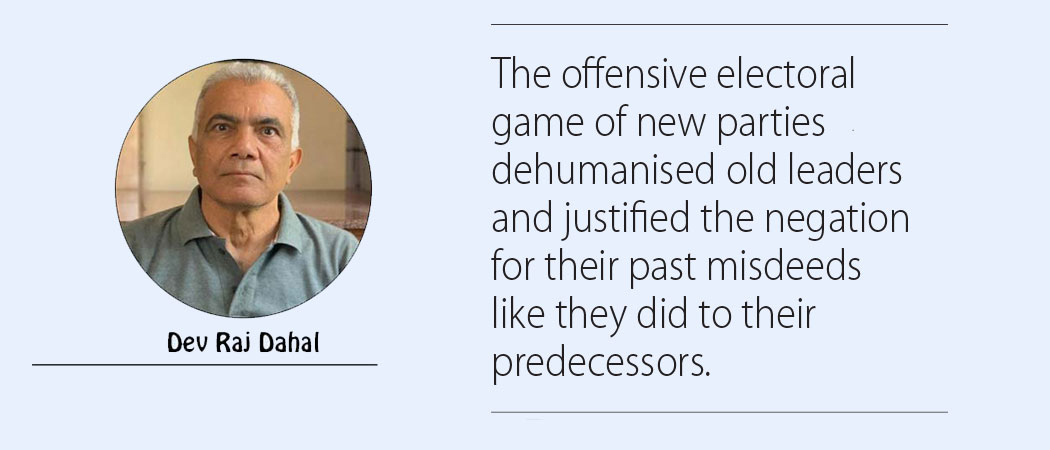
To drain the swamp of corruption and network politics of patronage stomached by personal, familial and business connections that raised the question of legitimacy of leaders and threatened the liberal spirit of democracy, the government is executing constitutional obligations and electoral pledges. The emergence of new parties like RSP and Shram Sanskiriti Party marked the transformational delegitimisation of the old establishment, breaking its syndicate to prevent the circulation of new elites in power. The offensive electoral game of new parties dehumanised old leaders and justified the negation for their past misdeeds like they did to their predecessors.
They also delegitimise the revolutionary violence, rise of neo-liberals and tribal formation of parties without the semblance of inner-party democracy and a culture of the formation of national communities where diverse Nepali society can walk along. The constant vigilance of the government by media, elites and oppositional leaders is likely to produce common cause to promote public and national interests while preventing authoritarian tendencies through deliberative politics and beating the reaction of reforms and reason devoid of wisdom. It is important to earn the esteem of others in national initiatives and muster international cooperation.
Extraordinary resilience
The extraordinary resilience of Nepal’s political culture of revenge and self-elevation is a Herculean task to break unless systemic reforms are introduced, institutional stability is acquired and rules are reinforced. This can overcome short-term political opportunism and long-term trust in leadership imperatives. Nepali democracy can grow if its political culture is uniquely democratic not a replica of transnational sub-culture. The system for long suffered from the rationality crisis even hobbling its national identity of a peaceful nation. Nepali people often loathe externally-driven regime change strategy. The new government’s strategy to break the tradition of continuous dominance of parties in education, health, economy, public administration, constitutional authorities and life-time leadership are greeted with disgust in the parliamentary election.
Democracy requires offering leadership an exit strategy when it is no longer functional, overcoming Nepali polity’s democratic imperfection and opening the social mobility of the poor in the governing process to make them stakeholders and enthusing in then a sense of national identity. Friedrcih Nietzsche is right when he suggests making the powerful leaders responsible for the effects of their deed, then for their actions, then for their motives and finally for their nature. This can improve the performance of democracy as per its intrinsic values and ideals and negotiate the conditions of modern national identity of inclusiveness. The link among shared aspirations of Nepalis, democracy and national identity is cheery and mutually embellishing to whet resilient traits.
(Former Reader at the Department of Political Science, TU, Dahal writes on political and social issues.)