- Sunday, 7 June 2026

The Mother Of 1084

He came across me at a film festival held in Kathmandu some fifteen years ago, gently stroking his bald head that resembled the bare ridge of a naked hill. "What do your films contain?" I had asked, somewhat naively, when I found the diabolically marvellous Indian director Govind Nihalani heading to the washroom at the Tourism Board. Contrary to my expectations, he stopped and took the question with remarkable seriousness. "My films carry a stance," he said. "You accept it or reject it, but they will never allow you to remain indifferent." After watching '1084 Ki Maa' directed by him at the women-centred film festival organised by the Indian Embassy, his words felt profoundly true to me.
Since then, I have watched this film repeatedly as one of my favourites. 'Favourite' and 'great' are not always the same. A favourite is something one can feel an intimate connection with, whereas greatness does not necessarily evoke such closeness. But Nihalani’s films, for me, embody both greatness and intimacy. Apart from '1084 Ki Maa', his films 'Aakrosh', 'Ardh Satya' and 'Party' are such works that arouse anyone sensitive to the question of justice. In 'Aakrosh', the protagonist, performed by veteran Indian actor Om Puri, does not utter a single word throughout the film, yet in the end his rage challenges the entire social order. In 'Ardh Satya', the deeply moving story of how the system renders a righteous man helpless shakes one to the core. Likewise, in 'Party', a film based on a play of the same title by Federico Garcia Lorka, he reveals the untold hypocrisy of high-class people.
Poignant intensity
A five-time winner of both the Indian National Film Award and the Filmfare Award, Nihalani is considered exceptionally skilled at adapting literary works into cinema. Based on a novel by the Magsaysay Award-winning Bengali writer Mahasweta Devi, '1084 Ki Maa' narrates the awakening of a mother's sense of justice after her son is killed, set against the backdrop of the Naxalite movement that began in 1967 in West Bengal. Nihalani invigorated Mahasweta's powerful novel, which masterfully captures the local realities of oppressed communities.
The film's flashback structure unties the story with poignant intensity. Only after her son is killed on his birthday does the mother, Sujata Chatterjee, realise that he had devoted himself to a revolutionary struggle to establish a fair state for the poor. His corpse, kept at the police station, is identified merely by the number 1084.
Betrayed by his father's infidelity and surrounded by a decaying aristocratic tradition embodied by his siblings, Brati Chatterjee felt deep disdain for his family. They were slaves to hollow customs. Brati loved his mother dearly, which is why he had not left home.
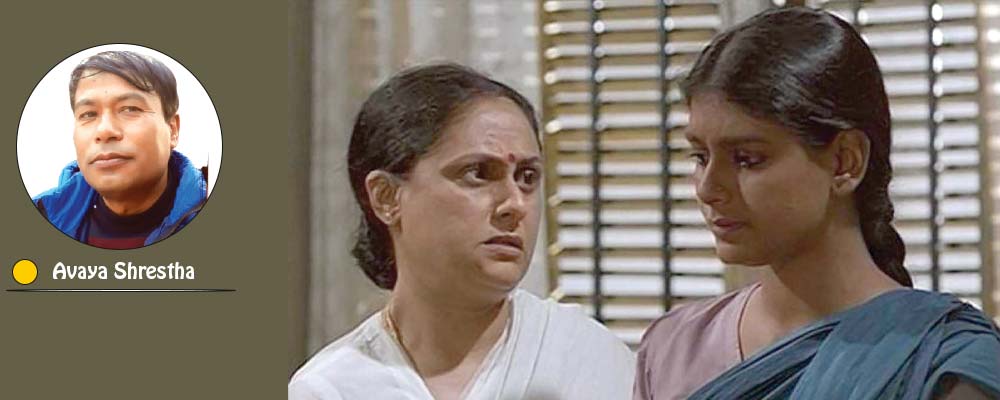
When Sujata meets her son's girlfriend Nandini and the mothers of his slain comrades Laltu and Somu, she realises that she herself had been a prisoner of so-called domestic ideals. Nandini, blinded by police torture, remains unwaveringly committed to resisting the oppressive system. This encounter shatters the narrow, self-centred walls of Sujata’s world.
One of the most powerful moments in the film occurs when an extravagant ceremony for her daughter's marriage is underway at home, while within Sujata another war is raging against this hypocrisy. Did Brati Chatarjee sacrifice himself for the comfort of such lazy, selfish, and corrupt people? No. Not at all. He had fought for a just society for the poor. Struggling with this inner conflict, the mother collapses unconscious. Every time I watch this scene, my consciousness bashes me, my breath feels suspended, and I am stunned with emotion. At this point, I remember the subversive lines from the poem 'A Song to Men of England' by English poet Percy Bysshe Shelley, which reads:
Sow seed—but let no tyrant reap:
Find wealth—let no imposter heap.
Weave robes—let not the idle wear:
Forge arms—in your defence to bear.
Those who tolerate injustice tolerate it only up to a point. Within them, a volcano is always simmering. When the system lays itself bare and begins to crush them relentlessly, that volcano inevitably erupts. Sometimes it manifests as class struggle, sometimes as a battle for self-respect. A consciousness of justice makes a person fearless and mentally strong. In Nihalani's film, Sujata Chatterjee gradually becomes active in the pursuit of social justice. Inspired by her son’s sacrifice and Nandini's companionship, she bravely captures a fleeing criminal, who has murdered a political activist named Nitu, even at the risk of her own life. Sujata's undying love for her son and his comrades converts into the love for the struggle they did. This stirring scene awakens the dormant sense of justice in the audience. Twenty-three years after her son's death, Sujata meets Nandini again. Having chosen not to marry, Nandini has made the struggle for justice her life-partner. Most significantly, Sujata's once-cruel husband also begins to support her fight for social justice.
Beyond praise
Having begun his career as a cinematographer, Nihalani’s visual storytelling is both striking and emotionally resonant. His style, where the camera unfolds alongside the narrative, adds to the film's appeal.
The performances of Jaya Bachchan as the mother, Nandita Das as Nandini, and Seema Biswas as Somu's poor mother are deeply
moving and beyond praise. Critics have included this film among the essential must-watch Indian cinemas.
Nihalani does not consider this a 'communist film'. He thinks that the Naxalite movement is merely a medium for the mother's social awakening. Nevertheless, it is undeniably a film that evokes sympathy for the struggle for justice. His films do not belong to the category that ends everything when we leave the theatre. Their impact begins after we leave the theatre itself. They unsettle, provoke, and compel the audience to confront society with countless questions that strengthen moral conviction and urge one forward.
More than physical violence, his films portray psychological violence. His characters carry a burning fire within themselves. In truth, Nihalani's characters represent not only the oppressed of India but also those of our own society, the marginalised, the suppressed, and the silenced. Whether it is Brati Chatterjee or Nandini, a justice-seeking police officer oppressed by the system, or an innocent tribal prisoner, his characters do not merely confront us with harsh truths, they inspire us to continue the struggle.
(Litterateur Shrestha is a cinephile and can be reached at avaya.writes@gmail.com.)