- Sunday, 7 June 2026

An Artist’s Home Bond
Often after one crosses lands, oceans and continents, the homeland becomes a beacon of light brimming with memories and nostalgia. One may part from home, but it still remains inherently within oneself. Unsurprisingly, little moments in a foreign land lead to reminders of home, whether it is the aroma of spices, splashes of rain under a building awning, a call from a childhood friend or even a sprawling sense of losing one’s footing between the liminality of two worlds. Creative people such as artists feel it most strongly. And they particularly find themselves returning to the symbolic motifs of their homeland as their calling.
Akanshya Upadhyay is one such artist who feels herself pulled increasingly towards her Nepali roots. An award-winning artist and multidisciplinary designer from Kathmandu, she is currently based in Washington, DC, USA. It has been a rewarding creative journey for her from Kathmandu to Baltimore, where she received her BFA in Graphic Design, and to DC, where her work is driven by infinite curiosity.
She truly believes that the visual world is one of the most powerful tools that shape how people connect with themselves and each other. Apart from visual arts, she is also entrenched in print projects.
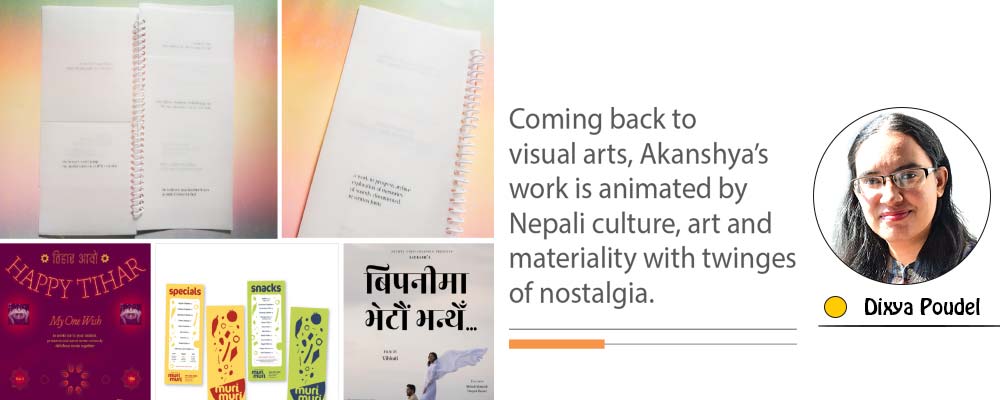
An example of her work is a project called 'The Sound Of'. An ongoing print project, it is built around a simple idea: what if you archived sound solely in words? It is a personal project for Akanshya, as it is tied to her memories of sound from different stages of her life. Instead of sound, it is printed on translucent vellum, the material itself becoming a part of the meaning. It is less a document than an act of remembering out loud and preserving not just the memories themselves, but also the feeling of nostalgia that surrounds them.
Coming back to visual arts, Akanshya’s work is animated by Nepali culture, art and materiality with twinges of nostalgia. Recalling her memories of munching on chatpate, the beloved Nepali street snack, she has created a branding project with the concept of a fictional restaurant that she calls Muri Muri, a nod to Nepali cuisine. She fondly recalls her teenage memory when she used to walk the streets of Kathmandu with her friends.
They would exchange gossip with talk of future ambitions. Years later and miles away, now they are beloved memories for Akanshya. Sometimes such memories come to her so vividly that it saddens her to live so far away from her friends and family, which is why she finds her way back to them through various passion projects.
Akanshya has even ventured into music videos. For example, she has collaborated in Bipani Ma Bhetau Bhanthe, a Nepali music video produced with the support of a close-knit Nepali diaspora. For this project, she led and designed the visual identity from promotional materials to title graphics. However, apart from such high-profile work, she has also worked on small and personal projects. She regularly designs festival invites for cultural and religious occasions for the Nepali community. Tihar and Dashain are among the favourite festivals for Nepalis during which various deities are worshipped and unique traditions are performed. Being so far away from family has heightened Akanshya’s childhood memories of such festivals, which include playing swings, worshipping deities, playing cards and especially putting on tikas and exchanging gifts. While she struggles with sadness and homesickness, especially on festival occasions, she channels her feelings into art, reaching across her Nepali community. She understands that her identity is tied to Nepal not only as a practitioner of art but also as someone who remembers what it felt like to be starting out. Thus, she mentors emerging designers and students through AIGA (American Institute of Graphic Arts) and educational institutes.
Nostalgia is often bittersweet, leading to reminiscences of the past. One cannot turn back the past, but one can pay homage to the memories. Most Nepali students aspire to shift abroad for higher education but, upon migrating, find that amid the academic rigour and challenges, memories of home become a source of comfort. They find that while living abroad has its charms, there is no place like home. Nostalgia then morphs from a feeling to a state of mind. And ultimately, memories of Nepal become an indelible part of Nepali identity as Akanshya has discovered for herself. As it happens, she is a representative of countless Nepali youths rediscovering their roots in foreign lands.
Art is not just about self-expression; it is also about a reflection of one’s national, traditional and cultural identity, very often elevating the personal into a creative outlet. Artists abroad occasionally find themselves reminiscing about their homeland and its heritage, both to create and to sustain. In reverence to their home that is now thousands of miles away, Nepali artists turn to art to fulfil their deep sense of connection, culture and identity. As such, moving across seas does not mean giving up identity but reconsolidating it with even greater creativity and fortitude.
(Poudel is a freelance writer from Kathmandu, pursuing MA in English Literature.)