- Sunday, 7 June 2026

Gold’s False Shine Traps Nepal

Think of a wild thing that happened in the closing days of British rule in India, as told in colonial stories that scared Europeans. When rioters broke into the homes of British diplomats who were departing, they ignored diamonds, emeralds, Burmese rubies, and Kashmir sapphires—stones that would sell for millions at London auctions—and went straight for the gold. This astonished people in the colonies because gold was common compared to those lovely, exotic choices. But to the robbers, gold was everything. They could carry it, split it up, melt it down, and trust it across generations and countries. People in postcolonial times still remember that event, which illustrates something about the Indian subcontinent that is at the heart of Nepal's current controversy over cabinet ministers' self-declaration.
This doesn't mean that it's bad or dumb to own gold. People in Nepal have traditionally thought that gold is a good method to save money. This is especially true for folks who are having problems with inflation, unstable politics, and access to banks. In the past ten years, the price of gold has steadily gone up from Rs. 50,000 per tola to more than Rs. 300,000 presently. This is not like stocks that go up and down a lot or homes that lose value. In our society, it's okay for pastors to say that gold is a family heirloom, a dowry, or an inheritance. I don’t want to point fingers at anyone or any organisation. I just want to know what this worldwide thirst for gold means.
This obsession isn’t just a cultural oddity. It is a deep sign of historical pain and present insecurity. The present argument about tolas and sovereigns that is dominating Nepal’s public discourse is not just because the rich are jealous. It is a big case of cultural myopia. Gold is not the most valuable thing. In fact, it is not even close. Rhodium, platinum, palladium, and iridium are rare metals that are sometimes 2–3 times the price of gold per ounce. They power cutting-edge fields like quantum computing, hydrogen fuel cells, and catalytic converters. Connoisseurs in Geneva and New York will pay $1 million per carat for perfect Colombian emeralds, blue sapphires from Sri Lanka, or pigeon-blood Burmese rubies. Americans and Europeans don’t hoard gold like it’s a national obsession. They buy it for its industrial uses, its rarity, or as a way to make money. Gold? It's become more open to everyone through ETFs and central banks.
But we're still fascinated by Nepal and all around South Asia. Ministers say they have huge amounts of gold and silver—hundreds of tolas in family vaults—causing anger not over policy stalemate but over dazzling metals. This is a complete waste of everyone's time and energy. While we bicker about gold’s gleam, real crises fester untreated. These include youth unemployment hovering at 20 per cent, agricultural collapse driving farmers to despair, hydropower projects mired in Rs. 50 billion losses at the Nepal Electricity Authority, and brain drain emptying universities for Gulf remittances. Gold won't make the Pokhara-Butwal highway, give electricity to distant Karnali villages, or create 500,000 industrial jobs. When we need factories, vocational training, and accountable government, focusing on useless symbols instead of national progress is a waste of time. It's like arguing over a family's silver spoon while the kitchen burns and children starve.
This mentality signifies deeper futility on the world arena. South Asia's gold infatuation—rooted in Vedic texts where gold symbolises divine purity (Surya metal), Mughal dowry rituals, and British colonial extraction (estimated drain of 45 trillion dollars from India alone)—keeps us anchored in pre-modern survival habits. Gold serves as a hedge against the inflation that ravaged Nepal during 2015 blockades (when families melted heirlooms for rice), weak commercial banks haunted by political interference, and regime instability from palace massacres to federalist gridlock. Families pass mangalsutras and sovereigns to daughters as portable inheritance; politicians flaunt vaults as proof of "honest success". But globally, it marks backwardness. Advanced economies trust abstract systems like Silicon Valley venture capital, German precision engineering patents, and Singapore’s sovereign wealth funds. They chase innovation such as semiconductors, AI, and green hydrogen instead of bullion vaults. Nepal's elite clutching gold while youth queue for Qatar visas? It screams insecurity, not sophistication.
Do you remember Nepal's own past? During the Maoist insurgency in the late 1990s, gold smuggling grew as families hid their money from both insurgents and royals. After the peace deal in 2006, politicians' families inexplicably got more tolas through "reconstruction" contracts. Gold prices shot up after the 2015 earthquake because billions of dollars from donors went into projects that never happened. Ministers who declare gold today send the same message: “We’ve got ours, you figure out the rest. This isn’t cultural pride. It’s desperation disguised as tradition. In a poor country, such wealth shows that privilege is inherited rather than earned, that things are hidden rather than clear, and that public dollars are used for private vaults instead of public goods.
The ministers' statements make this trap a lot worse. Gold says that power becomes ownership. Owning things is useless. It is like carrying around dead weight in a world that is always changing. It keeps inequality going, builds no factories, and makes fun of the millions of people who want just one bangle while ministers focus on their family legacies. Europe didn't get affluent during the Renaissance by keeping gold. They developed banks, joint-stock businesses, and a legal framework that keeps paper money safe instead. The United States runs the world on phoney empires like Hollywood IP, Big Tech platforms, and military-industrial complexes. People in our area have loved gold for hundreds of years, from Timur's sack of Delhi to the British conquest of the Koh-i-Noor.
This argument shows that bigger postcolonial problems are still around. It shifts focus from skill to possessions, allowing leaders to claim "cultural" justifications to avoid responsibility. They say it's tradition, as if being greedy is okay since it's been done before, even when 25 per cent of young people are out of work. Meanwhile, important problems are being ignored. These include the constitutional paralysis of federalism, the never-ending delays of the Melamchi water project, the lack of infrastructure in Pokhara for tourism, and tomato and other fruit and vegetable growers throwing away their crops as imports flood the marketplace. It's self-sabotage for a country to worry about gold. While we waste time arguing over trinkets, countries like Vietnam are building export empires and Bangladesh is starting clothing revolutions.
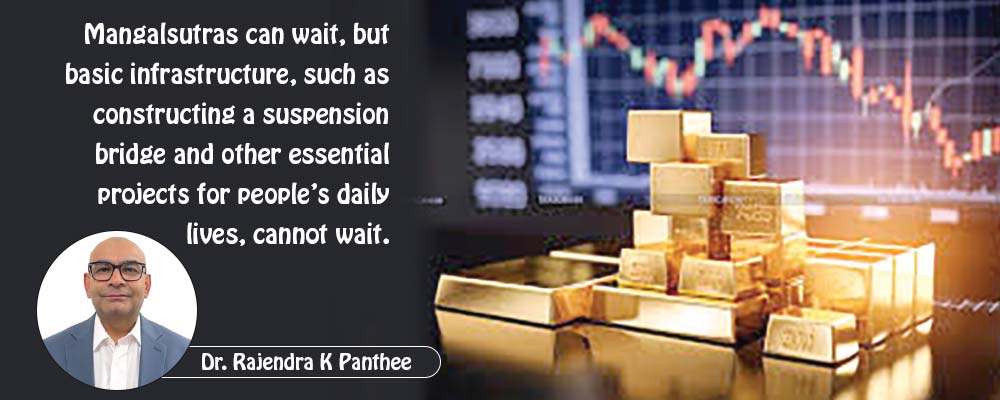
Nepal needs to stop thinking like this. Leaders, sell gold to sovereign development funds and use the money to build IT parks in Lalitpur and agro-processing plants in Chitwan. People ask for content instead of symbols. They say check the tolas, but make sure the policy comes first. Use supply chains instead of gold chains. Mangalsutras can wait, but basic infrastructure, such as constructing a suspension bridge and other essential projects for people’s daily lives, cannot wait. Our love of gold makes us look like relics—useless hoarders who hold on to things from the past while opportunities for the future pass us by. Not vaults, but real riches make countries strong. Let’s not just burn the metal. Let’s also change the way people think. Nepal should trust its people more than its riches in the future.
(The author is an associate teaching professor in the Department of Writing Studies, Rhetoric and Composition at Syracuse University, New York, US.)