- Sunday, 7 June 2026

Chulika Tradition At Bhimeshwar Temple

There are many temples of Mahadev across Nepal, but the temple of Bhimeshwar stands uniquely in Dolakha town. Historians place its origin in the early Lichchhavi period, when Dolakha served as a bustling commercial hub. According to “Nepal Desh Ko Itihas", King Mandev, while enshrining deities in Kantipur, invoked Bhimsen from Dolakha and established him west of Pashupatinath. A small mace preserved in the temple treasure bears the inscription Nepal Sambat 64 (1001 B.S.), making it about 1081 years old (Y. K. Pradhan, Cultural Heritage of Dolakha).
Foreign scholars such as Sylvain Lévi, Hamilton, and Mary Slusser note that Bhimsen from Dolakha was believed to have come to enjoy boating when the Kathmandu Valley lay as a lake. A copperplate dated 730 N.S. (1667 B.S.) describes Dolakha as a famed town where the greatly brilliant Bhimsen was established “like a real Indrapuri” (Historical Outline of Dolakha), reinforcing the view that the Bhimeshwar temple ranks among Nepal’s oldest.
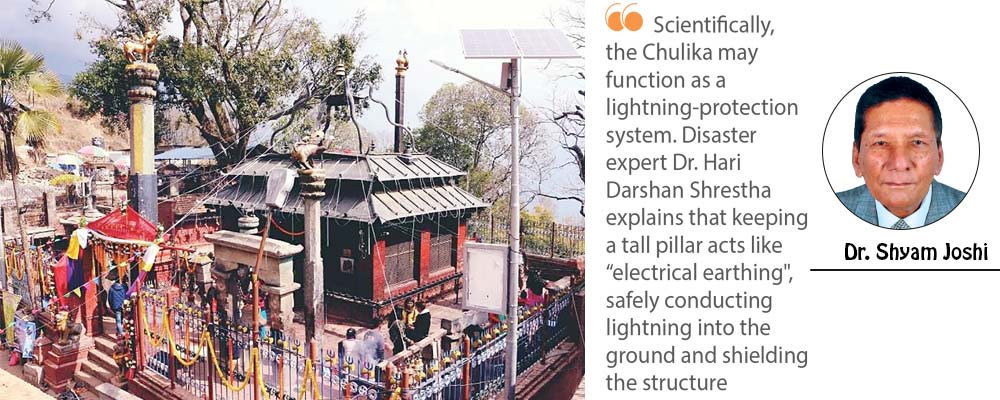
The Chulika of Bhimeshwar, locally known as “Chulkapsi” (the wood of Chulika), stands outside the temple wall just behind the idol. Revered as “Chudamani”—a precious head‑ornament—this pillar is installed or replaced according to strict ritual. Its total length is five cubits buried underground and 16 cubits visible above ground, crowned by a bronze statue of Mahadev. A red and white Tul (sacred cloth) stretches from the temple to the top of the Chulika, symbolically linking the deity and the pillar.
Four copperplates from the temple treasure record the Chulika’s history. The first, dated 774 N.S. (1711 B.S.), notes that during the reign of Shri 2, Pratap Malla Dev, the Chulika Lingo was installed for Shree 3, Bhimsen, in his Vijayarajya by the Pradhans Bharos and Panch Pradhans of Dolakha. Since no earlier inscriptions mention a Chulika, this appears to be the first installation. The plate also prescribes the ritual: the lingo buried five cubits deep and 16 cubits above ground, special lights (Chakmat) lit the night before the tree’s felling, goat sacrifices, a yagya on the day of installation, more goats where the tree halts overnight, and a pair of buffaloes along with worship of all deities on the following day. Later re‑installations followed the same pattern.
Subsequent copperplates show the pillar’s continuity. The second, of 836 N.S. (1773 B.S.), records that after 62 years Pradhan Bharos and a group of Panch Pradhans re-established the Chulika for Shree 3 Bhimsen under Shri Shri Mahendra Singh Dev. The third, of 889 N.S. (1826 B.S.), notes the pillar of Shri 5 Bhimeshwar erected 53 years later during the reign of Shri 3 Maharajadhiraj Prithvi Narayan Shahdev, again by local Pradhans and Panchas. The fourth, dated 965 N.S. (1893 B.S.), describes the renovation and re-establishment of the Chulika under Shri 3 Maharaj Rajendra Bikram Shah, with Dware Ratnamani, Trustee Dhanman of Dolakha, and several local leaders named as donors. All four plates express the donors’ hope that their offspring and wealth will increase and their wishes be fulfilled.
According to Y. K. Pradhan, the Chulika was replaced again in 2009 B.S., after 116 years as per available records. On Chaitra 20, 2070 B.S., it collapsed in a storm, and on Chaitra 25, 2070 B.S., a new Chulika was raised with the help of trustees and the local community. Tradition holds that animal sacrifices should not resume until the Chulika is properly re‑installed, underscoring its ritual centrality.
Spiritually, the Chulika is believed to channel Bhimeshwar’s divine presence. The temple hosts Rudri to Bhimsen, regarded as “Ishwar” (Mahadev), along with buffalo sacrifices and Pancha Bali. At the time of buffalo sacrifice, the idol is wrapped in a red and white Tul tied to the Chulika, and legend holds that Bhimeshwar’s divinity temporarily transfers to the pillar (Historical Outline of Dolakha). The cloth shield keeps blood from falling on the idol; only after the buffalo is sacrificed and the deity is bathed in milk, ghee, honey, and water in which Rudri is performed. The tall Chulika also enhances the temple’s visual grandeur, visible from afar.
Historically, the Chulika copperplates map Dolakha’s status. The town is styled as a “Pattan” and "Mahapattan", reflecting its prosperity.
Though the inscriptions name reigning monarchs, the actual re-installations are credited to local Panch Pradhans, Bharos, trustees, and Tharis. Dolakha’s designation as a “Vijayarajya” in plates from Pratap Malla and Mahendra Singh’s time suggests these rulers had conquered an earlier independent state. The shift from “Shree 3 Bhimsen” in the first two plates to “Shree 5 Bhimsen” in the later ones, alongside Prithvi Narayan Shah’s own title of Shree 3, indicates that he elevated Bhimeshwar’s status after integrating Dolakha into his realm. Earlier rulers styled themselves Shree 2 and addressed Bhimeshwar as Shree 3, a pattern repeated by all donors to the temple.
The 1893 B.S. plate adds a personal history: it names Dhanman, trustee of Bhimeshwar, whose military record shows that Major Dhanman Joshi of Dolakha reached Kumaon/Garhwal while serving in the Nepal Army under Maharaj Rajendra Bikram Shah (1873–1904 B.S.). The inscription confirms his rank of major and highlights that he was the only person from Dolakha to attain such a high position at that time. Dhanman descended from Jaya Krishna Upadhyaya, a royal priest brought from Kashi (Varanasi) in 1680 B.S., underscoring centuries‑long ties between Dolakha’s religious and political elites.
Scientifically, the Chulika may function as a lightning‑protection system. Disaster expert Dr. Hari Darshan Shrestha explains that keeping a tall pillar acts like “electrical earthing", safely conducting lightning into the ground and shielding the structure. Standard electrical earthing prevents structural damage, fire, equipment loss, and life‑threatening shocks by dispersing excess energy through the earth. Up to now, the Bhimeshwar temple has not been harmed by lightning. Similarly, the major earthquakes of 1990 B.S. and 2072 B.S. did not cause any damage to the temple.
(Dr. Shyam Joshi, a professor of business economics, writes on economic and cultural topics.)