- Monday, 8 June 2026

Turning Sweat Into Infrastructure

About two thousand young Nepali men and women leave the country every day to seek employment in the Gulf countries, Malaysia, and South Korea. This migration is largely motivated by economic necessity rather than personal choice. These workers are employed in various sectors, including construction, manufacturing, service and technology, and they remit earnings to their families.
In the fiscal year 2023/24, Nepal received approximately US$11 billion in remittances, accounting for over a quarter of the national Gross Domestic Product (GDP). These remittances represent the labour and sacrifices of 3.5 million Nepalis, and are essential for the country's economic stability. A Nepali worker overseas earns between US$500 and $1,000 per month and remits as much as they can to Nepal.
Nepal's imports totalled US$15.8 billion in 2023/24, while exports generated only $3.35 billion. In the absence of remittances, the balance of payments would become unsustainable, leading to significant economic challenges. Remittances are therefore critical not only for household consumption but also for national financial stability. Nepal's remittances are not merely a safety net. They are the very foundation upon which the entire economy stands – supported entirely by those who have left.
Nepali migrant workers remitted a US$ 44.1 billion from 2020 to 2024. For every dollar Nepal earns by exporting goods, it receives $3.28 in remittances. However, 78 per cent of all remittances are used for immediate consumption, including food, rent, medical expenses, school fees, and other household costs. Only 22 per cent is saved, and a negligible portion is invested in productive assets that could mitigate the need for future migration. In fiscal year 2023/2024, Nepal's trade deficit reached $12.45 billion, with remittances covering 88.4 per cent of this gap. Without the contributions of migrant workers, Nepal would face an immediate foreign-exchange crisis.
Establishing NRII
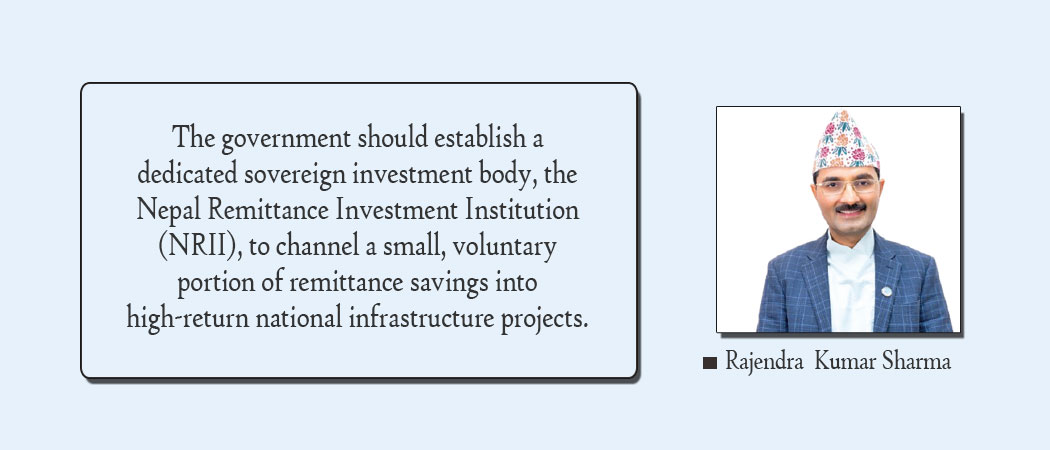
Amidst this scenario, the government should establish a dedicated sovereign investment body, the Nepal Remittance Investment Institution (NRII), to channel a small, voluntary portion of remittance savings into high-return national infrastructure projects, beginning with hydropower. The government bears a moral, economic, and generational responsibility to provide 3.5 million migrant workers with an investment platform that reflects the significance of their contributions. Since no such institution exists for now, the NRII is intended to fulfil this gap.
The calculations are both straightforward and conservative. If accessible investment products enable Nepal to reduce remittance-based consumption by 5 per cent, a substantial capital accumulation could be achieved by redirecting this portion from daily expenditures to long-term investment bonds.
Participation in this initiative will be entirely voluntary and will not constitute a form of taxation. The investment products are designed to offer returns that are competitive with informal savings options commonly used by migrant families. Compelling incentives are expected to encourage investment in Nepal. Assuming a 10 per cent annual growth rate in remittances, Nepal could accumulate approximately US$ 2.84 billion or so in investible capital over the next five years. This represents sovereign wealth generated domestically, independent of debt or foreign aid.
This vision has received powerful validation from the newly formed government. On 14 April 2026, Prime Minister Balendra Shah’s administration announced plans to issue an annual Rs. 100 billion diaspora investment bond as part of its “National Commitment” to mobilise Non-Resident Nepali capital into infrastructure, hydropower, and export-oriented industries. The initiative, which includes enhanced citizenship, property, and voting rights for the diaspora, demonstrates that policymakers are finally recognising the transformative potential of overseas savings. A dedicated Nepal Remittance Investment Institution would perfectly complement this national effort by offering accessible, voluntary remittance-linked products specifically tailored for the millions of migrant workers who form the backbone of Nepal’s remittance economy.
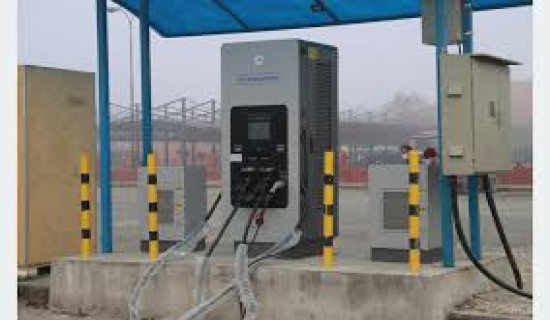
With an estimated potential of 83,000 MW, Nepal ranks among the world's leading water-energy nations; however, less than 4 per cent of this potential has been realised. At an average construction cost of US$3 million per Megawatt for Nepali hydropower projects, the $2.84 billion accumulated by the NRII over five years can finance hydropower projects of approximately 947 megawatts. It will help electrify households, support industrial operations, and substitute for petroleum imports. Analysis indicates that Nepal could feasibly reduce its fuel import bill by 30 to 40 per cent through the electrification of the transport sector. The adoption of electric vehicles to replace petrol and diesel, the use of induction cooking to substitute LPG, and the electrification of small industries all contribute to this transition.
Operation of NRII
While the concept is novel for Nepal, similar initiatives have been implemented elsewhere. India's 'Remittance Bonds' for its diaspora, Mexico's '3-for-1' programme that matches migrant investment with government funds, and the Philippines' Overseas Filipino Worker (OFW) investment frameworks all demonstrate the effectiveness of remittance-linked investment when supported by appropriate government structures. The NRII is designed as a straightforward financial instrument. Migrant workers or their families in Nepal can purchase NRII bonds in small denominations as low as Rs. 5,000 through mobile banking, local banks, or post offices. Bonds offer guaranteed returns above savings account rates and will be fully backed by the government, as proposed.
Funds are pooled by the NRII and deployed into pre-screened, high-feasibility hydropower projects, prioritising run-of-river projects with clear environmental approval, local community benefit, and export potential to India and Bangladesh. Migrant workers who invest thereby become stakeholders in Nepal's energy sector, with their remittances contributing to national wealth while generating financial returns. The NRII operates under an independent board with representation from Nepal Rastra Bank, the Finance Ministry, private-sector experts, and, importantly, elected representatives of migrant worker communities.
Nepal's continued dependence on remittances is unsustainable. Policymakers should recognise that global labour markets are evolving, with Gulf countries diversifying their economies and likely to reduce demand for low-skilled migrant labour. Additionally, climate change and potential disruptions such as pandemics or geopolitical crises could significantly impact remittance flows, posing risks to Nepal's balance of payments.
(Sharma is former President of the NRNA-ICC.)

-square-thumb.jpg)