- Sunday, 26 April 2026

Sudurpashchim hydropower potential largely untapped despite huge capacity
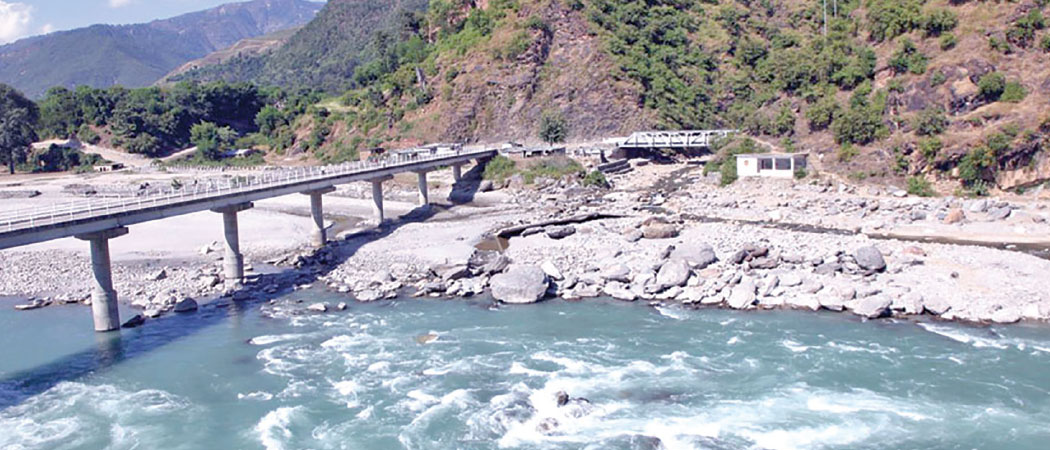
Photo: TRN Proposed site of West Seti hydropower project with 750MW potential.

By A Staff Reporter,Kathmandu, Apr. 26: Sudurpashchim Province, home to Nepal’s three major river basins—Mahakali, Seti, and Karnali—has utilised less than 1 per cent of its vast hydropower potential, raising concerns among government, investors and policymakers.
Speaking at an interaction programme titled “Possibilities and Challenges of Hydropower Project Development in Sudurpashchim” held in Kathmandu recently, Ganesh Karki, President of the Independent Power Producers’ Association, Nepal (IPPAN), highlighted the stark gap between potential and production.
"Sudurpashchim has the capacity to generate at least 18,149 MW of electricity, yet only 176 MW is currently being produced. This reflects serious structural and policy challenges,” Karki said. He noted that the province alone accounts for nearly 20 per cent of Nepal’s preliminary estimated 83,000 MW hydropower potential and holds strategic importance due to its proximity to India, offering a shorter route for electricity exports.
However, inadequate transmission infrastructure and restrictive government policies have hindered progress.
Karki urged the government to extend hydropower project licenses to 50 years, streamline forest clearance procedures, and introduce a one-window system to replace the current process that requires approvals from over 14 ministries and 30 departments.
If such reforms are made, the private sector is ready not only to focus on production but also to explore domestic and international markets for electricity export, he said. IPPAN Senior Vice President Mohan Kumar Dangi echoed similar concerns, stating that only 0.96 per cent of the region’s hydropower potential has been tapped.
“Sudurpashchim is highly promising, especially with cross-border trade opportunities such as selling electricity from Darchula to nearby Dharchula in India,” Dangi said. “But difficult terrain and lack of transmission lines remain major obstacles.”
Nepal’s overall electricity generation capacity has grown significantly—from 250 MW in 2051 B.S. to around 4,100 MW today—largely due to private sector involvement. Dangi said that if the private sector is allowed into transmission and trading as well, it could achieve similar growth in the next decade as it has in production. Presenting a working paper, IPPAN Executive Committee Member Suman Joshi said that 61 projects with a combined capacity of 5,900 MW are in various stages of study in Sudurpashchim Province.
Of these, 11 projects with a capacity of 1,117 MW could immediately move into construction if transmission line assurance is provided. Without transmission infrastructure, she warned, no further projects in the region may be possible for years.
She also highlighted that Bajura has the highest potential (2,188 MW), followed by Bajhang (1,935 MW) and Achham (1,348 MW). Joshi said that the hydropower sector contributes about Rs. 4.5 billion annually in royalties, provides employment to over 350,000 people.
The entrepreneurs have already mobilised Rs. 1.3 trillion in investment where they built 3,700 km of roads nationwide and constructed 160 health centres, 107 drinking water projects.
The hydropower projects constructed 55 irrigation projects, and supported salaries for 250 teachers.
However, she noted that Sudurpashchim Province has not benefited equally from these developments. Lack of basic infrastructure in Sudurpashchim is likely discouraging investors, she added.
Sagar Shrestha, Chief Executive Officer of Rastriya Prasaran Grid Company Limited, said that there is a plan to develop Sudurpashchim as Nepal’s largest electricity hub, but budget constraints are currently hindering transmission line construction.
Two major 400 kV transmission lines are planned—one from Humla to Dodhara in Kailali via Bajhang, and another from West Seti (Bajhang), Doti, and Dadeldhura to Dodhara in Kailali.
Electricity from projects such as Phukot Karnali, Upper Karnali, West Seti, and SR 6 will be integrated at Dodhara and connected to Bareilly, India, through a cross-border transmission line, he said. However, Shrestha said the total investment requirement of around Rs. 130 billion poses a major funding challenge.
Each 400 kV line can transmit about 2,500 MW of electricity. He also informed that 600 MW capacity has already been booked for West Seti at Dodhara.
Former secretary Anup Kumar Upadhyay said that private sector participation is essential not only in generation but also in transmission and power trading. He suggested amending the existing Electricity Act to fully open these sectors to private investors.
He also argued that the government should not insist on holding 51 per cent ownership while limiting the private sector to 49 per cent, and instead allow full private sector participation.
Lawmakers from Sudurpashchim, including Hari Mohan Bhattarai, Janak Raj Giri, and Jagat Joshi, pledged support for policy reforms, emphasising that hydropower development is key to national economic growth.
They also noted that the current government’s goal of producing 30,000 MW within 10 years could be achieved by mobilising both domestic and foreign investment, and that a stable government would help attract foreign investment more easily.