- Monday, 8 June 2026

FNJ, PCN And Press Accreditation

Last week, I visited the Department of Information (DoI) under the Ministry of Information and Communications at Media Village, Kathmandu, to inquire about the process of obtaining a press accreditation (pass) as a freelance journalist. An official informed me that an applicant must possess a Bachelor’s degree in journalism; submit a 300-word essay explaining how they have contributed to the nation; and submit 60 published works produced over a period of 10 consecutive years, with a minimum of six publications per year.
In an era where a journalist can build credibility in months through consistent digital reporting, a 10-year threshold is an exclusionary mechanism. These criteria raise a fundamental question: is journalism in Nepal a state-certified profession, or a constitutionally protected practice? Prima facie, these criteria appear to reflect a regulatory mindset reminiscent of the Panchayat era, when the state exercised tight control over the news media and granted accreditation only after extensive scrutiny.
Unrealistic requirements
In contrast, Nepal regulates other sensitive professions through statutory councils. For instance, medical doctors and health professionals must obtain accreditation from bodies such as the Nepal Medical Council and the Nepal Nursing Council. Lawyers are accredited by the Nepal Bar Council. In all these cases, professionals cannot formally enter the job market without certification from their respective councils. Instead, the state, through the Department of Information, retains the authority to certify journalists.
In practice, working journalists are issued press cards by their respective media institutions. Only in certain sensitive contexts or high-level events does accreditation from the Department of Information remain mandatory. Even then, such accreditation is typically granted upon submission of an official letter from a media organisation. By contrast, the criteria imposed on freelance journalists are not only disproportionately rigorous but also increasingly outdated.
Internationally, two distinct forms of press identification exist. First, media institutions—whether state-owned or private—issue press cards to their journalists. These cards do not license journalism; they merely establish that the holder is engaged in journalistic work. Second, there is accreditation, which is typically granted by governments, parliaments, courts, or event organisers. Accreditation serves a different purpose: it provides access to restricted spaces and is usually issued upon presentation of a valid press card and proof of assignment. Nepal’s current system, however, appears to conflate these two distinct functions.
In Europe and many democratic systems, press cards are issued by independent bodies rather than the state—typically national journalists’ unions or professional federations. Governments do not certify who a journalist is; instead, public authorities grant accreditation separately for specific events or institutions. The underlying principle is clear: the state should not define who qualifies as a journalist. Reflecting this norm, the International Federation of Journalists, of which the FNJ is a member, issues the International Press Card through national journalists’ unions.
Turning to Asia, practices are more varied. In India, the Press Information Bureau provides accreditation primarily for access to government institutions, while press cards are issued by media houses or journalists’ organisations. This reflects a functional distinction between professional identity and institutional access. In Bangladesh, however, the Press Information Department not only issues accreditation but also retains the authority to revoke it, a practice that has drawn concerns about press freedom. These contrasting examples illustrate a broader point: when the state controls accreditation, it risks turning a procedural mechanism into an instrument of control—and, at times, exclusion.
While Nepal’s system shares some similarities with India’s—particularly in the role of state-led accreditation—its centralized nature raises additional concerns. In countries such as Japan and South Korea, and across much of Southeast Asia, press clubs, professional associations, and media organizations play a significant role in issuing press credentials. Accreditation is typically institution-specific—granted by parliaments, police agencies, or event organizers—and there is no single, centralized ‘press pass authority.’ Across much of Asia, accreditation is largely tied to specific events such as conferences, summits, or official briefings.
In Nepal, however, only the DoI issues official press pass, effectively combining three distinct functions: identity, legitimacy, and access. This concentration of authority is unusual when viewed against broader international practice. It reflects a centralized, state-centric model of journalistic recognition that echoes the administrative logic of the Panchayat era.
The FNJ, the Press Council Nepal (PCN), and the DoI, all located within Media Village, have not, to public knowledge, engaged in a sustained institutional dialogue on this question. Neither the FNJ nor the Press Council Nepal, despite being primary stakeholders, appears to have formally pursued a restructuring of the current accreditation regime with the Ministry of Information and Communications. This is striking, given the FNJ’s distinguished history of resisting the autocratic Panchayat system and consistently advocating for press freedom and freedom of expression. Its recent milestone in electing its first female president also reflects an evolving and progressive institutional identity.
Time to reform
Under the leadership of Nirmala Sharma, the FNJ now has an opportunity to advance a substantive institutional reform. A more balanced model would allow the Press Council Nepal to issue professional press credentials—covering both institutional and freelance journalists—based on transparent criteria at the recommendations from the FNJ. The role of the DoI could then be limited to granting accreditation for access to specific state institutions and events. Such a shift would not only align Nepal with broader democratic practice but also strengthen the autonomy and credibility of its media sector.
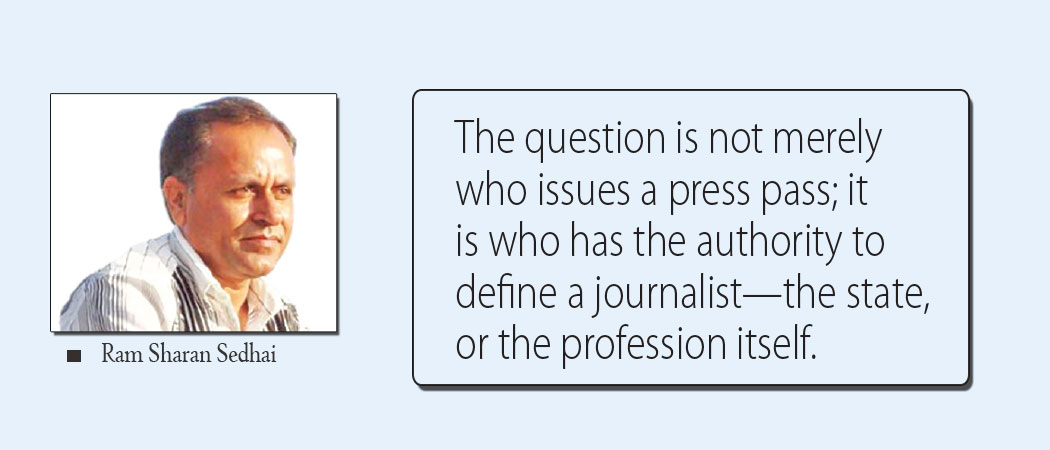
The question is not merely who issues a press pass; it is who has the authority to define a journalist—the state, or the profession itself. Reform is not about dismantling accreditation, but about relocating it: from state control to professional self-regulation, aligned with global democratic practice in the changed context.
(Sedhai is a freelance writer.)