- Saturday, 6 June 2026

Nepal’s Journey Toward Deeper Transformation

These days, being in Nepal feels different. Something is breeding hope, something quietly transformative. Life continues in its familiar rhythm, and personal struggles remain. But when one pauses to observe the national mood, a renewed sense of direction, an emerging belief that perhaps, this time, things may truly begin to change. This shift is not accidental. It follows a political transition: the Gen Z-led protests, the tragic loss of innocent young lives, the toppling of the government, the formation of an interim administration under former Chief Justice Sushila Karki, months of doubt, pain, and the general election bringing Balendra Shah to national leadership after the Rastriya Swatantra Party’s landslide victory in the March elections.
What stands out is not leadership change, but a change in approach. Unlike in the past, when governance often became absorbed by ceremony and symbolism, there is an attempt to prioritise work over optics. The government’s early direction, though still unfolding, signals urgency and intent to address long-standing gaps in governance, the economy, and public service delivery. The tone feels more focused and less performative. For years, many Nepalis had grown accustomed to political inertia. Fragile coalitions, prolonged negotiations, and slow execution steadily weakened public trust. Today, let’s not say that trust has been fully restored, but it is slowly returning.
Wary of vulnerabilities
People are hopeful, though wary of vulnerabilities. There is a clear understanding that governance is complex and mistakes are inevitable. Some decisions may appear rushed, reforms may face resistance, and promises take time to materialise. Yet there is also willingness to observe with patience and allow space for sincere effort. Challenges mount as the transition has not come without friction. As new leadership disrupts established systems, those who once held influence in older networks feel unsettled. This often appears as heightened criticism, where minor missteps are amplified, reflecting change is real enough to be felt.
Yet governance alone cannot carry the full weight of transformation. Policies can be announced, targets set, and intentions communicated, but the measure of change lies in execution, consistency. The risk is that reform remains at the surface and fails to reach deeper structures that require transformation. More importantly, Nepal’s challenges are not only political but deeply social. Caste-based discrimination, despite legal abolition, continues to shape lived realities. Dalits have been denied rooms in Kathmandu, punished for using public taps in towns and villages, and having affairs with so-called higher-caste partners, leading them to custody or jail continue making headlines.
The current government has taken symbolic steps toward acknowledging historical injustice faced by Dalit communities, reflecting willingness to confront the issue openly. But symbolism alone does not dismantle entrenched structures. Next, gender inequality and social hierarchies remain equally vital. Floods of hate speech and patriarchal expression on social media reveal how deeply these patterns persist. They survive not only through systems but through everyday expectations and inherited norms shaping behavior in subtle yet powerful ways.
These are not issues policy or apology alone can resolve. They are sustained across generations through what is accepted as normal, what is left unquestioned, and what is passed on. Cultural conditioning reinforces these patterns, while gaps in education and awareness, especially in marginalised communities, make change even harder. Even when opportunities exist, they are not always equally accessed or fully understood. This is where the real challenge lies. A government, no matter how committed, cannot single-handedly transform society. Structural reform must be accompanied by a shift in social consciousness. Without it, even well-intentioned efforts remain incomplete. The responsibility therefore extends beyond leadership. It rests with citizens, with those who are aware, who question, and who reflect. Change demands participation.
Structural progress
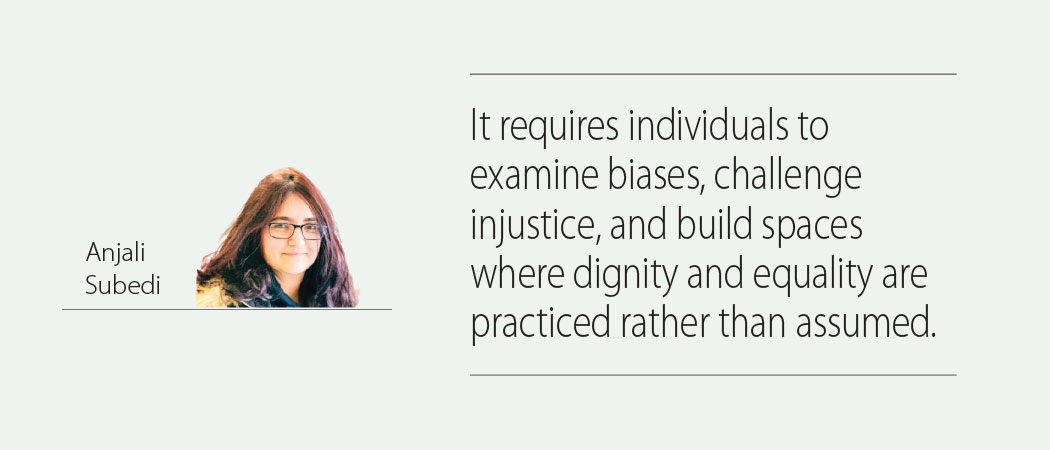
It requires individuals to examine biases, challenge injustice, and build spaces where dignity and equality are practiced rather than assumed. It demands empathy and willingness to recognise justice is not only a principle but a lived practice. At its core, Nepal’s present moment reveals a quiet but important truth: political change is moving faster than social change. If this momentum continues, Nepal has potential for meaningful structural progress. The direction, for now, appears promising.
For progress to become transformative, it must go deeper into homes, schools, workplaces, and communities. It must reshape not only systems but also mindsets. Nepal stands today at a rare intersection where political possibility meets social responsibility. The leadership shall facilitate, and the depth and permanence of change shall be shaped by participation, especially from aware, vocal, educated, reflective sections of society. These groups have a role: observers or critics, but active bridges between policy and society, working alongside government to translate intent into change on the ground. And perhaps, for the first time in a long while, there is not only hope in the air but a growing readiness to act.
(Subedi is a journalist and founder of HappyMe that focuses on healing, emotional well-being and social change.)