- Sunday, 31 May 2026

Honey production high in Mahottari district

BY RABINDRA UPRETI
Bardibas, Apr. 15: Despite unfavourable weather conditions during the peak honey-collection season, honey production in Mahottari district has increased encouragingly this year. Farmers attribute the rise to the abundant flowering of plants during the spring season and a reduction in forest fires.
According to the Navajagaran Beekeepers’ Farmers Group based in Khairenitar, Chitwan, a total of 26,800 kilograms (268 quintals) of honey was harvested from the forest areas of Mahottari during the months of Falgun and Chaitra alone. The wholesale market value of this honey is estimated at around Rs. 16 million.
Leading beekeeper Suresh Basnet stated that this year’s production is significantly higher compared to the past two years. He recalled that due to forest fires, storms, and unfavourable weather conditions, flowering in Mahottari’s forests had been limited, resulting in only 120 quintals of honey production in 2023 and 65 quintals in 2024.
This year’s increase in honey production is largely credited to eucalyptus, locally known as ‘Vicks’ trees. After nearly seven years, these trees have bloomed profusely, making nectar collection easier. According to another beekeeper, Yubaraj Karki, eucalyptus honey does not crystallise easily and is valued for its medicinal properties, leading to high demand and price.
However, weather conditions were not entirely favourable this year. Repeated hailstorms, rainfall, and strong winds during the month of Chaitra disrupted nectar collection by bees. Under normal conditions, honey can be harvested every 11-12 days, but this season, farmers were able to extract honey only twice.
Basnet said that after rainfall, bees are unable to collect nectar for up to two days. Rain washes away the nectar from flowers, while strong winds dry it out. Farmers estimate that if the weather had been more favourable, production could have exceeded 300 quintals.
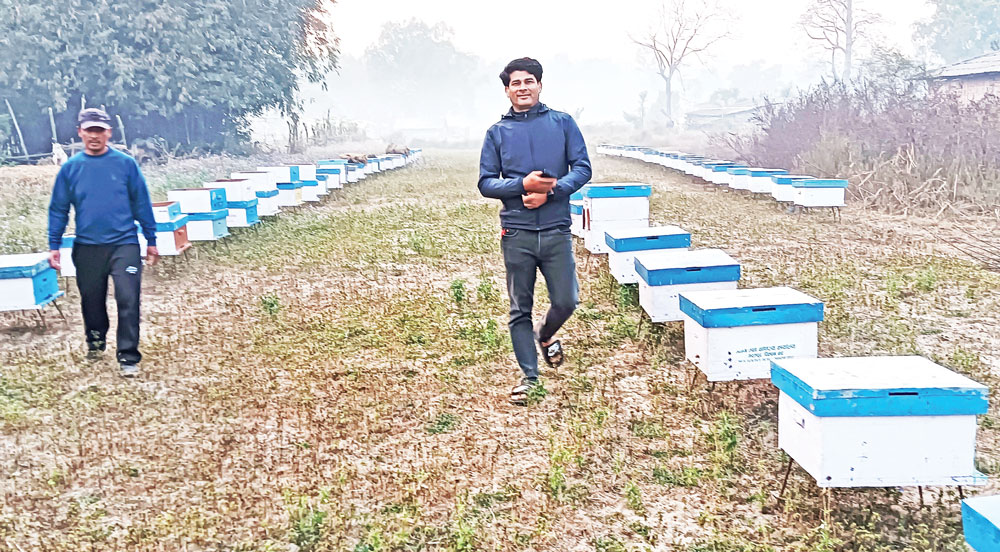
Mahottari’s forests are considered highly suitable for honey production, which has attracted beekeepers from Chitwan since 2007. This year, in February 23, 30 farmers arrived in Mahottari with 2,680 hives of the Apis mellifera species.
The forests of Mahottari provide diverse nectar sources, including eucalyptus, rudilo, jamuno, kyamuno, baji, sal, and sisau trees, along with flowers from litchi and moringa plants in nearby villages. This rich floral diversity has increased the attraction of commercial beekeepers from Chitwan to the region.
Currently, fields, orchards, and forest areas under the Sagarnath Forest Development Project, as well as areas in Bardibas and Gaushala municipalities, are filled with beehives. Key honey collection centres include Buddhachowk and Hattilet in Bardibas, and Ramnagar, Tarechauri, and Laxminiya in Gaushala.
Beekeepers said that the improvement in production compared to previous years had brought renewed enthusiasm to the sector.