- Sunday, 31 May 2026

Science Key To Healthier Society
In human history, the fragility of global health is a matter of concern everywhere. Considering the socio-political and economic context, there is an urgent need for shifts from reflections to actions. Because many low- and middle- income countries are yet to set clear national health priorities, strengthen donor coordination, and evaluate institutional readiness to build collective momentum for health sector reform. On the other side, development partners are not sufficiently addressing health financing needs and supporting locally appropriate financing models that align with national priorities.
This year’s World Health Day, which was celebrated on 7 April, essentially highlights the importance of scientific evidence and collaboration to protect human, animal and environmental health. Such a cross-sector collaboration is extremely helpful in addressing global health challenges and promoting health equity. This day urges key stakeholders in the health sector to effectively engage with evidence-based guidance, rebuild trust in science and facilitate science-led solutions for a healthy and resilient future.
Collaboration
While health concerns all of us, there are tremendous efforts to connect people across sectors and regions to exchange ideas, build networks, and co-create solutions for global health. Shaping a healthier future together is an utmost priority in global health. Strengthening the intersection of health, science and diplomacy is crucial in addressing global health challenges. Through cross-sector collaboration and partnerships, it is easier to mobilise evidence, dialogue and available resources for harnessing equitable and sustainable health systems.
By now, it is crystal clear that where health systems are weak, it is impossible to ensure easy access to basic health care services for those who are socio-politically, economically and culturally marginalised in the communities. In this context, crises spread faster and recovery takes longer. Therefore, it is urgent to strengthen health systems and the capacity of frontline health workers in order to protect and promote people’s right to health.
Capturing the spirit of global community, we are realistically experiencing unprecedented global interconnectedness, health risks, and shifting socio-political and environmental patterns within and across countries. The disease outbreaks, disasters and pandemics such as COVID-19 disrupt health infrastructures, human resources, global supply chains and delivery of essential health services. Understanding health security requires our ability to explore the diverse yet complex interplay between the planet and people. Integrating these insights into existing health policies, strategies and actions is necessary to achieve better health outcomes.
Current health reform initiatives in low-and middle-income countries are sharply constrained by inadequate political leadership, poor health infrastructures in rural areas, limited human resources and fragmented health data ecosystems. Additionally, factors such as poverty, geography, politics, economy, climate change, air pollution and socio-demographics heavily influence health outcomes. Over time, health resilience has been the core agenda of many policy debates and discussions within and across countries. Within health systems, analysis of inclusive federal health governance has mostly drawn attention of policy makers, partners and communities to expand understandings of how notions of health resilience have been or can be reworked and mobilised creatively and collaboratively for ensuring equity, diversity and social justice.
In light of contemporary political, economic and demographic transitions, there are still strong challenges policy makers continue to face in achieving universal health coverage and health-related Sustainable Development Goals (SDGs). Many health policies and strategic actions are focusing on an integrated approach to consider the health of people, animals and ecosystems as they are closely linked and interdependent. Therefore, wider determinants of health are increasing priorities for inclusive and equitable health policies and strategic plans for actions to control diseases, promote health and integrity of our health ecosystems.
More significantly, there are increasing concerns from the governments, civil society, academia, private sector and communities to address pressing health challenges by promoting science-based and interdisciplinary approaches to strengthen resilient and sustainable health systems. The role of digital technologies and integrated data systems is instrumental in transforming health surveillance, reporting and dissemination of the science-based evidence in global health dialogue. Thus, digital transformations help predict disease outbreaks, guide resource allocation and strengthen global health security at large. Apart from this, integrating traditional medicine with modern health care is also a high priority for ensuring holistic and equitable health solutions.
Global efforts
In times of geopolitical tensions, strengthening global efforts has been crucial to accelerate vaccine development and pandemic preparedness. Rooted in the latest science and good practices, these efforts need to drive innovative health solutions. Of course, connecting the scientific community offers enormous opportunities to inform global health priorities and support evidence-based health policy and practice. An enabling policy environment is crucial for communities to share their lived experiences, explore immediate health care priorities and effectively engage with political leaders, policy makers, health care providers, private sectors and other health partners. This eventually can drive progress towards a shared and committed understanding that resilient and sustainable health systems are important in the context of human security, diplomacy and stability.
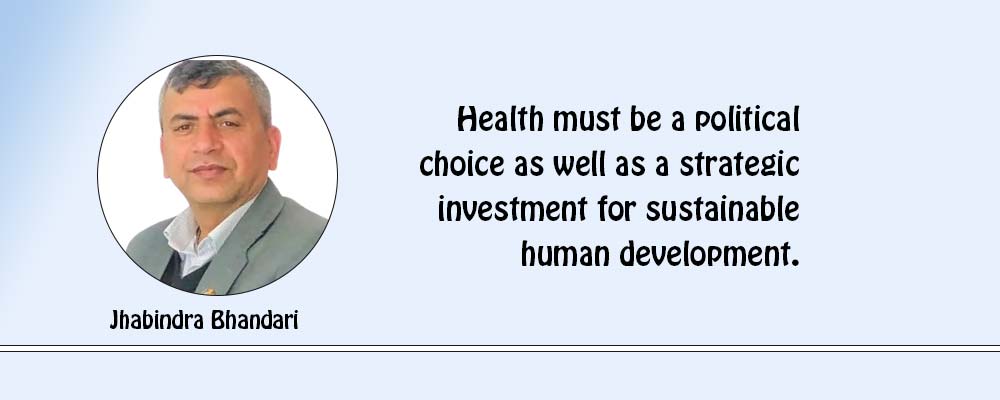
Recent drastic cuts in aid, low- and middle-income countries are seriously facing strong challenges in scaling up cost-effective public health interventions. On the other hand, the domestically-led health financing models are inadequate in most cases as the health economy still looks gloomy. In addition, without peace, health for all is elusive. Conflicts have profound impacts on human health and can undermine advancing health outcomes and strengthening health economies. Therefore, health must be a political choice as well as a strategic investment for sustainable human development.
(Bhandari is a health policy analyst interested in anthropology.)


-original-thumb.jpg)
-square-thumb.jpg)


-original-thumb.jpg)