- Thursday, 30 April 2026

Evident Benefits Of Generic Prescribing

The cost-effective healthcare system depends on rational prescribing, and in recent times, generic prescribing has been promoted as a cornerstone in this endeavour. Generic prescribing is simply prescribing medicines by generic names rather than brand names. In order to improve access, reduce costs, and ensure rational use, the practice of generic prescribing has been strongly promoted by international organisations such as the World Health Organisation (WHO). It has plenty of benefits, but not without limitations and concerns.
The cost of medicine represents a significant portion of health spending throughout the world. In low- and middle-income countries like Nepal, most of the medical costs are out-of-pocket due to inadequate insurance coverage. This leads to poor compliance as patients may not be able to afford to purchase the full course of medications prescribed by the healthcare providers, which leads to treatment failure and, in the case of antibiotics, chances of antibiotic resistance. Therefore, affordability is the main concern in medical treatment.
Patient compliance
Generic prescribing is more affordable in comparison to branded prescriptions. It has been found that branded drugs are often priced higher, mainly due to marketing costs and investment in drug development. Generic medicines are much cheaper in comparison as they do not carry the financial burden of initial drug development and marketing. The cost difference can have a profound effect on compliance and treatment success, particularly in countries where a large proportion of health spending is out-of-pocket.
The second most important benefit is improved access to essential medicines. Generic prescribing gives pharmacists flexibility to dispense available equivalent drugs, which decreases the chances of stock shortages. In rural and resource-poor settings, where branded drugs may not always be available, generic prescribing often helps in patient compliance, decreases the chances of antibiotic resistance, and ultimately leads to treatment success.
Generic prescribing promotes rational use of drugs. Healthcare professionals can focus on their professionalism and pharmacological properties instead of brand recognition, leading to more informed and evidence-based prescribing. The generic prescribing also reduces confusion as numerous brands exist for the same drug in the market.
It has been seen that generic prescribing fosters competition among manufacturers that often drives prices down and makes medications more affordable, particularly in resource-limited countries. The decrease in medication prices benefits patients as well as decreases the financial burden on healthcare systems and insurance programmes. It is important to note that generics should be bioequivalent to their branded products, ensuring strict regulatory standards. The government should invest in bioequivalence testing in government institutions in order to ensure that generics are as effective and safe as brand drugs.
Many developed nations have adopted generic prescribing. However, it has many challenges despite the cost-benefit. One of the main concerns is drug quality. Although generic drugs are required to be bioequivalent to their branded counterparts, in many countries, owing to inadequate regulatory oversight, generics may vary in efficacy and safety, leading to poor treatment outcomes.
Another concern is patient perception and trust. People often think higher cost means higher quality; thus, they believe that branded medicines are superior to generics. This thinking often leads to reluctance in taking generics, resulting in poor compliance. Therefore, it is necessary to educate patients with improved communication by the healthcare providers to overcome this perception.
Generic prescribing allows pharmacists to substitute drugs and can dispense different products by different manufacturers at different times. This can lead to confusion among elderly patients and patients taking multiple medications for multiple ailments. Different manufacturers produce their products in different colours, shapes, and packaging, and these variations may lead to an increase in non-compliance or medication errors.
Certain drugs have a narrow therapeutic index, and a small difference in dose or blood concentration can have a significant impact in clinical outcome. Although bioequivalent, small variations among generic drugs may have a tremendous effect on patient outcome, some healthcare providers prefer prescribing specific brands to have a consistent effect.
The success of generic prescribing depends on a robust regulatory system. In order to counteract substandard or counterfeit medicines entering the market, the government should invest adequately in strengthening the regulatory system. In low-and middle-income countries, it is therefore necessary to first strengthen the regulatory system in terms of both manpower and technology. It is therefore essential to have a balanced approach in order to get maximum benefits from generic prescribing. The government must also improve the supply chain and promulgate strict regulatory guidelines to ensure quality generics are available at an affordable price.
Patient education is of paramount importance to increase their confidence in generic drugs. To increase trust among them, healthcare professionals can play a significant role. Adequate communication when shifting different products of the same generics is necessary to have good patient compliance. In case of drugs with a narrow therapeutic index, brand prescribing may still be appropriate. Patient safety should not be compromised, and clinical judgement should guide prescribing practice for better compliance and good clinical outcomes. A large-scale public awareness campaign can support generic prescribing practices among the public.
Affordability
Generic prescribing offers better affordability and accessibility and is therefore sustainable for improving healthcare. It is more beneficial to patients in low-resource settings, as cost barriers often prevent them from receiving adequate and necessary treatment. However, a balanced approach is necessary to overcome its challenges, such as quality, patient perception, and clinical outcome.
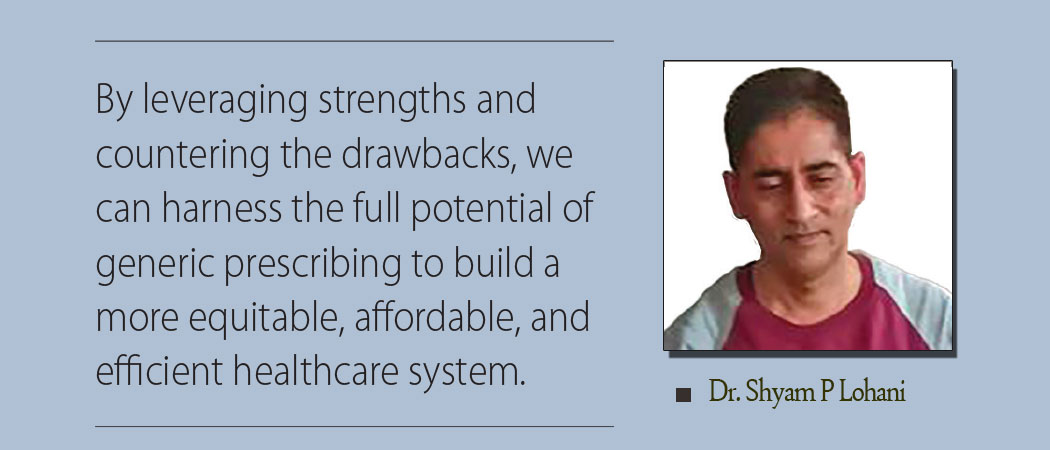
Lastly, the success of generic prescribing depends on healthcare professionals’ acceptance and practice that prioritises quality assurance, patient education, and evidence-based prescribing and dispensing. By leveraging strengths and countering the drawbacks, we can harness the full potential of generic prescribing to build a more equitable, affordable, and efficient healthcare system.
(Dr. Lohani is the clinical director at Nepal Poison Information Centre. lohanis@gmail.com)
-original-thumb.jpg)