- Saturday, 6 June 2026

Will PM Shah Act As Conscience Of Nation ?
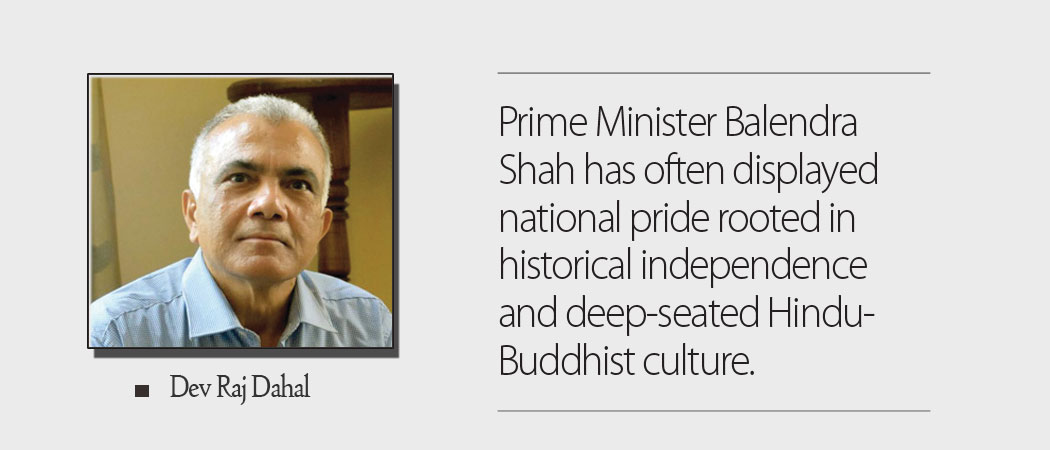

The strategic wisdom of the new Nepali leadership flows from setting policy priorities of action, not usual hyperbolic promises blown up to hypnotise innocent masses. Prime Minister Balendra Shah has often displayed national pride rooted in historical independence and deep-seated Hindu-Buddhist culture, driving the strategic Nepali sense of being one nation able to stand up for sovereignty. The action–thriller starring Shah and his team is likely to absorb multi-cultural excesses into the middle path and several political fractures swirling in protest and resistance to escape from the catharsis of self-inflicted wounds of electoral beat and past ills.
In a high-octane role, his team is focusing on national issues and deliberating with legislators about their solutions. It is oriented inward to transparency, accountability and efficiency of public administration rather than relishing foreign tours in the image-making programmes, which only dashes off legitimate popular expectation. The hundred-point reformist agenda of the government offers scope for upholding national integrity of governance and rectifying the failure of the old regime, which only exposed their own flaws in pushing for inapt educational, health, economic and political policies less attuned to the needs of the Nepali state and its people.
Shift
Is Nepal shifting from a soft state to a virtuous state capable of delivery-responsive rule? Correcting the flaws of skewed allocation of budget, breaking the web of power fixers and rectifying them through procedural and penal means can reignite the hope of people and manage the diversity, inclusion and equity — the resilient traits of this ancient nation.
Flaws of social scientists and ideologues: Nepali social scientists and ideologues misconstrued the genealogy of native knowledge and experience derived from the national context. It is vital to know how social scientists and ideologues have shaped behaviour of educated elites and leaders and gradually deconstructed and devalued native roots, aiming to generalise their behaviour based on modern reason and rationality peddled in positivism. They have forgotten the faith, feelings, sentiments and changing expectations of Nepalis, which altered their voting behaviour. The causal laws of the past alone cannot explain their attitude and cognition when a new generation of people has emerged in the political scene, catalysed by culture, history, education, digital web, exposure and values.
This new generation has evolved an ability to reflect the living conditions of people and crafted plans for social upliftment. Social scientists' insights are flawed because they are ahistorical, de-contextualised and determined by their own disciplines and, therefore, suffer from the perception of narrow self-interests of what Herbert Simon calls “bounded rationality.” While Nepali society’s problems are layered, diverse and complex, disciplinary insights are insufficient to grasp inclusive solutions sustainably. Nepal leaders, irrespective of their identities, relied on the increased role of economists in public policies who had a clear market bias.
Policy-making is the sovereign domain of parliament. It can muster inputs from legislators and frames by public admin. If an elected parliament gives up this responsibility and adopts policies fabricated for the external context, regardless of their utility, it does not promote cognitive and material liberation of people but only serves as a Trojan horse of colonialism. Blind pursuit of caricature without proper indigenisation of knowledge and policies has produced unintended outcomes. Now Nepalis remember not their esoteric speech but their misdemeanors. Shaha’s team is seeking to rectify it.
Geographic concentration: Formulation of correct economic and foreign policy strategies necessary to attract foreign aid, trade, tourism, direct investments and labour market opportunities across various geographic regions is essential to reduce pressure emerging for regime compatibility. Technology, transit and connectivity and diversification of supply chains of public goods can avert pressure to downsize the public sector and stem the spillover effects of global turbulence in energy, climate change, technological and arms proliferation and conflicts. The new leadership has talents, spirit and reformist commitments to do good, understand the strategic geography and its comparative advantages offered by vital resources, social capital, cultural richness and subterranean wealth.
Efforts in building vocational and technical skills, capacity and entrepreneurial zeal to beat economic misfortune spur output capacity of the polity so that growing the reserve army of the poor and jobless can be given useful opportunities in the nation and utiliwe their virtues for a cohesive nation-building. The art of statecraft, rooted in historical insight, can curb the habit of instrumental politics and the peril of diplomatic off-ramp.
Weak regulation: The old establishment had internalised the spirit of neoliberalism against the constitutional vision of social justice and opened free economic exchange of multinationals in many areas of the nation to create external communication, economic and political dependence without the ability to sustain institutional closure in favour of national sovereignty, immigration control and policy determination. Now the changing axes of global politics have proved the frivolity of this policy driven by the Anglosphere. The soft power of culture, education, democracy, and human rights, and the hard power of technology and resource control are the main sources of geopolitics. Even civil society and business have failed to act on the moral conscience of this ancient society, rooted in niskam karma and shuva lav.
The outside approaches have only subordinated national sovereignty, while aid could not reach the people. The imperfect market economy cannot be left to itself, with a free ride on profits and a disregard for people's rights. The Nepali state must fashion democratic regulation, improve competitiveness and strike a balance of demand and supply. The disincentives to agriculture and industry and sucking into import, remittance and aid dependence have bred a balance of payment crisis, dependency and loss of national aplomb to determine development policies. A porous and unregulated border has spiked the national security of the heartland and frontiers.
Burden of politics: Vulnerability of Nepali workers in the Gulf region owing to wars may reduce the amount of remittance to subsidise the bloated size of political and administrative classes. Its long-term solution demands massive investments in productive sectors of the economy and the revival of all import-substituting national industries recklessly privatised for rent-seeking purpose than national needs and restore backward linkage of industry with agriculture and forward linkage with trade and commerce. The cut of superfluous institutions is a right step. Now the zealots and executioners of neoliberalism are devoured by youth revolt and those surviving are facing decay owing to grand corruption, criminality and impunity.
They are now consumed by fearful legal cases and loss of life, comfort and cultivated contentment. The challenge for new leadership is how to reduce the cost of politics, settle the perils of the past and chart a shared, normative future with focus on ordinary Nepalis priorities. This is likely if it can enter into a necessary compromise with those who love this nation and loathe to misuse authority to enrich themselves, their families and cronies. Leadership guts spawn political will for disciplinary action and arrest the drift of democracy to multiple interpretations, thus confusing the people against their common sense.
Rehabilitating governance: Good governance hinges on the rule of justice, not force or empty slogans, which only corrodes trust and makes institutions fragile. It has to promote centripetal forces for shared public and national interests. Power of illicit forces cuts social relations and undermines fragile social institutions created by a long process of adaptation, struggle and readjustments with overlapping values and norms. The critical challenge for new leadership is to rehabilitate the governing structures so far cramped by partisan appointment of all constitutional and public bodies without any capacity for performance other than expansion of patronage, distribution of spoils and abuse of authority.
Good governance requires controlling the problems of thieves of the state, free-riders, deep state, special interest groups and middlemen by forcing them to comply with the rule of law or face consequences for foul play. At a time when global politics is detached from both multilateralism and the dispensation of global common good, a single-minded pursuit of enlightened national interests can harness international cooperation, shoring up the legitimacy of good governance.
Restoring the state’s power: The first initiative should be to restore the legitimate monopoly of the state power, establish the integrity of its institutions and enable it to perform basic state functions—security, rule of law, sovereignty, territorial integrity and production and distribution of public goods. The second is to keep the division and checks of power of the polity so that it can stand above the interest groups' ability to capture policy and institutions. Governance requires effective coordination of the functions of legislative, executive and judiciary functions to balance positive liberties of democracy and negative liberties exercised by NGOs, civil society and business. Internal cohesion of the people is vital for delicate maneuvering in the international political economy and balancing foreign policy in the neighborhood and beyond.
Irony
One irony of Nepali politics is that human rights NGOs and civil society hardly aim to enhance national security, public welfare or alleviation of the suffering of people. They issue only statements against the state, aiming to tarnish its legitimacy. Affiliated to leaders of various political parties, they act like eager robots as per the command and control of those providing patronage, funding and philosophy while keeping criminal silence on the capture of the state, polity and the government by patriarchs, thus depriving the public of goods. The last one is vital for the people to exercise their citizenship and human rights and abolish violence in their social, economic and political relationships.
A fresh look at the peace process is important to make leaders bound to the compliance of the timeline, accountable for the politics of negotiation, lingering of transitional justice and postponement of the principled peace, which begins with reconciliation and palpable yearning of Nepalis for peace dividends. Top leaders' willingness to swap power-sharing for peace crippled the trust of victims in the peace process. The new leadership reflecting the conscience of the nation must focus on just solutions based on distributive justice, not the power equation of powerful actors that refuse to acknowledge the legitimate concerns of Nepalis for security, freedom, livelihood and dignity. This is vital for sustainable democracy and progress.
(Former Reader at the Department of Political Science, TU, Dahal writes on political and social issues.)