- Thursday, 30 April 2026

Global Turmoil
 Dixya Poudel
Dixya Poudel
Dixya Poudel
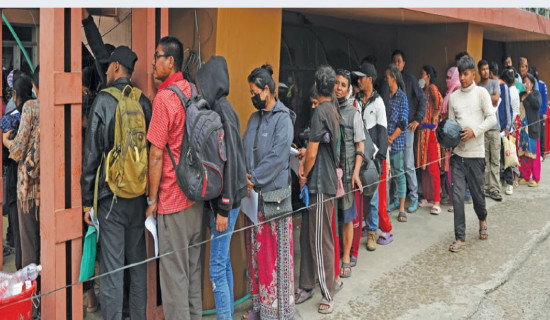
With the economy unsteady in the wake of the Middle East conflict and fuel crisis, it isn’t surprising that there is a sense of insecurity worldwide. Usually, it is anxious individuals who are prone to paranoia but nowadays, even those with a level-headed temperament are fearful for their future. Many people have lost their economic stability and are dependent on government subsidies. It has strained the fiscal budgets of the governments, only adding to the panic in the general public.
The media further tends to aggravate the circumstances. Turn on the television and the news is rife with war, famine, extreme weather, corruption, inflation and financial crises. Tune to the radio, log onto the internet or simply read a newspaper and you are blasted with a feeling of doom as the threat of a third world war looms large. Apocalypse, which is destruction on a catastrophic level, might seem like a far-fetched reality but history has shown that apocalypses can occur on a global scale. The first and second world wars are considered to have been apocalyptic. They cost human lives and loss of properties, as many nations took decades to mend.
Given such a turbulent history of the world, it is natural that people, organisations, institutions or even nations are anxious about the future. Fear is wired in human nature and it protects an individual from harm. However, when fears escalate collectively, it can lead to societal paranoia. And when people are collectively insecure towards their livelihood, future, family and loved ones, life can be quite strenuous.
As of the latest, the oil price has risen as high as $115 per barrel. As the Middle East turmoil is taking no time to abate, the fuel crisis has become quite volatile, resulting in an unstable economic market. Before the 2025-2026 conflict, the region had been exporting about 20-22 million barrels per day. This accounted for about 40 per cent of the entire globally traded oil. Most of it flowed eastward to Asia, with China, India, Japan and South Korea being its prominent buyers. Despite their global utility, non-renewable sources of energy are environmentally pollutive.
Crude oil is the liquid form of petroleum before being refined. Ignition of petroleum leads to the production of greenhouse gases like methane, carbon dioxide, carbon monoxide and sulphur oxides, among others. These gases lead to climate change, another crisis that the world continues to face. When it comes to world peace, it may get worse before it gets better, which is why it is necessary to collaborate, unite and brainstorm for world solidarity. Instead of squabbling over petty matters, world leaders today need to work together.
It is essential to focus on building a world that guarantees each individual not just equal rights and opportunities but also a sense of enduring peace. Economic stability brings with it a sense of safety and it enables a person to explore varied options in life, whether it is saving for the rainy day or following one’s passion. Then there is political and social stability that can strengthen a society. It is then fair to conclude that, as the world has gone off-kilter due to the Middle East conflict and resulting fuel crisis, a call for a diplomatic solution is required more than ever.
-original-thumb.jpg)