- Thursday, 30 April 2026

I Miss My Homeland
 Salviya Tiwari
Salviya Tiwari
Salviya Tiwari
Maybe leaving Nepal was never about distance, but about understanding what home truly means. Home is not just family. It is the slow mornings of Kathmandu, the distant ringing of temple bells, the familiar hum of political debates among neighbourhood uncles, the whistle of the garbage truck, the smell of fresh sel roti from nearby homes, and my mother pulling open the curtains at dawn.
These ordinary moments, once barely noticed, now return as fragments of memory I left behind. Even a simple plate of dal bhat, roadside chatpate, aloo chop, and momo from those narrow gallis feels like a luxury I no longer have. And yet, often at 3 a.m., in a foreign land, the urge to return home becomes the strongest. I imagine booking a ticket, going back and reclaiming everything I left behind. But, would it be worth it? Would it be worth risking the career I am trying to build, the stability I came here for?
Today, when I see my friends back home with their families, roaming around the valley, hopping between cafés and enjoying life, while here I can hardly even speak my own language, I feel that urge to leave everything here and return. But then I’m stuck with the same questions - Can Nepal provide the quality of education we deserve? Can it create opportunities for its skilled yet unemployed youth? Can it even offer the paths we wish to pursue?
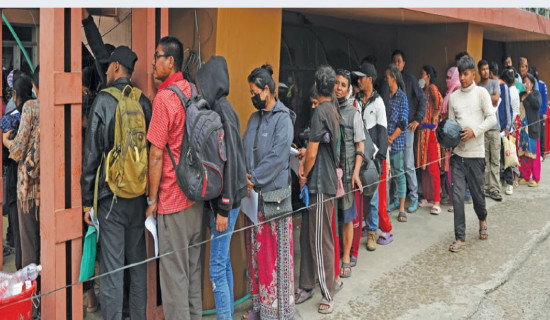
The problem is not just the lack of opportunities, but the growing gap between what young people aspire to do and what the country actually offers them. The degrees often feel disconnected from real-world skills, and even the qualified ones struggle to find a stable job. Over time, leaving has become normalised - not a difficult decision, but an expected one. Almost every young person seems to be preparing to leave.
But who is responsible for this? Is it the government that too often builds itself instead of the country? Or the people, who remain loyal to political parties rather than to national progress? And yet, despite everything, it is never as simple as blaming one side. It's easy to point fingers - at the government, at the system, at the people - but the reality feels far more complicated. Systems take time to change, and societies slowly become a reflection of the choices their people continue to make.
Maybe the problem lies somewhere in between, where responsibility is shared, but accountability somehow disappears. Where we expect change, but hesitate to demand it. Where we complain about what is broken, yet learn to live with it anyway. And along this way, it is disheartening to see leaving become so common in our country, where conversations among young people revolve around visas, university offers, and IELTS scores, rather than building a future at home.
And so, we live in between - carrying Nepal in our memories while building our lives abroad with the hope that times might change and we will one day see a better Nepal- one where young dreams are not crushed, where young people are allowed to dream freely without the burden of leaving home. We do miss home deeply, we miss the warmth of home, the chaos of our neighbourhood, family dinners, gatherings during Dashain and Tihar, even the small fights with siblings over a T.V remote. But returning is no longer a choice. Because the hardest truth is: sometimes, loving a country does not mean staying, but learning to live with the distance it creates.
-original-thumb.jpg)