- Saturday, 6 June 2026

When Protest Ends, Scars Continue To Linger

As the streets of Kathmandu and other cities across Nepal echoed with the voices and determination of young protesters, the country saw an important chapter in its long and arduous road to democracy. The youth from different backgrounds and walks of life came together to voice their demands for transparency, accountability, and an end to corruption. While the movement began as an impassioned call for reform, it soon turned into one of the most significant youth-led movements in the history of Nepal. However, while the political impact and outcomes of this uprising are out in the open, there is an underlying and often overlooked aspect that needs to be considered: the psychological impact of this movement on the young minds that led this revolution.
Thousands of young protesters took to the streets demanding better governance, job opportunities, and an end to corruption on September 8 last year. The protesters included young students and professionals who saw their future being threatened by the decades-long mismanagement of the country. The movement was an epitome of hope and the power to bring about an alternative political landscape. Nevertheless, the protests took an instant, tragic turn. This is because there were clashes between the protesters and the security forces. As a result, there were fatalities. According to the reports, at least 75-76 people were killed during the two days of unrest. Most of the victims were young protesters.
Deep scars
There was also destruction of properties in various parts of the country. This is because government properties, political party premises, media houses, and commercial properties were destroyed during the resulting chaos. This is an indication of the level of frustration that had been building up among the youth. Behind these dramatic scenes of protest and conflict, there are thousands of young people with emotional burdens that are yet to be spoken about. For many activists, the experience of witnessing violence and loss of friends, or living with fear and uncertainty every day, has left deep scars. The protests are over, but the scars are not.
Mental health has long been associated with stigma and silence. Talking about anxiety, depression, trauma, and burnout is still not easy. For the young activists who took part in the protests, mental health issues are not just concepts but realities. The activists had to deal with their university life, jobs, and family demands while simultaneously organising demonstrations and rallies and speaking out against social injustice. During the protests, the activists faced huge pressure. The activists spent nights without sleep, faced scrutiny on their social media handles, and risked facing the security forces. Once the protests became violent, the activists experienced shock, grief, and trauma. The deaths of their fellow youths, who were students, friends, and random people who shared the same cause, had an emotional impact on the activists.
In the Nepali culture, emotional vulnerability is discouraged. The culture often relates strength to silence. Young people who are going through emotional distress are often asked to “stay strong” and “look towards the future” rather than being encouraged to seek professional help. As such, young people are often forced to go through their emotional distress alone. This is further complicated by the fact that Nepal has a weak mental health system. For example, there is a lack of trained counselors and psychiatrists, particularly in rural areas. Mental health is not integrated into primary healthcare systems in the country. Additionally, the general public is not educated enough about the importance of mental health. For the youth activists in Nepal, this is particularly challenging.
Collective action
The youth movement showed the strength of collective action, and this is particularly empowering for the youth in Nepal. However, the youth movement also showed the importance of collective action in terms of the need for collective care. Social movements need to understand that activism is a form of emotional work. Another factor is the role of educational institutions and work environments. Learning environments must be provided in educational institutions where the issue of mental health is discussed and where help is available. People in the community and at home must learn how to listen without judgment and how to validate the emotions of the youth.
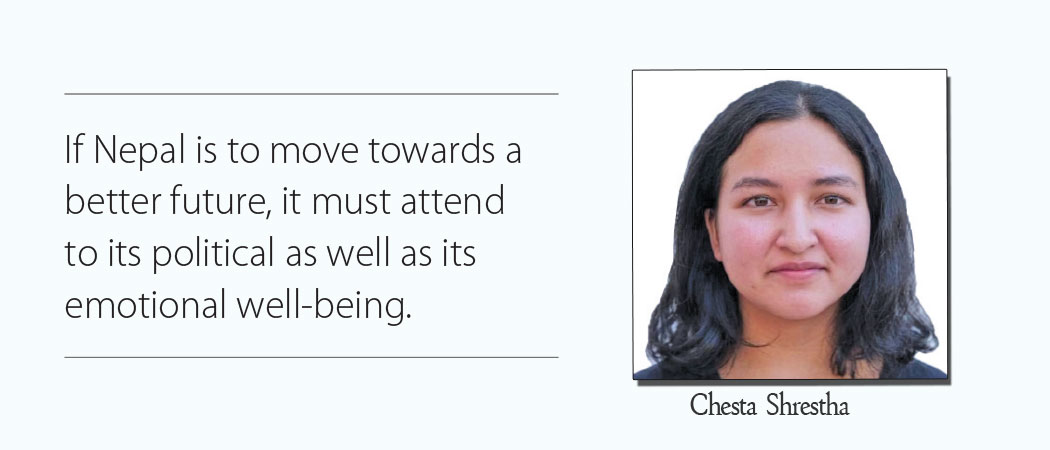
The September protests were a reminder of the fact that the youth of Nepal are ready to fight for justice and change in the country. However, the sacrifices made during the days of the protests, including the lives that were lost and the trauma that was experienced, must not be forgotten. A society that believes in justice and democratic participation must also believe in healing. If Nepal is to move towards a better future, it must attend to its political as well as its emotional well-being. The voices that emerged in protest must be not only heard but also cared for, supported, and empathised with.
(Shrestha is pursuing a Bachelor's degree in psychology at St. Xavier College, Maitighar, Kathmandu.)