- Wednesday, 15 April 2026

Chaudhary's art journey from sand to canvas
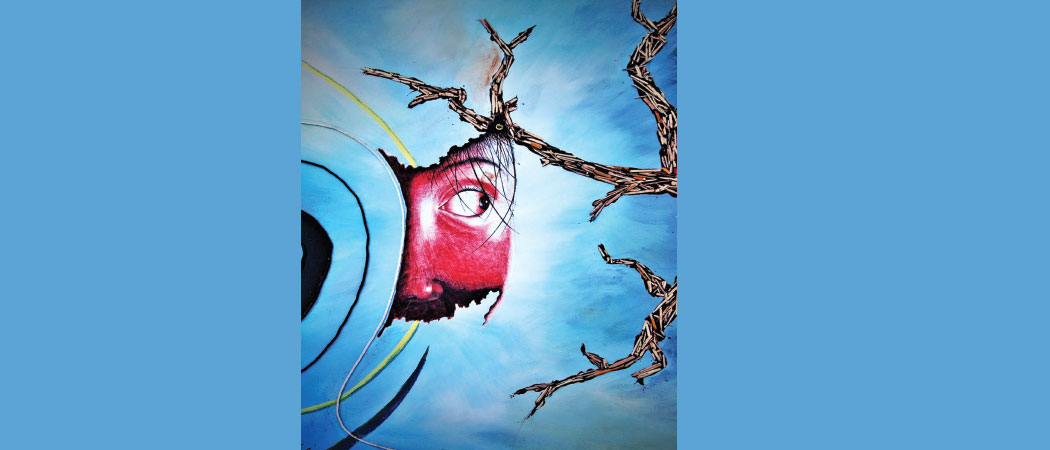
Photo: Dhirendra Prasad Sah\TRN Gopal Chaudhary's painting.

Dhirendra Prasad Sah,Rajbiraj, Mar. 15: From shaping houses in river sand and drawing pictures with his fingers on the riverbank, painter Gopal Prasad Chaudhary's humble beginning has grown into an inspiring tale within Nepal's art scene.
Born in Khadak Municipality-10 of Saptari, the 45-year-old artist began showing creative tendencies from his childhood. The riverbank near his village served as his first canvas. His small hobbies, building houses in the sand, writing his friends’ names with his fingers, and sketching images already hinted at the future artist within him.
During his school years, he participated in various art competitions and won several awards at the district and regional levels in Saptari and Morang. Alongside formal education, he continued practising art informally and consistently.
Carrying his parents’ dream of becoming an engineer, he went to Kathmandu. However, he secretly began formal studies in fine arts. “I was afraid my parents would stop funding my studies if they knew,” he said. While his friends were studying at Pulchowk Engineering College, he chose the path of art.
After about two and a half years, when he achieved excellent results in the Proficiency Certificate Level in Fine Arts, he finally revealed the truth to his father. Initially disappointed that his son had abandoned the dream of becoming an engineer, his father later supported him after advice from relatives, including Suresh from the village, and senior artists.
After completing his bachelor’s degree, he felt uncertain because postgraduate studies in painting were not available in Nepal at that time. During this period, he remained active in national and international art activities and created works in both figurative and abstract styles.
He says that the works of Nepali senior artists Shashi Bikram Shah, K.K. Karmacharya, Kiran Manandhar, Manuj Babu Mishra, Alok Lenge Gurung, Ragini Upadhyay, and Gopal Kalapremi Shrestha had a deep influence on him.
While pursuing his master’s degree in painting at Tribhuvan University, Kirtipur, he conducted research on topics such as “Indigenous Art and Craft of the Tharu Community,” “Expression through Hand Gestures, Mudras and Symbols,” and “Van Gogh and His Art,” graduating with a first division in Fine Arts.
During this period, he was also influenced by the artist couple Dr. Seema Sah and Umashankar Sah, which led him to create abstract paintings using elements of Tharu folk art. Since then, he has dedicated his artistic journey to the promotion of Tharu folk art.
After teaching art for about five years at various colleges in Kathmandu, he became active as a social campaigner with the goal of linking art with development work. During this seven-year period, he shared that he could not produce significant artistic works, which he describes as a painful phase.
He also expressed concern that society and the state have remained largely silent regarding the commercialisation of art. According to him, artists often do not receive fair value for their work, and due to weak institutional support for art promotion, many artists have either migrated or taken up other professions.
Since 2023, he has been working as a local peace expert in partnership between Samagra Jan-Utthan Kendra, Lahan (Siraha) and the German Civil Peace Service. He said that encouragement from the organisation’s president Rambharosi Mahato and peace advisor Sadhuram Tamang inspired him to return to artistic creation, giving new energy to his art journey.
With full support from his family and motivation from colleagues, he picked up the canvas again after nearly a decade and recently participated in the National Art Exhibition through the Provincial Art Exhibition 2082.
The small artistic journey that began on the riverbanks of Saptari has now become an inspiring story of struggle, courage, and revival. According to Jivanath Chaudhary, chairman of the Maithili Development Fund, the future creative journey of artist Chaudahry, who has dedicated his life to preserving and promoting folk art, will shine even brighter.

-square-thumb.jpg)
-original-thumb.jpg)