- Saturday, 6 June 2026

Rational Politics Pushes Systemic Reforms

Politics is an arena where leaders can imagine the nation’s future beyond meeting the requirements of their existence in position or nakedness of power and greed. Nepali people and leaders, as rational actors, make choices and decisions after carefully calculating the reward and punishment in a situation of uncertainty, scarcity and conflict. Rational politics is the one in which voters choose those candidates who serve their interests both short-term and long-term. Reason is more than frosty, calculating and lifeless logic. It elegantly marks the process of modernity and frees people from sanctified tradition, magic, surprise and operates under the justice-governed path, not just laws.
Its moral reasoning sets up some coherence of the diversity and complexity of Nepali life and reduces the scale of anomalies occurring in everyday practices. Politics can bring democratic rationality to the lives of Nepalis for suitable private and public pursuits. It is vital to bring political stability in the nation and exonerate it from the old politics of penetration of security, administration, economy and technology and secure modern politics of freedom, justice and realisation of self-dignity. To be sure, rational reflexivity can remedy the vices of rituals associated with blind faith and prejudice without undermining the potentiality of spiritualism that helps people see beyond self-interest, which democratic politics purports.
Information revolution
Information revolution has enabled Nepali scholars to conceptualise electoral politics with new angles and praxis with revulsion against the contradiction-fed parties, youth bulge, diasporas’ influence and emerging digitised spheres, which seem to uproot the old style politics of privilege, patronage and impunity. Nepal’s new style of politics seeks to detribalise politics fragmented on the basis of caste, class, gender, ethnicity, region and religious lines with a new rationality of citizenship. The new order of politics transcends primordial loyalties and expects to contribute to nation-building.
This has brought Nepal to the cusp of a new chapter of politics. But it has to bridge a generational divide, invent a unifying culture to fill the void of ideology and orient to the values of democracy to spawn the welfare redistribution that the Nepali constitution has visualised. Nepalis crave to secure the ancient habits of feeling and faith because they provide an apt sociability. Both modern versions of human rights and rationality are grounded on individual choice, where people freely associate with political parties, civil society, business and professions without the constraints of inherited customs and engage in their creative pursuits.
In this sense, political socialisation is important to become rational and assume public rationality of politics by removing the inflation of passion, false spin doctoring and dispelling the cloud of doubt in thinking that wrecks democratic sensibility of political actors. Modern politics triumphs in cultivating collective conscience and building social solidarity for organising large-scale collective action, which is not possible through individual efforts. The promotion of public and national interests demands widening of perspectives and fostering collective rationality, which is a basis of the social and political order of the Nepali state.
This order turns robust if its implicit rules are followed by its constitutional bodies to realise popular expectations and evade the incursion of geopolitical predators. Rationality presumes the use of reason in decisions and actions based on clear thinking, serious analysis of risks and opportunities and systematic appraisal of all data. It is largely context-dependent. But behavioural analysis cannot ignore the psychological aspects of passion, feeling, emotion and fear that drive political action. For example, electoral waves and mass demonstrations also affect the political behaviour of people, prompting them to join the bandwagon, the winning side.
As political educators, Nepali leaders have yet to awaken people to think for the society and the nation. But the irony of political life is that there are so many values, principles and institutions to make political power responsible. But economic and technological power are free from these and political power is not able to rationally control them to serve human life and alleviate a sense of scarcity, fear of the unknown and uncertainty created by the self-extension of powerful leaders beyond moral limits. Awakening of conscience is the prime goal of political education because it can help reflect on the living condition of people and use courage and ethical means to bring evocative change for a better life, liberty and equality. Setting certain constitutional limits and democratic regulation of the economy and technology, like politics, can enhance the general welfare of society. The rationality of democratic politics is the availability of basic economic goods. It is vital to lift ordinary Nepalis to their full stature and orient the powerful to a feeling of compassion and solidarity.
The Nepali constitution visualises the creation of a good society founded on the notions of equality, justice, inclusion, representation and peace, not coercion. The allocative efficiency of politics is therefore vital to secure social and political stability. This enables people to share something in common. Requirement of this allocative efficiency is coupled with the capacity of the Nepali state to assume a legitimate monopoly on power, act autonomously against the dominant interests of society and set up good governance that can deliver public goods to the people.
The questions are: can the newly elected regime with a fresh mandate fix all constitutional bodies to impartially operate as per their mandate, efficiency and integrity and break the old inertia, patronage and status quo? Or as usual, distribute all positions in a clientelistic manner to loyalists by caring less about the performance legitimacy of anti-corrupt governance? Do the outbursts of fury of youth and their self-determination foster a new political culture of accountability and transparency and set new political standards beyond populism, thriving in the reckless articulation of demands? Obviously, the rationality of politics does not hold ground if it does not connect people with the Nepali state and raise the latter’s welfare outreach in the entire society.
The rule of law cannot reasonably operate in a condition of social hierarchy, economic injustice, poverty, deprivation and alienation. These elements devastate the souls of people and fail to create equal playing fields for them to compete in the society, economy and the political processes. This means incubation of a new political culture requires strengthening meritocratic tradition in the civic institutions and public admin that can devise economic policies conducive to the welfare spirit of the constitution, not the adoption of the already discarded theory of trickle-down now repackaged as neo-liberalism, which is insensitive to both nature and people. Traits of neo-liberalism only heap up profits to those powerful actors of society who can influence the economic and political process and control the output side of legitimacy.
Meeting the essential needs alone can enable Nepalis to exercise their choices in other matters. Education is another aspect that can enable Nepalis to understand their inner urge, the complexity of the outer world they live in and their common normative framework of cooperation, which eases their conscious life and evolves the capacity to think above and beyond self-interests. Growth in the reason and rationality of Nepalis can help them destroy uncritical acceptance of blind faith, prejudice, injustices and authoritarianism.
High level of civic engagement in elections is important to enhance Nepalis’ stake but not sufficient unless this is translated into a corresponding level of community engagement so that politics becomes not a one-day electoral event but a concatenation of a series of productive activities. It builds trust among people, communicates with each other on matters of shared concern, honours collaborative spirit and leverages organisational power for the solution of problems. It is hard to shape leaders and people’s conduct rationally when their existential interests are at risk.
Voting in Nepal so far has been determined by parochial considerations — kinship, caste, ethnicity, gender, region, religion, money considerations and utopian promises are shifting to the aspiration of modernity. Vote-buying and vote-selling in no way reflect the rationality of the public purpose of politics to select the best representatives who are capable of making sound public policies to uplift them and the nation. It is shady to preoccupy one's own interests, glorify one’s own personality and ditch democratic duties to the people who are the source of legitimacy and sovereignty.
The inability of Nepali leadership to enhance the common life of people and the state weakens the foundation of democracy. It fails to create the authority of government to enforce binding rules of society and the constitution, the common roadmap of the nation, promulgated to build security, social unity and national integration. One critical deficiency of Nepali politics is its lack of autonomy from the powerful interest groups of society so that its leadership and authority are seen as impartial, neutral and performing. Building this culture is a major task for new leadership.
Public institutions
When the public institutions crafted to serve various public interests are hamstrung by the corruption of partisan power, they lose both internal and international acceptability. It makes politics a matter of privilege and impunity. It breeds dishonesty and blurs the boundary between the private and the public sphere, like in the ancien regime of Ranas, thus feudalising democracy and disconnecting people from access to the institutional resources of the state.
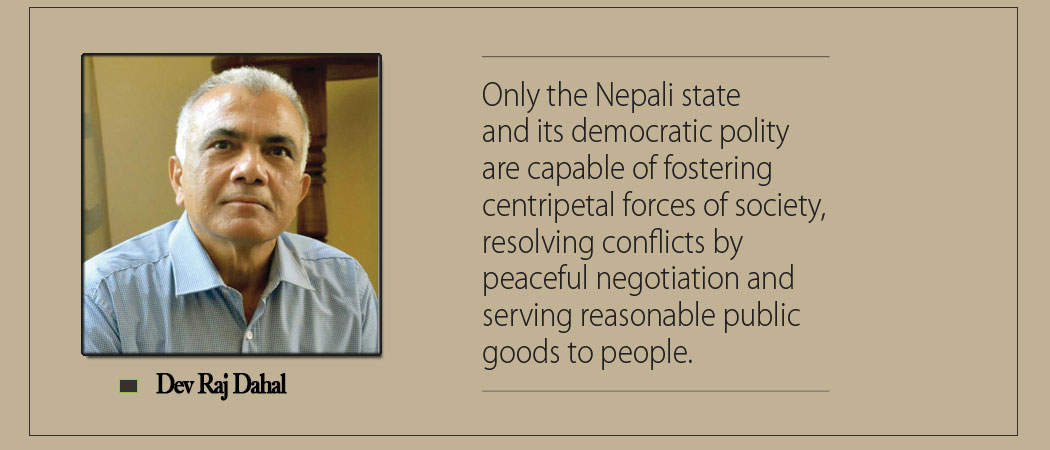
The danger of this tendency is that it discourages rational forces of society from thinking about reasonable change in the condition of living and uplifts the voiceless. In such a condition, national loyalty of people to the system and the state suffers even if other institutions, political parties, civil society, business and interest groups may thrive. Only the Nepali state and its democratic polity are capable of fostering centripetal forces of society, resolving conflicts by peaceful negotiation and serving reasonable public goods to people.
(Former Reader at the Department of Political Science, TU, Dahal writes on political and social issues.)