- Thursday, 21 May 2026

Promoting Safe And Sustainable Agriculture
 Dilli Ram Sharma, PhD
Dilli Ram Sharma, PhD
Dilli Ram Sharma, PhD
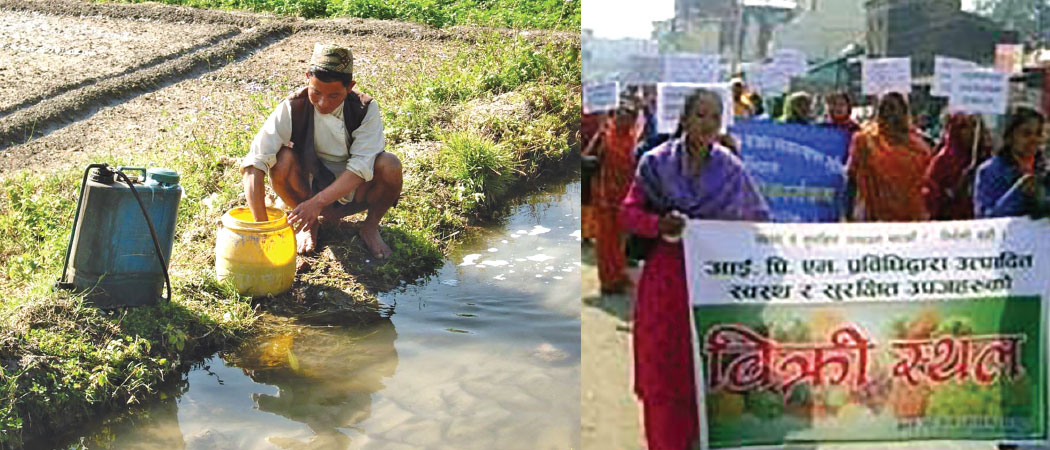
The agricultural sector is the main pillar of Nepal supporting the economy, and millions of people rely on it as a source of livelihood. But with the rise in usage and improper application of pesticides, it has become a major cause for health and environmental hazards, which can no longer be overlooked. This article is written in the form of a suggestion to the government and concerned authorities regarding how to avoid the risks associated with the use of pesticides in Nepal, which, according to a study, is a major cause of health hazards for both the users and those who consume the products and is even linked to suicide cases. Hence, it is most imperative for the government to take immediate and stringent steps in this regard, and farmers and authorities should follow suggestions given by experts.
The vision for pesticide risk reduction shall be “to ensure safe, sustainable, and residue-compliant agricultural production systems that protect consumers' health, farmers' well-being, and the environment.” The overarching goal shall be to reduce pesticide risks to human health and the environment through strengthened regulation, improved monitoring mechanisms, enhanced capacity building for farmers, and increased consumer awareness.
Strategic objectives to be achieved in the next ten years shall include the strengthening of activities in the area of regulatory reform and enforcement, as well as the reduction in the percentage of vegetable and fruit samples that exceed the MRLs by 70 per cent in 2035 in accordance with the Codex standard. At the same time, the level of Integrated Pest Management (IPM) practice adoption shall be enhanced to 80 per cent of all commercial vegetable farmers in the country.
In addition, a fully functional National Pesticide Residue Monitoring Network shall be developed in all provinces of the country to ensure effective surveillance and compliance with pesticide residue standards.
In the same vein, strategies shall be developed to reduce reported cases of pesticide poisonings among farmers by 60 per cent and increase public awareness of safe food handling practices, targeting at least 80 per cent of all urban households. The existing pesticide registration policy across the nation is weak and in urgent need of review and updating by 2026/27.
This includes the phasing out of HHPs, ensuring compliance inspection for pre-harvest intervals, and strengthening the system of agroveterinary licences, as well as the implementation of applicator certification, which should be made mandatory by 2029. Another factor is the absence of advanced residue labs, a national reference lab, and a national pesticide residue database in all the provinces of the country.
Farmers need proper knowledge of safe pesticide application methods and a clear understanding of the adverse impacts on health and the environment.
Therefore, Integrated Pest Management (IPM) technology should be expanded through Farmer Field Schools in all provinces by 2029. To encourage the use of IPM, financial support should be given to the biological controls, climate-resilient and pest-resistant varieties, and the development of mobile advisory tools.
To protect users’ health, farmer health awareness campaigns must be conducted, subsidised Personal Protective Equipment (PPE) should be made available, pesticide poisoning reporting systems should be strengthened, and coordination with Poison Information Centres should be enhanced by 2028. It is also paramount to mobilise the Protection of Consumer Rights authorities to launch public awareness campaigns on proper washing and safe food preparation practices.
A safe produce certification scheme should be introduced, traceability pilot projects should be implemented in major wholesale markets such as Kalimati and Balkhu, and food safety education should be integrated into school curricula to help minimise pesticide residues in fruits and vegetables. An action programme should also be developed to support university-led research on long-term pesticide exposure, conduct national poison surveys in pesticide-using communities, and establish performance monitoring indicators and impact evaluation programmes by 2030. In order to develop a strategic plan, careful budgeting and resource mobilisation is required. Funding sources should be identified and allocated through the Ministry of Agriculture and Livestock Development (MoALD), with cost-sharing arrangements from provincial governments, public–private partnerships, and coordination with national and international organisations and development partners. This ten-year action plan is a realistic, measurable, and structured roadmap for the change that needs to be brought about in the management of pesticides in Nepal.
With political commitment and financial support, it is possible to make significant progress in minimising the risk of pesticides while maintaining the level of productivity and food security. Coordination would also be required with the country's experts, research institutions, universities, and international organisations, civil society groups, consumers' forums, and development partners. Technical assistance would also be required to improve the laboratories' capacity, risk assessments, training programmes for the farmers, and application of global best practices. International assistance would also be required to improve the level of financial assistance, better compliance with the Codex standards, and capacity to manage pesticides to increase the export capacity.
(The author is a former director general of the Department of Agriculture.)







-original-thumb.jpg)