- Wednesday, 20 May 2026

Good governance key economic agenda: Dr. Wagle
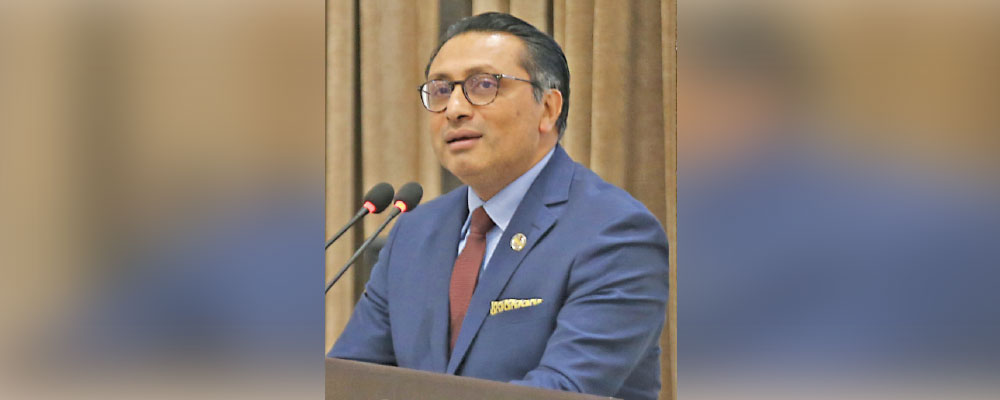

By A Staff Reporter,Kathmandu, May 20: Finance Minister Dr. Swarnim Wagle on Tuesday said the government has placed good governance and the expansion of the middle class at the centre of its economic agenda, arguing that sustainable economic growth would not be possible without systemic reform and institutional accountability.
Responding to lawmakers’ queries in the National Assembly on the principles and priorities of the Appropriation Bill (except tax) for the upcoming fiscal year, Dr. Wagle defended the government’s policy direction and stressed that Nepal needed a fundamental shift in governance culture to unlock economic potential and restore public trust.
“We believe sustainable growth cannot be achieved without good governance,” said Wagle. “Corruption, delays, middlemen and the capture of institutions by vested interests have not only increased the cost of the state but also weakened citizens’ confidence,” he added.
Minister Dr. Wagle said the government was pursuing what he described as economic reform through system reform, with emphasis on e-governance, digital public service delivery, one-time data submission and performance-based administration. According to him, the state must evolve from a spending state into a delivery-oriented state.
The Finance Minister said the country had paid a heavy economic and social price over the past three decades because of poor governance, policy uncertainty and collusion between political and business interests.
He claimed the resulting loss in investment opportunities, employment generation and potential economic growth was unimaginable, and argued that the government’s concept of a dividend of good governance aimed to reverse that trend.
Finance Minister Dr. Wagle also sought to reassure the private sector amid concerns raised by some lawmakers over investor confidence. He said the honest and investment-oriented businesses had nothing to fear from the government’s policies and pledged legal reforms and policy stability to encourage production and entrepreneurship.
“At the same time, the state will no longer protect collusion that exploits public institutions for the benefit of a limited group,” he said, adding that the government would not hesitate to act against policy capture and misuse of state mechanisms.
Minister Dr. Wagle further said the government’s vision was rooted in a competitive and production-oriented liberal economy guided by democratic values and social justice. Rather than acting as a structure that controls everything itself, he said, the state should focus on empowering citizens, communities and the private sector.
He added that the administration intended to transform Nepal’s consumption-driven and import-dependent economy into a more dynamic system led by production, innovation and entrepreneurship.
Defending the government’s emphasis on expanding the middle class, he said the concept was not aimed at benefiting a privileged section of society. Instead, he argued, it was intended to improve the economic status of poor families, labourers, farmers, landless people and marginalised communities by increasing income, productivity and access to opportunities.
“When citizens gain skills, income and access to opportunities, only then can real upward mobility take place,” he said.
Minister Dr. Wagle also rejected criticism that the government’s policies either repeated old approaches or abandoned long-standing national priorities.
While acknowledging continuity in areas such as agriculture, education, energy, infrastructure, health and employment, he said the key difference lay in implementation, accountability and expected outcomes.
He noted that the economy currently stood at around Rs 6.6 trillion, while last year’s national budget amounted to nearly Rs 1.96 trillion, and criticised lawmakers for focusing excessively on small local projects rather than broader economic direction.
Dr. Wagle said this year’s budget framework had placed particular emphasis on implementation architecture, including legal reforms, institutional accountability, digital tracking, direct monitoring and measurable outcomes. “Citizens are no longer looking for speeches, they are looking for results,” he said.
Calling on opposition parties to become constructive partners in the reform process, he urged lawmakers to support efforts aimed at strengthening governance and improving economic delivery while holding the government accountable whenever necessary.
-original-thumb.jpg)