- Wednesday, 20 May 2026

Tobacco Control Vital For Health Gains

Every cigarette smoked in Nepal carries a hidden cost - one that is not only paid by the smoker, but by families, the health system, and the nation’s economy. As tobacco-related diseases rise, so too does the financial strain on Nepal’s health insurance programme, quietly threatening its long-term sustainability. Nepal is at a critical juncture in its public health and financing journey. While the country has made important strides in expanding access to healthcare through its national health insurance programme, a silent but preventable threat continues to undermine these gains—tobacco use. Tobacco remains one of the leading causes of death and disease in Nepal, contributing significantly to cardiovascular diseases, cancers, chronic respiratory conditions, and tuberculosis.
Recent estimates indicate that nearly 39,200 deaths each year are attributable to tobacco use, up from 24,200 in 2019. This represents not only a major public health concern but also a substantial economic burden. The financial cost is equally alarming. Tobacco-related illnesses cost Nepal an estimated Rs. 45 billion annually through healthcare expenditures and productivity losses. The losses are equivalent to 1.2 per cent of Nepal’s gross domestic product (GDP). At the household level, high out-of-pocket spending still accounting for more than half of total health expenditure means that many families are pushed into poverty due to preventable diseases.
Pressure on insurance
Nepal’s national health insurance programme was established to reduce financial hardship and improve access to healthcare. However, its long-term sustainability is now under growing pressure. Tobacco-related diseases are a major contributor to this challenge. The health insurance system is increasingly burdened by rising claims for chronic and costly conditions such as cancer, cardiovascular diseases, diabetes, and tuberculosis, many of which are strongly linked to tobacco use. In simple terms, the more Nepal spends on treating tobacco-related illnesses, the more difficult it becomes to maintain an affordable and sustainable insurance system for everyone. Without stronger prevention and tobacco control measures, the financial viability of the health insurance programme will continue to be at risk.
Tobacco control must be understood not merely as a health priority, but as a strategic investment in Nepal’s economic and social development. Evidence from the World Health Organisation demonstrates that key tobacco control measures such as increasing taxes, enforcing smoke-free environments, banning advertising and promotion, and providing cessation support are among the most cost-effective interventions available to governments. Investing in these proven tobacco control measures will prevent 114,000 lives and avert Rs. 88.1 billion in health costs and economic losses by 2037. For every rupee invested in these measures today, Nepal will avert Rs. 11 in health care costs and economic losses by 2027 and Rs. 26 by 2037.
Despite an existing legal framework, Nepal’s tobacco control efforts remain incomplete. Tobacco taxation in Nepal remains low at around 35.7 per cent of the retail price far below the 75 per cent level recommended by the World Bank and the World Health Organisation. Nepal also lacks a law requiring standardised plain packaging and has yet to fully ban emerging products such as e-cigarettes and vaping devices. Enforcement of existing measures including pictorial health warnings, smoke-free public spaces, and bans on advertising remains inconsistent. At the same time, cessation services are not systematically integrated into primary healthcare or covered by health insurance.
Policy improvements and implementation are further weakened by tobacco industry interference and the continued engagement of government officials with the industry. Together, these gaps undermine the effectiveness of current policies and allow tobacco use to persist. Nepal has a clear and practical path to address this challenge. First, increasing tobacco taxes to at least 75 per cent of the retail price would significantly reduce consumption while generating additional domestic revenue. Second, adopting standardised plain packaging and strengthening regulations to ban emerging nicotine products would reduce the appeal of tobacco, particularly among young people.
Equally important is the need to fully enforce existing laws at federal, provincial, and local levels. Integrating tobacco cessation services into primary healthcare and including them within the health insurance benefit package would further support individuals who wish to quit. The government must also ensure full accountability in implementing the World Health Organisation Framework Convention on Tobacco Control, particularly by safeguarding policymaking from conflicts of interest and completely preventing tobacco industry interference, in line with its obligations under the treaty.
Public funds
In addition, public funds should not be invested in tobacco companies, given that these companies drive preventable disease and death and impose substantial economic and social costs on the country. Finally, earmarking a portion of tobacco tax revenue for health financing, including the health insurance programme, can create a sustainable funding mechanism while reinforcing public health objectives.
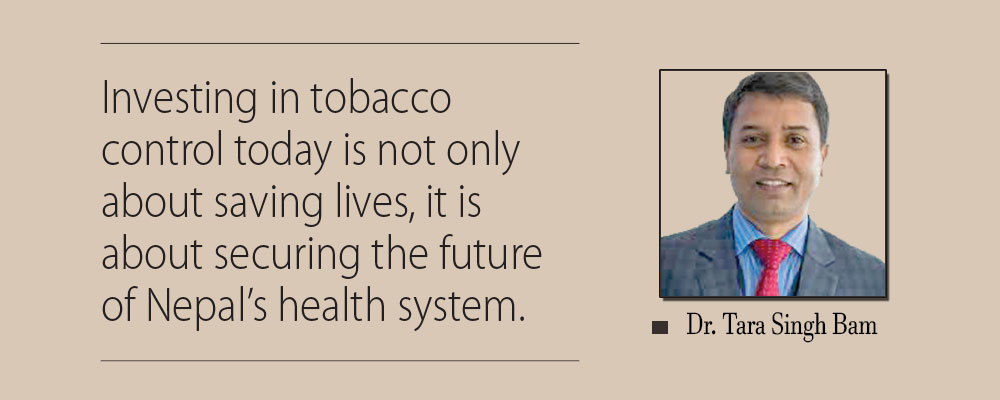
Tobacco control represents a rare policy opportunity where health and economic interests align. By reducing preventable diseases, Nepal can lower healthcare costs, protect households from financial hardship, and ensure the long-term sustainability of its health insurance system. The evidence is clear, and the tools are available. What is needed now is strong political commitment and coordinated action. Investing in tobacco control today is not only about saving lives, it is about securing the future of Nepal’s health system.
(The author is associated with Vital Strategies, a global public health organisation based in Singapore.)