- Wednesday, 20 May 2026

Tourists suffer as trekking trails disappear in Manang
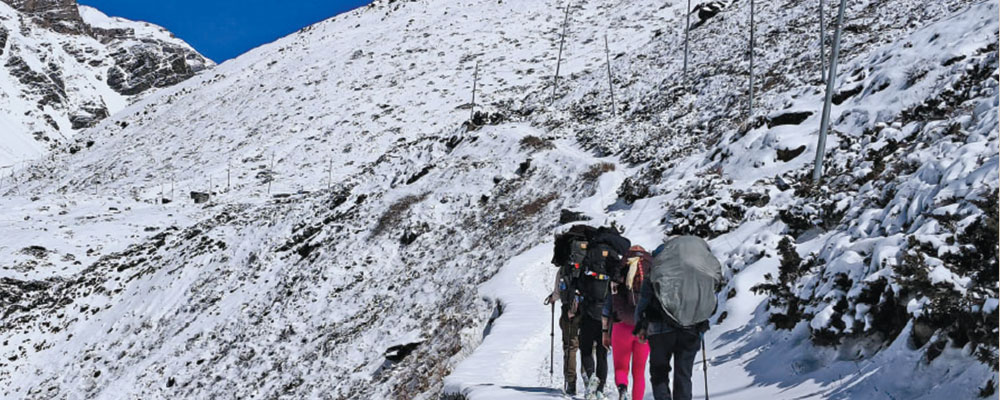

By Our Correspondent, Manang, May 20: The world-renowned Annapurna Circuit trekking route has increasingly come under threat in recent years due to road expansion.
As traditional trekking trails gradually disappear, complaints have grown from tourists who feel they are no longer getting the authentic trekking experience they expected. Local tourism businesses have also been adversely affected.
Although construction of the Besisahar–Chame road section began many years ago, upgrading work has still not been completed.
During the monsoon season, mud and landslides make travel difficult, while dust creates hardship in winter. Since the road and trekking trail now overlap, the risk to both pedestrians and vehicles has also increased, said Binod Gurung, President of the Manang Tourism Entrepreneurs’ Committee.
“Manang Ngisyang Rural Municipality has built alternative trekking trails within its area for tourists, so there is no problem there,” he said. “But if we truly want to provide convenience for all tourists, every local authority must construct alternative trekking routes.”
According to him, the issue can only be resolved if alternative trails are developed right from Besisahar in Lamjung. Efforts made solely by Upper and Lower Manang would not be sufficient.
The Dumre–Besisahar–Chame road stretches for a total of 61 kilometres. Only the eight-kilometre section from Besisahar to Khudi has been blacktopped.
Gurung said that because the Dumre–Besisahar–Chame road project, which started six years ago, has progressed slowly, tourists continue to suffer from mud and landslides during the rainy season and dust during winter.
“Blacktopping work in the Manang section has not even begun. Since there are no alternative trekking trails from Besisahar onwards, tourists are forced to endure these difficulties,” Gurung added.Nabin Bista, information officer for the Dumre–Besisahar–Chame Road Project, said that work on the road section has been halted for the past two and a half years.
“The Environmental Impact Assessment is currently pending at the Ministry of Agriculture, Forests and Environment. It has not yet been approved, which has prevented work on the road from moving forward,” he explained.
Bista further stated that permission must also be obtained from community forests, the Annapurna Conservation Area Project (ACAP) and other authorities before construction can proceed.
As a result, tourists are likely to continue facing dust and muddy conditions on the Besisahar–Chame road for several more years.
Previously, foreign tourists would spend around 21 days completing the Annapurna Circuit while enjoying lush forests, Himalayan settlements and Gurung culture. However, with the expansion of road access, many tourists now travel directly to the upper regions by vehicle. Consequently, trekking durations have been reduced to just 10 to 12 days.
The disappearance of traditional trekking routes has also directly affected guides, porters, and local hotel businesses.
In the past, long-staying trekkers supported village hotels, tea shops, and trade in local products. Now, as more tourists travel by vehicles, overnight stays in many villages have declined, according to Sherap Bista, a hotel entrepreneur in Chame.
He said that while roads are necessary, the absence of proper planning to preserve trekking trails has worsened the situation. Since tourists seek peaceful surroundings, natural beauty, and the experience of walking, he stressed the need to build safe alternative trekking routes alongside the roads.
If road construction can be managed in an organised and environmentally friendly manner, including dust control measures, separate walking trails for trekkers, signboards, and rest areas, the tourism sector could once again be revitalised.