- Wednesday, 20 May 2026

Over 61 % Nepalis drink water polluted with E. coli
.jpg)

By A Staff Reporter, Kathmandu, May 20: The latest National Multiple Indicator Cluster Survey (NMICS) 2024-25 showed that only 40 per cent of people have access to safely managed sanitation and 47 per cent to safe drinking water, while 61 per cent drink water contaminated with E. coli across the country.
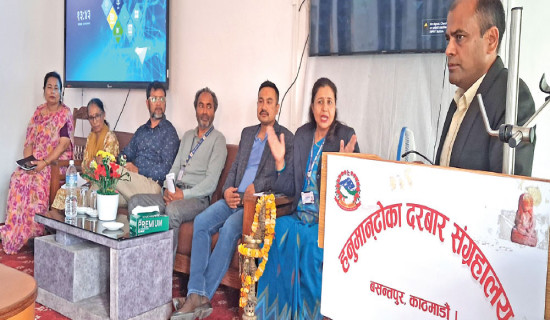
Giving information at the Media Roundtable Series on MICS Data for Children: Water, Sanitation and Hygiene (WASH), Siddhi Shrestha, a WASH specialist, said that the survey conducted by the National Statistics Office (NSO) with the technical and financial support from UNICEF, found widening provincial and socioeconomic disparities, highlighting that progress must accelerate sharply if Nepal is to meet its 2030 SDG targets.
A total of 12,960 sample households were selected for the survey. According to the survey, 40 out of every 100 people have access to safely managed on-site sanitation. This metric signifies that human waste is being safely contained and treated at the community and household levels.
According to the survey, a regional breakdown of the national sanitation average (40 out of 100) reveals significant gaps between provinces. Gandaki province leads with 63, followed by Koshi at 49, and Lumbini matches the national average at 40. Bagmati stands at 39, Sudurpaschim at 34, Karnali at 32, and Madhesh records the lowest access at 28.
In particular, the Sustainable Development Goal target, as per the National Planning Commission (NPC) revised indicator for 2023, is set at 90, it said.
Evaluating sanitation by demographics reveals subtle differences. Rural areas exhibit higher safety-managed sanitation access, at 46 out of 100, compared to urban areas at 37. Across the wealth index quintiles, access rates remain tightly grouped -- the poorest demographic is at 37, the second quintile is at 40, the middle quintile is at 41, the fourth quintile is at 42 and the richest quintile rests at 41.
Looking at chronological trends, sanitation access has unfortunately decreased by 22 points, dropping from 62 in 2019 down to 40 in 2025. To achieve the National Planning Commission's revised SDG target of 90 by the year 2030, progress needs to accelerate by three times. There remains a significant current gap of 50 points between the 2024/25 MICS status and the 2030 target.
Drinking water availability metrics show that 47 out of 100 people have safely managed drinking water available directly at home when needed. This specific indicator requires the water supply to be entirely free from E. Coli and Arsenic contamination, maintaining levels below 50 parts per billion (ppb).
Regional data regarding safely managed drinking water shows Madhes province leading substantially at 67 out of 100, well above the national average of 47. Lumbini follows at 54, Bagmati at 48, and Sudurpaschim at 44. The lowest rates of safe water access are documented in Koshi at 39, Gandaki at 28, and Karnali at 22. Similar to sanitation, the overarching revised 2023 NPC SDG target is set at 90.
Presenting the survey outcomes, Shrestha said, when looking at the area of residence, urban dwellings have a safe water access rate of 53 out of 100, whereas rural areas lag behind at 36. Wealth correlation is starkly visible for this metric: access rises linearly from 26 among the poorest quintile, to 38 in the second, 49 in the middle, 57 in the fourth, and peaks at 66 for the richest quintile.
In positive growth, safe drinking water access has increased by 28 points, climbing from 19 in 2019 to 47 in 2025. However, to close the remaining gap of 43 points and reach the 2030 revised NPC target of 90, progress must scale up at double the current speed (2x), with projections aiming for a status of 70 by the end of the decade if current acceleration scales up.
Microbial contamination poses a substantial threat, as 61 out of every 100 people are drinking water contaminated with E. Coli directly inside their homes.
With a national average of 61 out of 100 people exposed to E. Coli in their household water, the situation sits in stark contrast to national policy objectives. The official Sustainable Development Goal target outlined in the National Planning Commission's Status & Roadmap (2016–2030) dictates that this metric should ideally be brought down to just 1 out of 100.