- Wednesday, 20 May 2026

Heritage conservation requires community collaboration

By A Staff Reporter, Kathmandu, May 20: Various museum heads across the nation pointed out the need for training museum workers for the sustainable development of museums, collaboration with local communities for conservation, and heritage conservation and management during disasters.
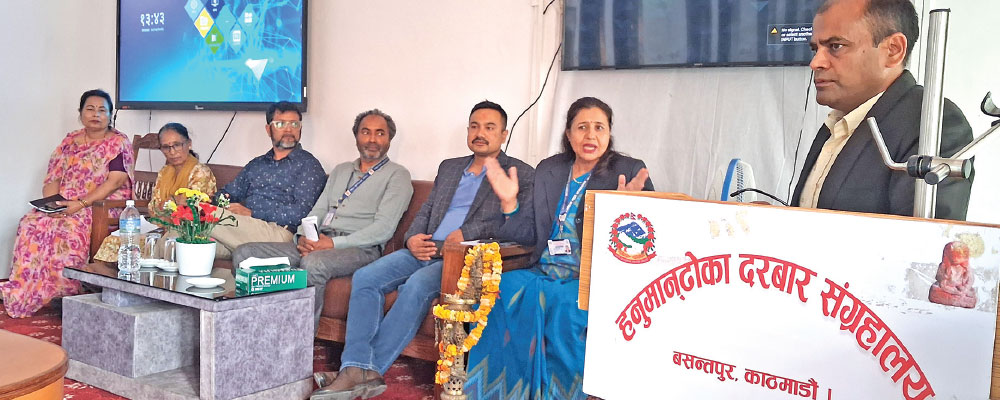
Museum workers participating in a programme organised by the Hanumandhoka Durbar Museum Palace in collaboration with the International Council of Museums (ICOM) Nepal in the capital on Tuesday shared their experiences related to natural disasters.
At the programme titled “Challenges of Inconvenience: Experience of Museums and Learning,” a total of 12 museum stakeholders shared the challenges they faced in operating museums by presenting separate working papers.
During the programme, a book, “Intangible Cultural Heritage of the Hanumandhoka Area,” was also launched.
Kaji Man Pyakurel, Executive Director of the Hanumandhoka Durbar Museum Palace, said that it had been possible to preserve heritage from structures damaged by the devastating earthquake at Hanumandhoka Durbar Museum with the help of local activists.
Dr. Pashupati Neupane, a member of ICOM Nepal, expressed the view that museums will always remain important as they inspire people to unite at a time when individuals around the world are being divided and discriminated against on various grounds, including caste, religion, class, region and socio-economic status.
He recalled that the Hanumandhoka Durbar Museum Palace and the surrounding religious structures, including monasteries and temples, have been famous as open museums since the 15th century, adding that many heritage items are still preserved in Hanumandhoka. He said that many heritage items that are yet to be exhibited are still being kept in storage.
Aruna Nakarmi, head of the National Museum at Chhauni, said that despite the devastating earthquake and Gen Z protests, the support of local people has helped preserve the museum's tangible and intangible heritage. She added that the National Museum organised a “virtual tour” after the COVID-19 pandemic.
Bimala Shakya, head of the Natural Science Museum, said that the museum holds distinct importance as it collects and exhibits materials, including the remains of plants and animals, making it different from other museums. She also said that the museum faces a shortage of skilled manpower.
Shanta Chaudhary, Manager of the Tharu Museum in Dang, said that the museum, managed in collaboration with the community, has succeeded in preserving various original aspects of Tharu communities across Nepal, including their traditional art, customs, cultural materials and cuisines.
Similarly, Executive Director of the International Mountaineering Museum, Nirmala Kumari Neupane, said that Nepal is known to the world because of the Himalayas and that the museum, which provides comprehensive information on the mountaineering sector, including equipment used in mountaineering and biographies of record-breaking climbers, has become a major attraction for both domestic and foreign tourists.