- Saturday, 6 June 2026

Left Dominance Ends With RSP's Sway

Elections to the House of Representatives (HoR) have concluded peacefully. Vote counting under both the First-Past-The-Post (FPTP) and proportional representation (PR) systems has also ended. The elections, which had seemed nearly impossible when announced on September 12 last year and even after the Election Commission (EC) made public the election schedule on October 7, concluded without any unwanted incidents. No violence was reported, nor was re-polling required in any constituency.
It is the first parliamentary election in Nepal to be entirely free of violence. The government, particularly Prime Minister Sushila Karki and the members of her Cabinet, deserve kudos for holding peaceful elections on the scheduled date. It will also be an injustice not to commend the EC for accomplishing the key tasks in such a short timeframe. The election results have also dispelled widespread speculations that no party could secure a majority under the existing electoral system. The Rastriya Swatantra Party (RSP) not only achieved a simple majority but came close to a two-thirds majority in the 275-member HoR. The party won 125 of 165 seats under the FPTP electoral system and secured over 48 per cent of votes under the PR system.
Rare feat
The seats won by RSP under FPTP account for 75 per cent of the total, which is a rare feat for a single party in the country's electoral history. The Nepali Congress (NC) had won a two-thirds majority in the first parliamentary election in 1959 by securing 74 of 109 seats (67.8 per cent). Even the CPN-UML and the CPN-Maoist Centre together won only 116 FPTP seats when they forged an electoral alliance in 2017. No single party has managed to garner over 35 per cent of the votes under the PR system since its introduction in 2008.
Balendra Shah (Balen), the RSP's prime ministerial candidate, made this seemingly impossible feat possible by leading the party's nationwide electoral campaign. He not only defeated powerful UML chairman KP Sharma Oli in the latter's home constituency in Jhapa with a margin of about 50,000 votes, but also generated a wave in favour of the party across the Tarai from Jhapa in the east to Kanchanpur in the west and in the urban centres of the valleys and hills. Many leaders, including Nepali Congress president Gagan Kumar Thapa were swept aside by the 'Balen wave' in Sarlahi - 4. Thapa lost election to RSP candidate Amaresh Kumar Singh.
Shah quit the post of Mayor of Kathmandu Metropolitan City on January 18, joined the RSP, and addressed the party's first election rally in Janakpur the following day. His nine-minute address of January 9 proved pivotal in the party's resounding victory. A rapper by background, Shah had previously won the mayoral race in 2022 by defeating the candidates of the big parties like the NC and the UML. This time, he further cornered them in the parliamentary elections. The NC won only 18 seats under the FPTP electoral system while the UML won nine, and the Nepali Communist Party, led by Pushpa Kamal Dahal 'Prachanda', seven.
The RSP swept the Kathmandu Valley, winning all 15 seats across its three districts, and 30 of the 32 seats in the Madhes Province. It also won all seats in the plains of Koshi, Lumbini, and Sudurpaschim provinces, and 15 of 18 seats in Gandaki province. The UML failed to win even a single seat in Madhes, Bagmati, and Gandaki provinces, while the NCP did not win any seat in Gandaki, Sudurpaschim and Koshi provinces. However, the RSP won only one seat in Karnali and other seats were shared by older parties. Prachanda has been elected from Rukum East.
For the old parties, the elections were humiliating. The NC, which was the largest party in the previous HoR with 89 seats, is likely to secure only 37 seats this time. The communists and the Madhes-centric parties fared even worse. None of the mushroomed Madhes-based parties, which had made a meaningful presence in the parliament right from the first Constituency Assembly elections, won a seat. For the first time since 2008, the HoR is free from communist dominance as well as old leaders. While the Maoist Centre and the UML won nearly a two-thirds majority in the 2017 elections and remained the largest force after the 2022 elections, with 78 members of the UML and 32 of the Maoist Centre. But now they are reduced to 41 lawmakers combined.
Likewise, the RPP that had 14 seats in the previous HoR won only one seat under FPTP system. However, the newly formed Shram Sanskriti Party of former Dharan Mayor Harka Raj Rai won three seats under the FPTP system and got the status of a national party. Rai won from Sunasri-1, surviving the 'Balen wave'. The feat achieved by Rai's party resembles that of Rabi Lamichhane's RSP, which won 21 seats in the 2022 elections held juts five months after its formation,
With the RSP's landslide victory, its senior leader, Balendra Shah, is poised to become the new Prime Minister, probably the youngest Prime Minister under Nepal's parliamentary system. Voters who placed their trust in him and his party are eagerly waiting for his appointment, expected within two weeks.
Public expectations
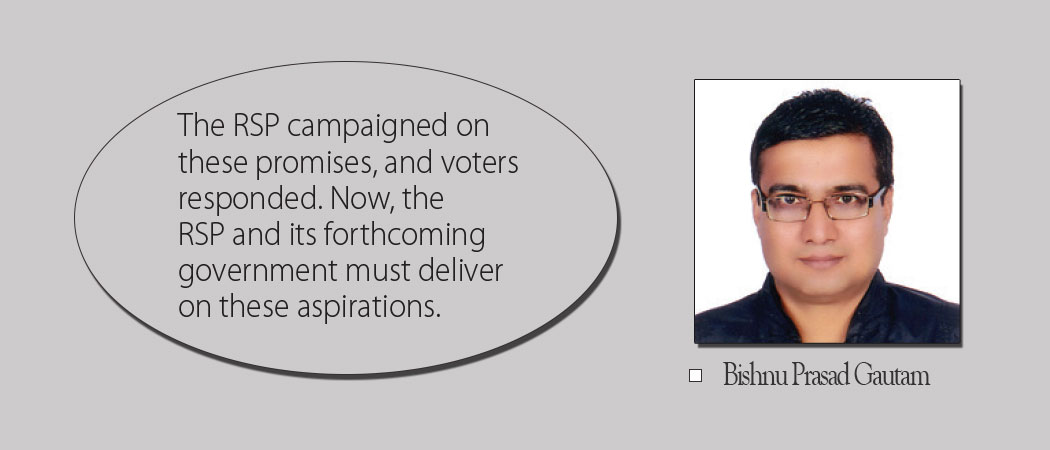
Obviously, the people voted for the RSP to establish good governance, end the syndicate of the old parties, which had been in power since 1990, control corruption, accelerate development in the country, and create jobs for youth so that they need not seek employment abroad. The RSP campaigned on these promises, and voters responded. Now, the RSP and its forthcoming government must deliver on these aspirations.
As said above, Nepali people have straightforward demands—good governance, corruption control, development of the nation and job creation, and punishment to the wrongdoers—and they can be accomplished if the leadership works honestly. The RSP's new government will have no excuse to betray voters' trust, although it faces significant challenges, mostly due to the latest situation in West Asia and beyond, which require immediate attention.
(The author is Acting Editor-in-Chief of this daily.)