- Thursday, 11 June 2026

RSP set to target domestic production, IT, power exports to achieve high growth rate


Kathmandu, Mar. 11: With a likely two-thirds majority win in the March 5 elections for the House of Representatives (HoR), the Rastriya Swatantra Party (RSP) is heading to form the next government generating hopes that the governance system would be improved within a short period.
The party said in its election manifesto that it will begin the move to good governance with an investigation of the assets of the high-ranking officials who held the public posts since 1990. Illegally acquired assets will be confiscated and nationalised, it said.
This agenda has been in public discussion for the last couple of decades but no governments in the past took steps towards it. Meanwhile, the private sector has been demanding for a self-declaration of the wealth for once so that it will be a taxable asset in the future.
According to the RSP, judges for high and Supreme Courts will be appointed based on meritocratic and competitive system, not on political quotas. It has also proposed studying the possibility of live broadcasting of court hearing for transparency.
The party has also pledged to end the practice of sister organisations and party-affiliated trade unions in civil service. Formation of an autonomous board to handle civil service transfers to ensure stability is also proposed.
Likewise, by 2031, public services will be shifted to online platforms, along with a creation of national database linking to the National ID cards to streamline social security and policy implementation, to supplement the good governance initiatives.
The ‘Nagarik App’ and National ID card will be fully integrated, and the influence of middlemen in services such as land revenue, driving licence, and passports will be completely displaced.
The traditional paper-based decision-making system will be replaced by digital approvals, and if the decision is not made within a set timeframe, the file will be automatically approved or the official will be held accountable, read the manifesto.
“By 2031, the ‘compulsion’ to visit offices and meet employees to receive government services will be brought to an end, and the basic framework of a ‘face-less’ and ‘paperless’ administration will be prepared,” it said.
These digital targets are easier to meet as infrastructure including the fibre-optics, broadband internet, telephony and electricity has been expanded across the country. However, in the short term, special campaigns for digital literacy should be implemented to educate and empower people in using the technology safely.
Similarly, the RSP’s other announcements, like establishing Nepal as a reliable IT export country and centre for skilled youth, also match with the digital progress made so far. The IT sector will be declared a strategic industry and an autonomous IT Promotion Board will be established.
By increasing IT exports to over 30 billion annually over the next 10 years and building infrastructure—including high-speed internet and ‘co-working spaces’ for ‘digital nomads’—Nepal will have become South Asia’s best technology centre, according to the party. Current IT exports is estimated at approximately US$ 1.5 billion. The party has also announced tax discounts and easy repatriation of profits to the investors in the IT sector.
According to the experts, in order to achieve these targets, system and style of IT education in Nepal should be revamped and better connectivity should be established between the academic institutions and industry.
To create favourable environment for IT sector development, instead of exporting electricity, it will be supplied to large-scale data centres and server farms, the party said.
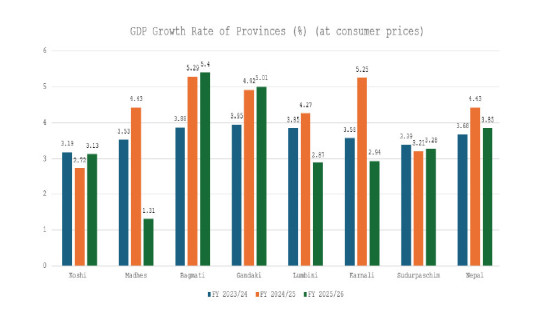
In terms of the broader national target, the RSP has aimed for a 7 per cent annual economic growth rate to create a foundation for a US$ 100 billion economy and per capita income exceeding US$ 3,000 within the next 5-7 years.
While the political stability can ensure policy stability and help in attracting more investment and create business-friendly environment in the country helping to achieve 7 per cent economic growth, doubling the per capita income (PCI) is rather challenging. Currently, Nepal’s PCI is US$ 1496. It took one-and-a-half decades to double the per capita from US$ 721 in 2010 to 2025.
It has set a target to transition Nepal from the remittance-based economy to production and export-oriented economy. It has presented increased electricity generation as a supportive pillar to this target.
According to the RSP, internal electricity consumption will be increased to 8,000 MW and import of LP gas in household and industrial sectors will be reduced by 50 per cent.
The party has also set a target to reduce foreign employment by 20 per cent through the creation of ‘Nepal Production Fund’ and ‘Remittance Investment Fund’ to mobilise 30 per cent of capital obtained from foreign employment in national pride projects and industrial infrastructure.



-original-thumb.jpg)