- Saturday, 6 June 2026

Rays Of Hope Against Despair

In the election to the House of Representatives, the Rastitira Swatanta Party (RSP) has emerged with colossal weight. No wonder it was anticipated by many at home and abroad amid widespread despair over the rampant corruption across the country. People have voted for the new party, hoping for rapid reforms in the governance system, rather than liking the new faces and disliking the older ones. This can be regarded as a hope in the face of despair.
Until recently, political leaders and their followers were engaged in accusing others of dishonesty and corruption, ignoring the practical agenda for national development. While the opposition leaders were busy charging the government with corruption and misgovernance, albeit without substantial evidence, the government was deaf to the opposition's charges. It would be natural to criticise the former for their incompetence and underperformance, but the allegations were largely ad hominem attacks. Even during the election campaign, the agenda for national development remained only on paper as political actors continued to accuse their counterparts on non-political grounds.
Before the new government is formed, the ripples on the political pond seem to calm down. However, Nepal still seems to remain in a tumultuous political situation. It looks like we are still amidst the chaos and confusion. Just as a journey without a clear destination leads us nowhere, a government without a clear vision, mission, and goals sends us into a dark hole that suffocates us to death and destruction.
For the most part, political actors in our country make double-standard statements, expressions that differ in different situations by the same person in their own interests. This is a dangerous trend that ultimately harms them and others. Yet they repeat the same, even if they understand they are not doing the right thing. Now is the time for both victors and vanquished to be responsible in their speeches and behaviour. If politicians continue as before, the situation will worsen, inevitably leading to despair again amid the present hope, making it inexcusable. One and all must stop the cacophony “full of sound and fury signifying nothing.”
Pandora’s box
The present result of the general election reminds us of an ancient Greek myth that tells the tale of the prevalence of evils, miseries, and sufferings, but with a little hope inside the box, covered by a lid. No matter how much evil troubled us with woes and suffering, there was hope in the womb of despair. As the myth goes, Pandora's box is a large jar (pithos), containing all the troubles of the world, given to the first woman, Pandora, by the Greek God Zeus. Despite Zeus’s order not to open the box, Pandora opened it out of curiosity, releasing the woes and sorrows upon mankind. Only Hope remained trapped inside when she closed the lid, which we still think will come out one day to make us happy, without the evils and the troubles they create.
Can we expect the hope hidden in Pandora’s Box to come out in Nepal, making all Nepalis prosperous and happy? It depends on the winning party’s unravelling of its agenda for good governance and development, which remains inadequately explained.
Ground reality
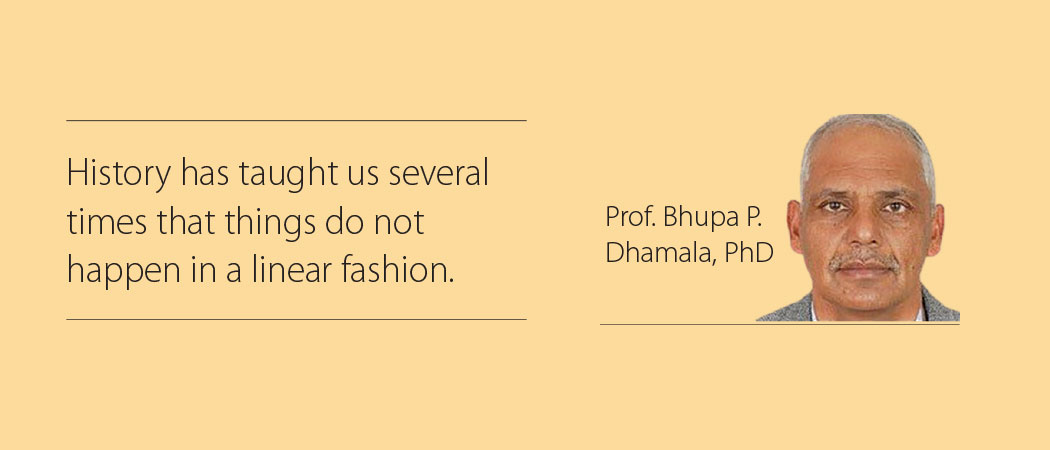
No matter how hard we struggle to achieve what we hope, we have never been successful in our endeavours before. The reason for our failure is simple: no one can fully accomplish what they promise. History has taught us several times that things do not happen in a linear fashion. Unlike the dream, the real path of the journey is topsy-turvy, yielding undesirable results. The old powers might still claim that they will stand firm against any new power. In fact, they have a long history of political struggle and are well-versed in the principles of democracy and socialism, albeit somewhat deviated from them in practice. It is very likely that they will resurrect from their decline in popularity and once again become a major force in tackling the situation if they correct their political course and behaviour to people’s satisfaction.
Considering the enigmatic environment around us, we feel we are living in an upside-down world. The leaders of the conventional parties, the old powers, want to retain the language of their regime: praise for their past and a desire to repeat it in the present. Meanwhile, the leaders of the new parties agitate for rapid development. Their slogan is simple: development brings prosperity to all, and they are the agents of this imminent change. This slogan, as they state, rumbles with low sound now but will grow louder with time.
It is a positive sign that a single party gained a majority of seats in parliament, so there will be no barrier to making decisions in the cabinet and executing them. Yet it should seek a national consensus to make significant changes. And that is not impossible either if the new force has an open heart. It seeks constructive comments and suggestions from the opposition, no matter how thin their presence will be in parliament. Further, it is the need of the nation that ideologically close parties, such as RSP and NC, on one side, and CPN (UML) and NCP on the other, can forge respective political alliances, establishing their agenda as “democratic socialism” and “progressive socialism”, as no party can exist in this region without a socialist agenda. These alliances may develop into party unity in the future, so that if one ideological group fails to achieve its expected goals, the alternative ideological group may take its turn, leading to political stability in the country, which we have long been expecting.
If, on the contrary, the opposition parties continue to play foul games, making the elected government fail with an ulterior motive of gaining power, there will be a painful revision of the past, which we have long hated. Let us wait until hope comes out of Pandora’s Box.
(The author is the chairman of Molung Foundation. bhupadhamala@gmail.com)