- Saturday, 6 June 2026

A Mandate For Transformation

Nepal goes to the polls today. A total of 275 members for the federal parliament will be elected in these elections. Out of 275 seats, 165 seats will be filled through First Past-the-Post (FPTP) in single-member constituencies, while 110 seats will be elected through Proportional Representation (PR). According to the law, political parties must secure 3 per cent of valid national votes to get PR seats. A total of 18,903,689 voters are registered, securing their eligibility to vote. The voter base this time has grown with many new registrations, particularly among youth.
About 915,000 new voters have been added by recent tallies. According to the Election Commission (EC) statistics, about 186,000 voters are registered to vote under PR outside their home districts. Reporting suggests that there are 800,000 first-time voters, and youth participation is high, with over 1,000 candidates under 40 years of age. Sources report 64 parties are competing, with a total of 3,484 candidates nationwide. Detailed gender breakdowns vary, but official numbers suggest 3,037 men and 391 women among the total registered candidates.
Historic political juncture
Altogether 10,967 polling stations are installed nationwide, which has increased slightly from the previous election. Altogether 23,112 polling booths have been set up across the country. The nation thus passes through a historic political juncture with competitive rivalries between the political parties to win the elections. This election is different from the previous ones. The fresh energy from a rising generation of voters has reshaped Nepal’s electoral landscape this time. This election is not simply another cycle of polls usually held for choosing political representatives for the federal parliament.
It is the first national vote since the seismic Gen Z movement that has unsettled the country’s political order. What was once a contest for political power dominated by conventional party functionaries now bears the imprint of youthful discontent and demands deeper socio-economic transformation and governance reforms. Not only in Nepal, but Gen Z youths are also a growing political force worldwide. Gen Z youths make up a large and digitally connected portion of many countries’ populations, estimated at roughly 20 per cent of the world’s population. Their voting behaviour and activism increasingly shape public debates, including on climate change, economic opportunity, and rights worldwide.
Across Europe, North America, and Asia, young people show different political preferences. For example, their support on issues like jobs, gender equality, and social freedoms is markedly pronounced. Gen Z voting patterns vary from country to country. Patterns in several European countries show that young men tend to incline towards options like employment, climate crisis, and social empowerment. In many countries, polls show that political parties increasingly focus on youth issues because Gen Z’s votes and activism matter in national elections.
Nepal’s Gen Z protests were driven by anger over corruption, social media restrictions, and unequal opportunities. The Gen Z-rooted movement in Bangladesh helped oust an entrenched government. However, its newly founded political party failed to succeed in converting protest energy into election wins, capturing only a small number of seats in the parliamentary polls held recently. In Madagascar, Gen Z-led protests were cited as influential in forcing leadership change, although questions remain about how Gen Z will shape formal politics and subsequent polls.
Gen Z often leads to increases in first-time voter registration and energizes youth turnout. Youth polls and opinion indexes often show prioritization of jobs, corruption reform, digital freedoms, and equity issues that conventional politicians tend to deprioritize. Even where Gen Z energetically protests, converting that into sustained electoral victories is found to be difficult in some contexts without organisational infrastructure. The Gen Z uprising in Nepal had begun as resistance to a government-imposed social media ban but quickly morphed into a broader protest against corruption, inequality, and lack of opportunities, especially for young Nepalis.
The unrest drew unprecedented participation from citizens born after the millennium, many of whom felt alienated from a political system. The energy of that movement has been carried over into the poll campaigning. Young electorates are talking about jobs, transparency, governance, and accountability, even as they question whether elections alone can transform the system. If past elections were about loyalty to party structures, this contest is increasingly about issues that resonate with younger voters: jobs, corruption, digital engagement, and political participation.
Youth unemployment remains a defining concern, pushing thousands of Nepalis to seek work abroad despite political promises of reform. Parties across the spectrum have attempted to address job creation in their manifestos, but skepticism remains high among many first-time voters. Representation is also a contested topic. While many incumbents remain older and experienced, both new and traditional parties were under pressure to include younger and female candidates on their lists.
Beyond entrenched elites
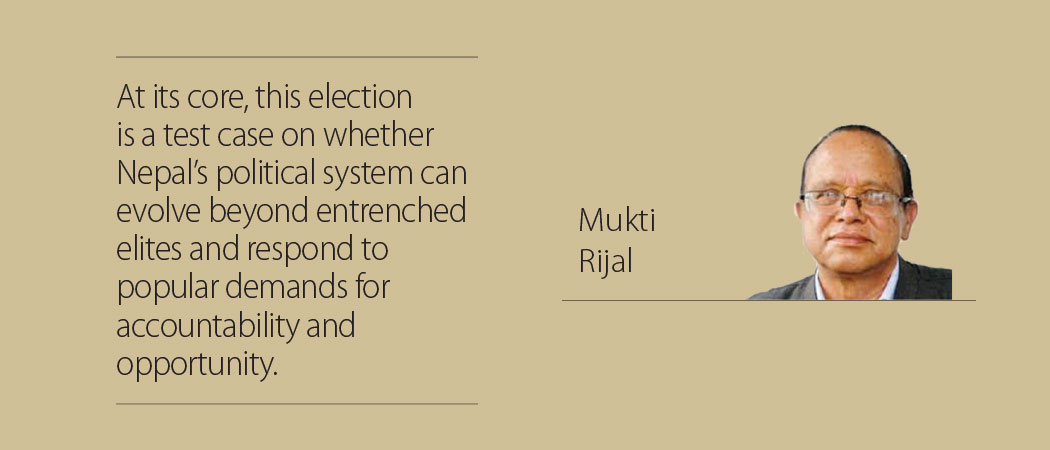
Yet critics point out that inclusion often remains symbolic rather than substantive. Digital campaigning has taken on an unprecedented role in this election, with social media, viral content, and online engagement shaping political conversations. At its core, this election is a test case on whether Nepal’s political system can evolve beyond entrenched elites and respond to popular demands for accountability and opportunity. While established parties seemingly possess some structural advantages, by all indications, their citadel is likely to crumble this time.
The rise of new contenders backed by young voters suggests a more volatile and unpredictable outcome. Whether this election ushers in transformational change or reinforces the resilience of old power structures will depend on how Nepalis, especially the youth, cast their ballots and how those votes translate into meaningful representation in parliament. These elections and their outcome tell us whether a generational awakening can become a lasting force in shaping the country’s destiny.
(The author is presently associated with Policy Research Institute (PRI) as a senior research fellow. rijalmukti@gmail.com)